
Summary
SK Telecom has formalized an "AI colleague" organizational experiment that assigns employee IDs to AI agents and operates them like people within its HR management framework. More than a simple promotion of in-house digital transformation, it reads as a signal that a telecom carrier has begun to redefine AI not as a cost-cutting tool but as a unit of labor.
What matters to investors is that this announcement demonstrates SKT's AI business direction and its determination to monetize, while also forming a ripple pathway that extends to data center, semiconductor, and solution partners through expanding in-house AI infrastructure demand.
The Full Story
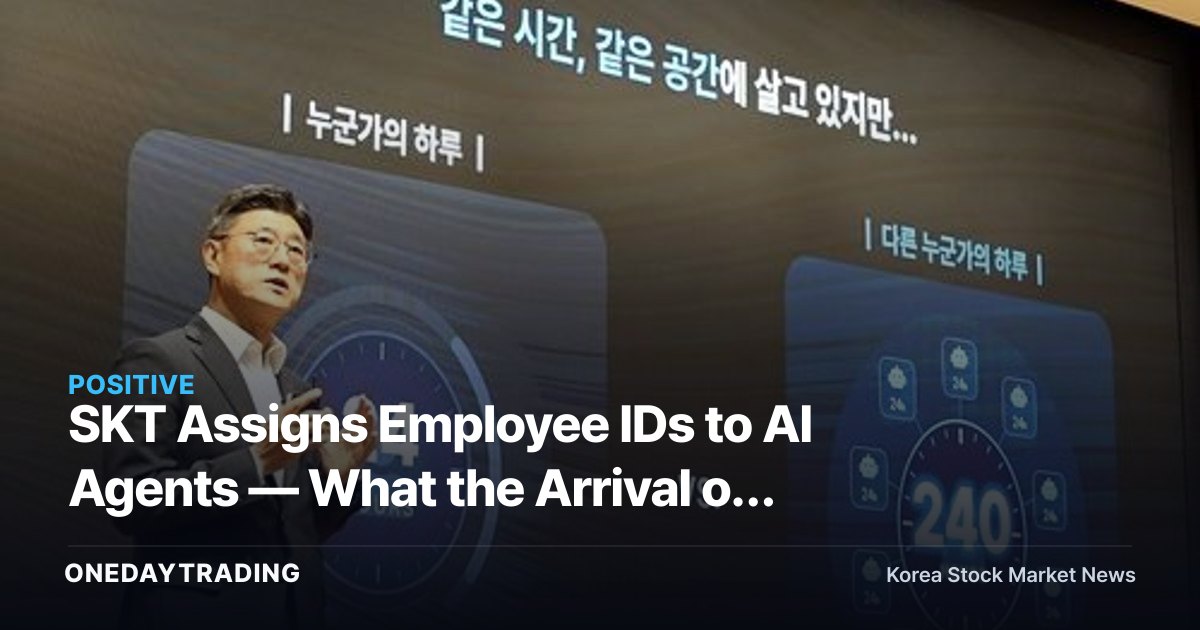
SK Telecom said it will assign AI agents employee IDs similar to those of human staff and introduce a system to manage and evaluate them within the organization. The core idea is to position AI not as a one-off automation tool but as a "member" that continuously performs specific tasks, thereby clarifying its responsibilities and roles.
This lies on the same trajectory as the proprietary large language model (LLM) and agent-type service strategy that SKT has been pursuing. The interpretation is that a company that has championed AI as a new growth axis amid stagnating growth in its core telecom business intends to deploy agents fully into internal operations first — ahead of customer-facing AI services — in order to accumulate validation data.
In-house adoption immediately becomes a reference for agent services aimed at customers and enterprises (B2B). Because the company must prove productivity and accuracy in its own operations to strengthen its external sales pitch, this move is less a marketing event than a preparatory step toward monetization.
Structural Background
Korea's three telecom carriers face subscriber saturation and tariff-regulation pressure, leaving core-business growth stuck in single digits. As a result, the carriers share a strategy of growing the share of non-telecom revenue such as data centers, cloud, and AI solutions. The full-scale in-house adoption of AI agents is a structural choice aimed at improving labor-cost efficiency while also commercializing accumulated operational know-how to convert it into new revenue.
Impact on Stocks and Industry Sectors
- SK Telecom: The key player. If embedding AI agents leads to greater operating-cost efficiency and expanded B2B AI revenue, there is room for a multiple re-rating — though the time lag until a visible earnings contribution is a variable.
- SK Hynix: The spread of in-house and customer-facing agents is a structural driver of demand for inference memory (HBM, DDR5). It is a direct beneficiary of the AI infrastructure investment cycle.
- SK Square: As an intermediate holding company that owns stakes in SK Hynix and SKT, the strengthening of the group's AI value chain could be reflected in its net asset value (NAV).
- KT and LG Uplus: Competitors have a stronger incentive to accelerate similar AI organizational strategies. Differences in the pace of AI transformation could emerge as a point of differentiation among telecom stocks.
- AI solution and SI partners: Software and systems-integration firms that support agent deployment and operation can expect a trickle-down effect from expanded carrier orders.
Bull vs. Bear Scenarios
The bull case focuses on the point that SKT is using AI simultaneously on two fronts — cost reduction and new revenue — giving telecom stocks an uncommon growth narrative. If agents that have passed internal validation translate into B2B products, the scope for profitability improvement could widen.
The bear case points out that this announcement is still a symbolic measure not yet proven in revenue and profit figures. If AI infrastructure investment burdens are front-loaded as short-term costs and the agents' actual productivity contribution falls short of expectations, only the valuation burden may remain. If the stock is in a phase where AI-theme expectations are already priced in, there is also a risk of momentum exhaustion.
Investor Action Points
- Check whether the share and growth rate of SKT's AI and B2B (enterprise) revenue actually improve in next quarter's earnings.
- Monitor the trends in labor and operating costs from AI agent adoption and the resulting changes in operating profit margin.
- Cross-check demand signals across the group's overall AI value chain, such as SK Hynix's commentary on HBM shipments and orders.
- Track competitive intensity and the progress of differentiation within the sector by watching whether competitors KT and LG Uplus announce similar AI organizations and services.
SK Telecom Through Real-Time Data
SK Telecom's latest closing price is 102,400 won (-2.85% from the previous day), and the signal light combining foreign and institutional investor order flow with news and momentum is 🟡 Neutral — Wait and See. With positive and negative signals mixed, it is a zone to watch.
- ▼ Trend Alignment — Short- and mid-term downward alignment (intraday -2.9% · 1-week -4.0% · 1-month -3.2%)
- ▲ News Flow — 4 positive catalysts vs. 0 negative catalysts — positive catalysts dominant
Recent related news is favorable, with 4 positive catalysts and 0 negative catalysts.
※ Price and foreign/institutional investor order-flow data are provided by Korea Investment & Securities (KIS), as of the time of publication.
This article is content automatically summarized and analyzed based on the original news. View original (Yonhap News, Industry)