
Three-Line Briefing
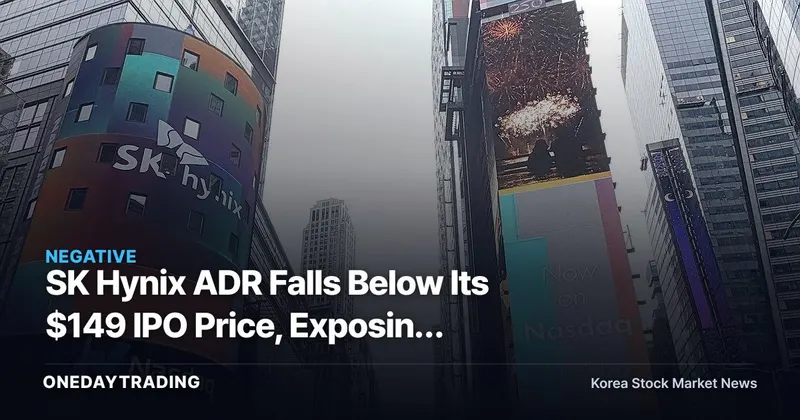
- SK Hynix's ADR fell to as low as $139.01 intraday on July 27, dropping below its $149 IPO price.
- The offering totaled 177.9 million ADRs, raising roughly $26.5 billion. Each ADR represents one-tenth of a share of the company's Korea-listed common stock.
- SpaceX shares are also trading below their $135 offering price, signaling that large-cap IPO premiums are broadly deflating.
What's Changing
HBM can no longer prop up a stock price on the strength of "great technology" alone. SK Hynix's ADR falling below its offering price doesn't mean U.S. investors are abandoning the AI memory supply chain. More precisely, it signals that capital which already paid a premium for SK Hynix's dominance in HBM supply to Nvidia and expectations of large-scale capacity expansion is now demanding proof — in the form of actual shipments and margins.
The mood on the first day of trading was very different. The IPO priced at $149, and the stock opened around $170. It closed the first day near $168, roughly 13% above the offering price. The trouble came afterward. As selling in U.S. semiconductor stocks continued and a Chinese memory maker's own listing drew strong demand, the premium flipped from scarcity value to a burden. Newly listed stocks tend to rise faster when liquidity is thin — and for the same reason, they fall faster once doubt creeps in.
What domestic investors should watch isn't the ADR price itself but its link to the underlying shares. Since 10 ADRs correspond to one common share, the U.S. price effectively serves as an external benchmark for SK Hynix's valuation back home. The ADR slipping below its offering price raises the odds that the phase in which foreign supply-demand (order flow) unconditionally propped up the common stock is coming to an end. That's a negative catalyst for Korea's large-cap semiconductor names.
The Numbers in Context
This deal was not small. SK Hynix sold 177.9 million ADRs to raise roughly $26.5 billion, earmarked for the Yongin cluster, the Cheongju fab, and investment in advanced packaging and equipment. Over the long run, this capital will expand HBM production capacity. But equity markets ask about post-expansion margins before they ask about order backlogs. When HBM supply is tight, capacity expansion builds pricing power. But when competitors and Chinese producers are catching up at the same time, that same expansion could instead pull forward the cycle's peak.
SpaceX's trajectory reads the same way. Its offering price was $135, it peaked above $225 post-listing, and it now trades around $113.50. The market paid up for a narrative of future dominance, but the moment shares entered the public market, investors began scrutinizing quarterly earnings and lock-up share overhang. SK Hynix is no different. Its technology narrative is validated by HBM stack count and yield, while its valuation is validated by customer orders and DRAM pricing.
Winners and Losers
- SK Hynix: The ADR's break below its offering price is a negative catalyst for near-term supply-demand (order flow). Still, medium-term competitiveness can hold up if the proceeds are funneled into high-value-added HBM and advanced packaging investment.
- Samsung Electronics (005930): It would face pressure alongside SK Hynix if the memory industry sector's re-rating cools. Conversely, if HBM yield improvements and customer qualification are confirmed, it could gain a relative opportunity as SK Hynix's premium narrows.
- Hanmi Semiconductor: Since expectations for HBM packaging equipment are already priced in, the stock is sensitive to any shift in customers' expansion pace. If actual equipment orders are delayed, multiple compression will show up first.
- SK Square: Its value is structurally tied to its stake in SK Hynix. The greater the volatility in the underlying semiconductor stock, the more pressure builds for a wider holding-company discount.
- Micron: It's the closest U.S.-listed memory peer for comparison. If SK Hynix's ADR premium keeps deflating, it could spread into a broader repricing across the entire AI memory peer group.
Risk Check
- If Big Tech's AI infrastructure spending is delayed beyond expectations, visibility into HBM orders weakens.
- Capacity expansion and strong IPO demand for Chinese memory makers heighten long-term oversupply concerns.
- If conversion constraints between the ADR and the common stock widen the price gap, arbitrage may fail to function properly.
- Shipment volumes, ASPs, and HBM margins need to be confirmed at the additional domestic share listing on July 29 and in the next earnings report.
Bottom Line
SK Hynix's ADR breaking below its offering price isn't a sign that the AI memory cycle is ending — it's a warning that the market has begun repricing the HBM narrative against hard numbers: shipments, yields, and customer orders.
SK Hynix by the Numbers: Real-Time Data
SK Hynix's most recent closing price was ₩1,592,000 (-12.33% vs. the previous day), and the composite signal combining foreign/institutional supply-demand (order flow) and news momentum reads 🟡 Neutral / Wait-and-see. Positive and negative signals are mixed, making this a range worth watching closely.
- ▼ Trend Alignment — Short- and medium-term downtrend alignment (day -12.3% · 1 week -13.3% · 1 month -40.4%)
- ▲ News Flow — Positive catalysts 9 vs. negative catalysts 1 — positive catalysts lead
Recent related news skews favorable, with 9 positive-catalyst stories versus 1 negative-catalyst story.
※ Price and foreign/institutional supply-demand (order flow) data are provided by Korea Investment & Securities (KIS) and reflect the time of publication.
This content was automatically summarized and analyzed based on the original news article. View original (Yonhap News Securities)