
Summary
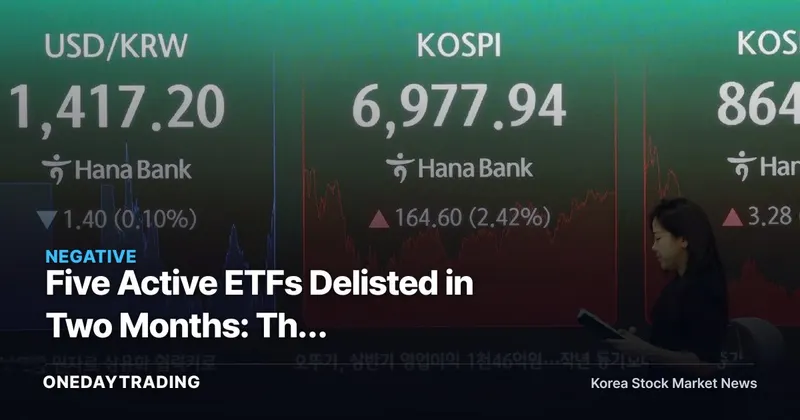
Five active ETFs have gone through delisting procedures over the past two months. It isn't because their returns were poor. It's because their excess returns over the benchmark index grew so large that their correlation coefficient fell below the regulatory floor of 0.7. Timefolio Asset Management's TIME US Dividend Dow Jones Active is cited as the leading example. A paradox is unfolding in which well-managed funds are being shut down for violating the rules.
What Happened
Unlike passive ETFs, active ETFs are granted the manager's discretion over stock (ticker) selection, but in exchange they must maintain a correlation coefficient of 0.7 or higher with the benchmark index to keep their listing. The correlation coefficient is a measure of how closely a fund's returns move in the same direction and magnitude as the index. The problem is that this number doesn't distinguish between good and bad performance. If a manager takes positions that deviate significantly from the index's constituent weightings and generates large excess returns, the return curve diverges from the index and the correlation coefficient falls. As a result, the more a fund beats the market, the greater its risk of being delisted.
The industry points out that this standard has no parallel anywhere in the world. In advanced active ETF markets such as the United States, there is no precedent for correlation coefficients being written into listing-maintenance requirements. In Korea, an active ETF must effectively prove it is genuine active management rather than merely a variant of an index fund in order to survive — yet, paradoxically, the more successfully it proves this, the more likely it is to become grounds for delisting.
Structural Background
This rule was originally introduced to prevent active ETFs from degenerating into passive products in name only. The correlation floor was, in fact, intended to guarantee managers' autonomy. However, the market never fully examined the opposite risk — a situation in which excess returns become so large that the coefficient breaches the upper bound. As the active ETF market has grown and more asset managers have significantly beaten their benchmarks through aggressive stock selection, this blind spot in the regulation has become a real problem. Unless financial authorities revise the listing-maintenance requirements, an adverse-selection dynamic is likely to persist in which the best-performing products are the ones most likely to be nominated for delisting.
Stock (Ticker) and Industry Sector Impact
- Korea Investment Holdings: Its subsidiary Korea Investment Management has been expanding its active ETF lineup under the ACE brand, and outperforming products are the ones most exposed to delisting risk.
- Kiwoom Securities: Its subsidiary Kiwoom Asset Management's Heroes active ETFs have leaned heavily on aggressive management strategies, making them sensitive to this regulatory risk.
- KB Financial Group: KB Asset Management's KBSTAR active lineup is subject to the same correlation coefficient requirement.
- Mirae Asset Securities: Mirae Asset Global Investments' TIGER active series holds the largest share of Korea's active ETF market, making it a bellwether for how any regulatory change would affect the industry as a whole.
Bull vs. Bear Scenarios
If regulators move to ease the rule, asset managers would be able to roll out more ambitious active products aimed at excess returns, driving growth across the entire active ETF market and boosting management fee revenue. Conversely, if the current rule stays in place, managers will be forced to self-limit how far they deviate from the benchmark to avoid delisting, risking a shift toward passive-style management that no longer lives up to the "active" label. For investors, the clear risk is that a fund could be delisted precisely because it performed too well.
Investor Action Points
- Check the most recent correlation coefficient disclosures for any active ETFs you hold, either on the asset manager's website or in regular reports.
- Watch the schedule for discussions by the Financial Services Commission and the Korea Financial Investment Association on revising active ETF listing rules.
- For active ETFs with large excess returns, check in advance the redemption process and any potential tax disadvantages in the event of delisting.
- Track each asset manager's active ETF net asset share and its contribution to management fee revenue at earnings releases to gauge the regulatory impact.
Mirae Asset Securities: Real-Time Data
Mirae Asset Securities's most recent closing price was 37,650 won (-1.05% versus the previous session), and the signal combining foreign investor/institutional investor order flow with news and momentum reads 🟡 neutral / wait-and-see. Positive and negative signals are mixed, making this a period to watch.
Recent related news shows 2 positive catalysts versus 0 negative catalysts, a favorable skew.
※ Price and foreign/institutional order-flow data are provided by Korea Investment & Securities (KIS) and are current as of publication.
This article was automatically summarized and analyzed based on the original news report. View original (Maeil Business Newspaper, Securities)