
KOSPI at 4,915.68: Time to Watch Order Flow, Not Prices
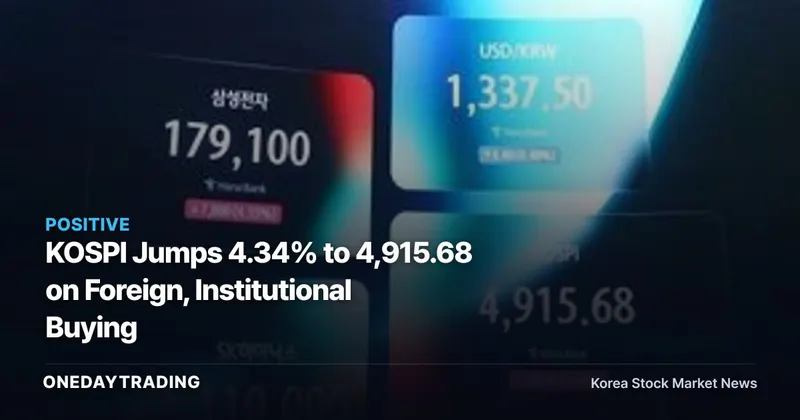
The KOSPI closed at 4,915.68 on 2026-11-27, up 4.34% amid net buying by foreign investors and institutional investors. The session reported by Infostock Daily represents more than a simple index rebound for investors. The buyers behind the rally have been identified, but the conditions needed to keep that capital flowing have yet to be established.
The KOSDAQ also ended the day at 708.99, up 8.13%. The session can be characterized as a shift in supply-demand (order flow) across both the KOSPI and KOSDAQ, with foreign investors and institutional investors turning net buyers while retail investors sold on a net basis. Although the two indexes posted markedly different gains, they shared the same directional buying pattern.
The Three Investor Groups Behind the KOSPI Rally
In the KOSPI market on 2026-11-27, foreign investors recorded net purchases of 1.1314 trillion won, while institutional investors bought a net 235.9 billion won. Retail investors sold a net 1.7734 trillion won over the same period. The index gain alone may suggest that expectations across the market converged, but the actual supply-demand (order flow) showed a clear divide between buyers and sellers by investor group.
What matters most is not the size of the gain but whether the buying continues. Continued net buying by foreign investors and institutional investors would preserve the supply-demand (order flow) conditions supporting this move. Conversely, if either group turns into a net seller, the index gain alone would not be enough to extend the same investment case.
Inside the KOSDAQ’s 8.13% Gain
In the KOSDAQ market on 2026-11-27, foreign investors bought a net 307 billion won and institutional investors bought a net 587.1 billion won, while retail investors sold a net 885 billion won. The KOSDAQ’s close at 708.99 was likewise supported by both buyer groups. The same supply-demand (order flow) direction across the KOSPI and KOSDAQ helps explain the breadth of the rally.
However, the data do not show which stocks foreign investors and institutional investors purchased or at what prices. There is therefore insufficient evidence to attribute the index gains directly to an earnings re-rating in a particular industry sector or individual stock. What has been confirmed is market-wide net buying; the stock-level selections behind it remain unknown.
Samsung Electronics’ Roughly 30 Trillion Won Dividend: Expectations Versus Facts
Samsung Electronics paid dividends totaling roughly 30 trillion won on 2026-11-27. Investors should distinguish between payment and reinvestment. The dividend payment has been confirmed, but the amount actually reinvested in the stock market has not been disclosed.
The view that dividends returning to the market could create additional buying capacity is conditional. Until the actual reinvestment amount is confirmed, the entire roughly 30 trillion won cannot be treated as capital flowing into equities. Any assessment of Samsung Electronics likewise depends less on the amount paid than on whether subsequent fund flow can be verified.
The Significance of the Proposed 20-Trillion-Won-Plus Market Stabilization Fund
It was reported that a proposal is under consideration to expand the existing market stabilization fund from approximately 10.76 trillion won to at least 20 trillion won. The market may already have priced in expectations of an expansion. What cannot yet be assessed is the final size or whether the plan will be approved.
If the proposal leads to an actual expansion, expectations for market-stabilization funding would gain firmer support. Unless the final increase is confirmed, the figure under consideration should not be treated as though it had already been implemented. The gap between policy expectations and policy confirmation is the biggest policy variable affecting this market move.
Items Investors Should Verify Separately
- KOSPI supply-demand (order flow): Watch whether net buying of 1.1314 trillion won by foreign investors and 235.9 billion won by institutional investors continues or reverses into net selling.
- KOSDAQ supply-demand (order flow): Whether simultaneous net buying of 307 billion won by foreign investors and 587.1 billion won by institutional investors continues will be critical to the index’s direction.
- Samsung Electronics dividend: Distinguish the confirmed payment of roughly 30 trillion won from the amount actually reinvested in the stock market. The reinvestment amount has not yet been confirmed.
- Market stabilization fund: Verify the final approval and size of the proposal to expand the fund from 10.76 trillion won to at least 20 trillion won.
The Next Condition for Further Gains Is Verifiable Capital
The bullish scenario requires continued net buying by foreign investors and institutional investors, confirmation of the market stabilization fund expansion, and evidence that Samsung Electronics’ dividend has actually been reinvested. If these conditions align, the day’s index gains would look more like sustainable fund flow than a one-off price reaction.
The trigger for the opposing scenario is equally clear. If supply-demand (order flow) from foreign investors and institutional investors weakens, the KOSPI’s 4.34% gain and the KOSDAQ’s 8.13% rise alone will offer little guidance on the next direction. The next indicators to watch are not new forecasts, but whether net buying persists, how much of the dividend is reinvested, and the final decision on the market stabilization fund.
Samsung Electronics Key MetricsAs of 2026-11-28
| Period Returns | 1 Week -2.02% 1 Month -22.67% |
|---|---|
| Trading Value · Trading Volume | 79.8 billion won · 23,563,543 shares |
| Supply-Demand (Order Flow) | Foreign Investors +624.3 billion won net buying Institutional Investors +85.5 billion won net buying |
| Recent News Tone | positive catalyst 1 · negative catalyst 0 |
Real-time price and supply-demand (order flow) data are provided by Korea Investment & Securities (KIS), while supply-demand (order flow) and news-tone figures are calculated independently by OneDayTrading.
Order Flow and Momentum Assessment🟢 Buyers Dominant
Foreign-investor, institutional-investor, news, and momentum indicators are showing positive signals.
- ▲Combined BuyingForeign investors +624.3 billion won · Institutional investors +85.5 billion won in simultaneous net buying
Upcoming Events to Watch
- 12.09FOMC Policy Rate DecisionHighU.S. Federal Reserve monetary policy announcement — direction of interest rates and the dollar
- 12.10Futures and Options ExpirationMediumQuadruple witching — watch for volatility and supply-demand (order flow) disruptions
- 01.14Index Options ExpirationLowKOSPI200 options expiration
- 02.11Index Options ExpirationLowKOSPI200 options expiration
This article was automatically summarized and analyzed from the original news report. View the original article (Infostock Daily)