
Three-Line Briefing
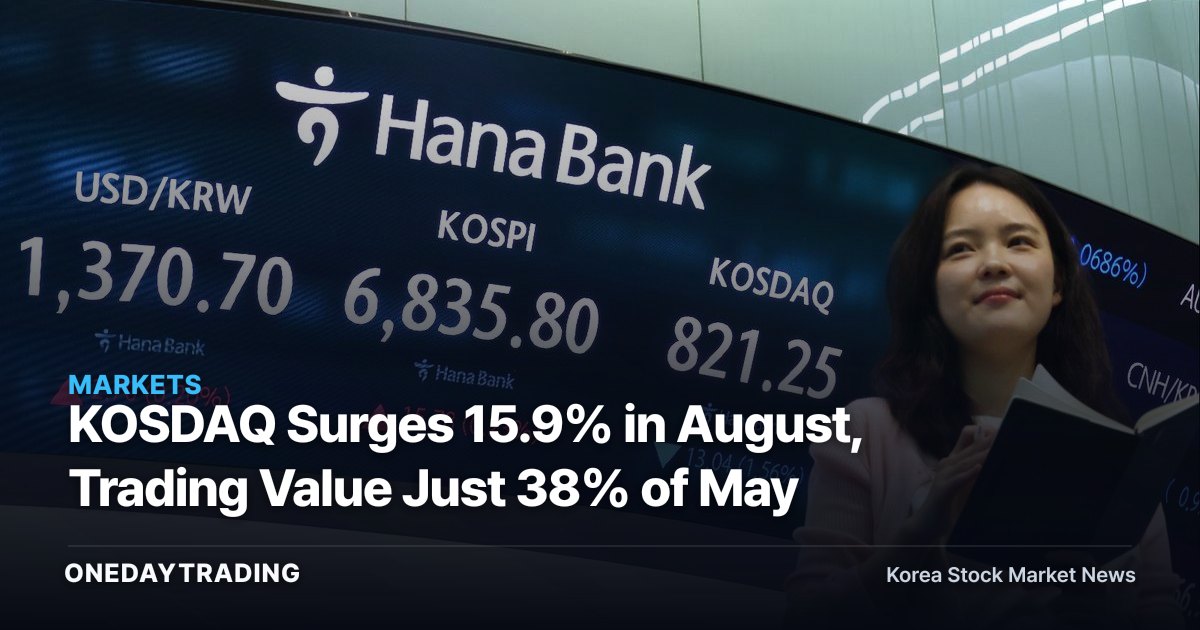
- KOSDAQ’s 15.9% August gain signals strong demand, while also showing how quickly the index can move in a thin market.
- Average daily trading value at just 38% of May levels raises the possibility that this rally formed on narrow liquidity rather than broad buying participation.
- The key market interpretation is simple: prices moved ahead, but trading has yet to catch up.
What Is Changing
KOSDAQ’s 15.9% August gain sends investors a more important signal than a simple return figure. KOSDAQ has a high weighting of growth stocks and small- and mid-cap stocks, making it more sensitive to interest rates and liquidity. So even if the index posts a sharp gain (surge), a rally unsupported by trading value looks more like multiple expansion than earnings improvement.
This market is testing what investors have already priced in versus what remains unpriced. Already reflected in prices are optimism and a risk-asset preference anticipated in advance. Yet the durability of actual fund inflows—and the trading recovery needed to connect this advance to next quarter’s earnings—remain unconfirmed.
When trading value remains at 38% of May, the rally cannot broaden and instead contracts into a stock (ticker)-specific market. If trading recovers, KOSDAQ’s high-beta character becomes an advantage again. Even the same 1% fund inflow has a larger impact on the index when liquidity is thin.
In Numbers and Context
The record of KOSDAQ’s strongest August gain since launch is clear. But the nature of that record matters. With trading value at 38% of May, the price rise may have resulted from orders moving rapidly through the quotes rather than broad participation. In such a market, one bout of net buying by foreign investors and institutional investors—or sharp gains (surges) in a few large growth stocks—can easily lift the entire index.
KOSDAQ is fundamentally a market that reacts more strongly when discount rates fall. Expectations move first, and earnings follow later. For this rally to carry real meaning, upward revisions to profit estimates must appear in the next quarterly earnings season. Otherwise, the market may be left with a segment where only multiples have risen, followed by a phase in which stock prices wait for earnings again.
Beneficiary and Vulnerable Stocks
- Biotech stocks: Large growth stocks such as Alteogen and HLB tend to react first in a liquidity-driven market. Multiples rise on clinical expectations and the potential for technology exports.
- Secondary-battery materials and equipment: High-beta stocks such as EcoPro BM and EcoPro gain more momentum when fund inflows are thin. But pullbacks are also faster when trading declines.
- Small- and mid-cap stocks with clear earnings visibility: Companies with confirmed revenue and profit gain a relative advantage when funds are concentrated narrowly. They offer better defense than stocks driven mainly by expectations.
- Loss-making growth stocks with rapid cash burn: They may rise in a liquidity-driven market, but come under pressure first when funding turns lower. The burden of new financing remains a factor for reassessment.
Risk Check
- If average daily trading value falls below 38% of May, the advance will struggle to continue.
- If foreign investors’ supply-demand (order flow) turns lower, KOSDAQ may become volatile faster than KOSPI.
- If the September Bank of Korea Monetary Policy Board meeting and U.S. CPI undermine expectations for rate cuts, the multiple burden on growth stocks will increase again.
- If earnings releases bring no upward revisions to profit estimates, this advance is likely to be classified as a short-term technical rebound.
Bottom Line
KOSDAQ’s August rally looks less like a powerful trend reversal than an early price signal on thin liquidity. If trading value revives, the advance could last longer; otherwise, the record will remain while durability stays weak.
Frequently Asked Questions
Does KOSDAQ’s 15.9% August gain mean earnings have improved?
Not necessarily. A more natural interpretation is that liquidity and risk-asset appetite moved first, ahead of earnings. The quality of the advance will be confirmed only if upward revisions to earnings estimates follow.
Why is trading value at 38% of May a problem?
When trading value is thin, the index can move sharply on small purchases, while profit-taking can produce equally large declines. In other words, price momentum may look strong, but market depth is shallow.
What should investors watch next?
Investors should watch the September Bank of Korea Monetary Policy Board meeting, U.S. CPI, and KOSDAQ’s average daily trading value together. If all three improve at the same time, this rally could become a trend; if even one turns lower, its pace could slow immediately.
KOSDAQ Index MetricsAs of 2026-09-01
| Period performance | 1 week +0.97% 1 month +27.37% |
|---|
Index, commodity, and exchange rate data are based on global markets and reflect values at publication.
This article was automatically summarized and analyzed based on the original news report. View original article (Maeil Business Newspaper Securities)