
Samsung Biologics' Paid-In Capital Increase: Timeline Risk Eases, but Price Remains the Question
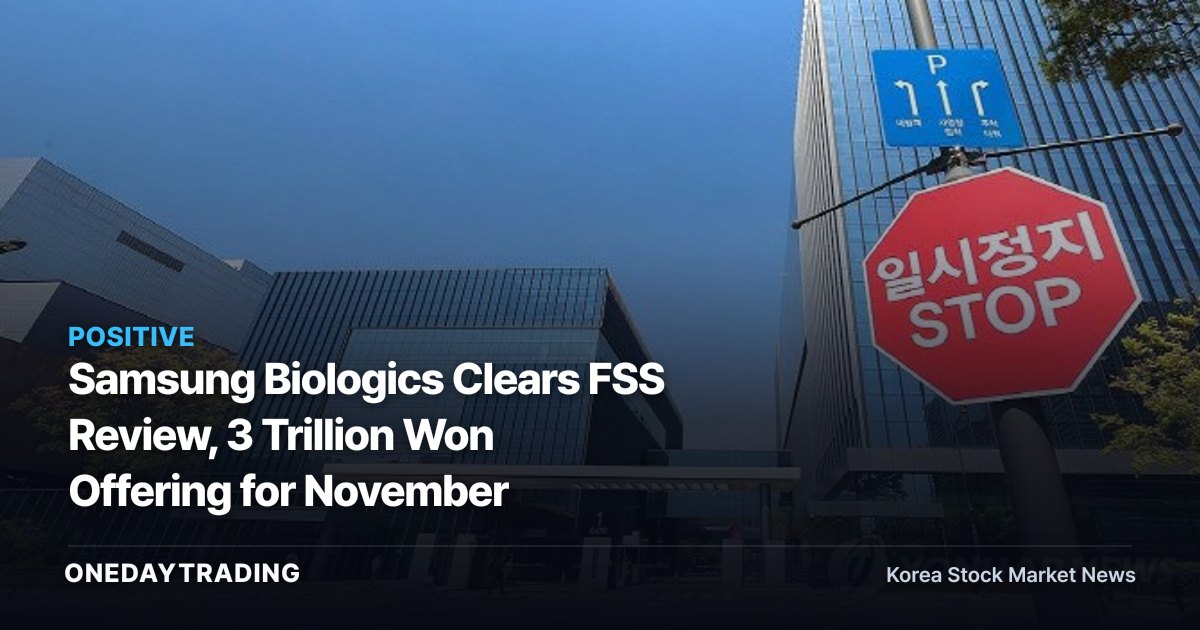
Samsung Biologics has moved forward with its 3 trillion won paid-in capital increase without a separate revision order from the Financial Supervisory Service (FSS), advancing the fundraising process needed for a major acquisition and production-facility investment to its next stage. For investors, the key question has shifted from "did the registration statement pass review?" to "at what price, and how fully will it be subscribed?" According to Maeil Business Newspaper's securities desk, the securities registration statement took effect on September 12, 2026, and the company disclosed its prospectus on September 14.
What the Effective Registration Means
Samsung Biologics filed its roughly 3 trillion won paid-in capital increase registration statement on August 28, then submitted an amended statement on September 11 that supplemented risk-factor disclosures. Because the FSS did not issue a separate revision order, the company avoided the procedural delay that occurs when a registration statement is deemed unaccepted from the date such an order is issued. That is why the planned subscription and payment schedule remained intact.
On the same day, the FSS said it would differentiate its approach to revision orders — reviewing registration statements with adequately disclosed risk factors quickly, while applying stricter scrutiny and public disclosure to cases with repeatedly inadequate supplementation. Lee Seung-woo, deputy director general at the FSS, said, "It is also important to let companies raise capital smoothly through the capital markets when they need it," adding, "We will improve review efficiency through selective focus." This case shows that passing review does not by itself guarantee that funds will actually come in, but it does improve schedule visibility.
Where the 3,000.94 Billion Won in Proceeds Will Go: Acquisition and Plant Expansion
According to the prospectus, the company will issue 2.27 million new shares, with planned proceeds of 3,000.94 billion won. Of that amount, Samsung Biologics plans to allocate 2,706.2 billion won to acquiring Swiss peptide CDMO PolyPeptide Group and 294.8 billion won to building Plant 6 at its Songdo Bio Campus II. Because the use of proceeds is specified across these two items rather than described as general working capital, the market will be watching whether the company actually completes the acquisition and expands production capacity.
The company said it also considered using cash on hand, corporate bonds, and bank borrowing, but chose a shareholder-allocation offering with a general public offering of forfeited shares after weighing the financial burden of large-scale borrowing against reduced room for future investment. As a result, the fundraising's benefit of limiting debt growth comes with a trade-off: the outcome hinges on whether existing shareholders participate in the subscription and whether any forfeited shares are absorbed in the general public offering.
What Hanwha Solutions Shows About the Risk of a Revision Order
A large paid-in capital increase does not guarantee that its registration statement will take effect at the same pace as others. Hanwha Solutions received two revision orders from the FSS this year, and the size of its offering shrank from about 2.4 trillion won at initial filing to a final 1,171.3 billion won. At the time, the FSS said the company needed to more fully disclose liquidity risk and alternative funding options beyond the rights offering for investors to make informed decisions.
Samsung Biologics moved through the process without a revision order, but that is not the same as having its final proceeds locked in. The planned issue price is 1,322,000 won per share, and the final issue price will be set at whichever is lower between the first and second provisional prices. If the stock falls further, the actual amount raised could come in below the planned 3,000.94 billion won.
Four Numbers and Dates for Investors to Watch
- Nov. 9–10, existing shareholder subscription: The participation rate of existing shareholders will determine the size of forfeited shares. A lower participation rate increases the burden on the general public offering.
- Nov. 12–13, general public offering of forfeited shares: This is the window that will show whether the market absorbs the remaining shares. The subscription result is not yet known.
- Nov. 17, payment date: Only once the actual payment is made will the cash available for the acquisition and Plant 6 investment be finalized.
- Nov. 30, scheduled listing date for new shares: This is when the newly issued shares enter the market for trading, so it should be read together with the issue price and the outcome of existing shareholders' participation.
Separating the Positive Catalyst from the Downside Risks
The removal of the risk of a schedule delay from an FSS revision order is a positive catalyst in that it allows the PolyPeptide Group acquisition and the Songdo Plant 6 construction to proceed as planned. If the 2,706.2 billion won in acquisition funds and the 294.8 billion won in facility funds are disbursed as scheduled, Samsung Biologics' growth narrative moves into the execution stage of actually putting the capital to work.
Conversely, if the stock price falls below the planned issue price, both the final issue price and the proceeds calculation will change. If existing-shareholder subscription is weak and the general public offering of forfeited shares also underperforms, the final amount raised will shrink, introducing uncertainty into how funds are allocated between the acquisition and the plant expansion. The actual subscription turnout, the final issue price, and the existing shareholders' participation rate all remain unconfirmed.
So the positive catalyst here is not the outcome of "3 trillion won has already come in," but rather procedural progress: a timeline has opened up and the use of proceeds has been disclosed. Once the November subscription and payment disclosures confirm the volume and price, the market will also see exactly how much value to price in — and how much dilution burden comes with it.
Samsung Biologics Key MetricsAs of 2026-09-14
| Period Return | 1 Week -2.59% 1 Month -8.70% |
|---|
Price and supply-demand (order flow) data are real-time figures from Korea Investment & Securities (KIS); supply-demand and news-tone aggregation are calculated by OneDayTrading.
Upcoming Dates to Watch
- 09.16FOMC Policy Rate DecisionHighU.S. Federal Reserve monetary policy announcement — direction for rates and the dollar
- 10.08Index Options ExpirationLowKOSPI 200 options expiration
- 10.22Bank of Korea Monetary Policy BoardHighBenchmark interest rate decision meeting
- 10.28FOMC Policy Rate DecisionHighU.S. Federal Reserve monetary policy announcement — direction for rates and the dollar
This article is automatically summarized and analyzed based on the original news report. View original (Maeil Business Newspaper Securities)