
At a Glance
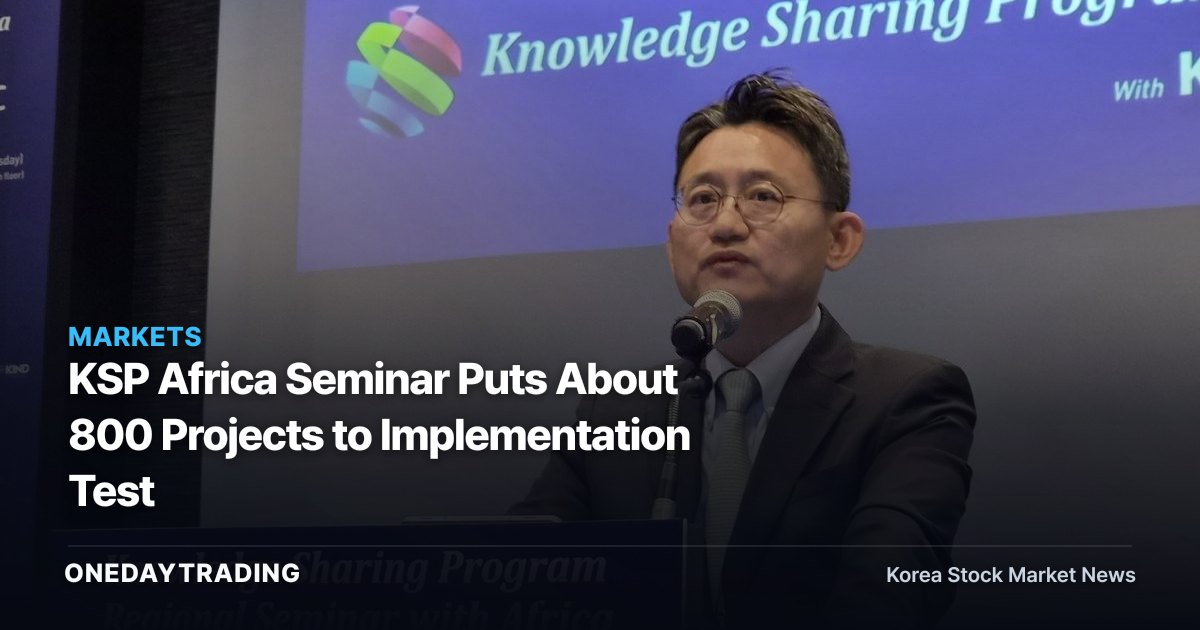
The number of policy cooperation projects has grown, but investors should focus on implementation rather than the project count. According to Yonhap News Agency, the Ministry of Finance and Economy held the KSP Africa Regional Seminar in Seoul on September 9, 2026, discussing the conditions needed to apply Korea’s economic development experience to Africa’s institutions, infrastructure, and industrial ecosystems. The seminar was held in conjunction with the 8th Korea-Africa Economic Cooperation (KOAFEC) Ministerial Conference.
KSP is a policy advisory program overseen by the Ministry of Finance and Economy that supports partner countries’ economic and social development and strengthens their policymaking capacity. According to Yonhap News Agency, since its launch in 2004, KSP carried out about 800 projects with 106 countries and 12 international organizations over the 23 years from 2004 through 2026. While this track record demonstrates the program’s scale, whether individual projects have become embedded in local fiscal and administrative systems requires separate verification.
Why It Matters Now
Kim Jung-wook, executive director of the Korea Development Institute’s Center for International Development, told Yonhap News Agency that global supply-chain restructuring, the green transition, the African Continental Free Trade Area (AfCFTA), and artificial intelligence (AI) could create opportunities for Africa, but would not automatically lead to sustainable development. Policies, institutions, and implementation capacity must work together.
Kang Yun-jin, director general for development finance at the Ministry of Finance and Economy, said KSP helps build the institutional foundations for policymaking in partner countries based on Korea’s development experience and expertise. From an investment perspective, this structure is closer to establishing long-term prerequisites—such as institutional design, data systems, and workforce development—than to generating near-term contract announcements. Investors should therefore assess subsequent contracts, budgets, and implementation separately rather than viewing the seminar itself as an immediate earnings signal for companies.
Key Issues
- Data-driven water management in Ghana According to Yonhap News Agency, Ghana pursued the development of an integrated water resources and sanitation management system through KSP in 2022–2023. Policy recommendations included reviewing Korea’s information and communications technology (ICT)-based information systems, data-collection indicators, and financing options.
- Support for natural gas vehicles in Mozambique A Mozambican government official presented a natural gas vehicle (NGV) support project involving the Korea Gas Safety Corporation and other participants. The report did not disclose the number of vehicles deployed or any financial results.
- Zimbabwe’s industrial ecosystem Zimbabwe presented Korean examples of building industry-academia collaboration ecosystems and supporting startups. The scale of implementation and results achieved by local companies were not disclosed.
- Implementation capacity bottleneck Eric Ogunleye, director of the African Development Institute (ADI), said the key challenge is building an industrial ecosystem that translates markets and natural resources into public benefits and jobs.
Impact on Related Stocks and Sectors
- Policy and development cooperation The event did not announce revenue or contract wins for any specific listed company. Yonhap News Agency did not report additional support amounts by country or quantitative results for individual projects, making it difficult to map the event directly to any stock (ticker).
- Gas safety and mobility The Korea Gas Safety Corporation and other entities were confirmed as participants in Mozambique’s NGV support project. However, the report did not address the corporation’s listing status or disclose contract values for individual private-sector companies, leaving no basis for identifying related stocks.
- ICT and data infrastructure Information systems and indicator design were mentioned in the Ghana case. However, no suppliers, contract amounts, or recurring revenue details were disclosed, so an earnings benefit for Korean ICT stocks cannot be assumed.
Investment Considerations
- Investors should monitor follow-up disclosures, not seminar attendance. According to Yonhap News Agency, more than 130 people attended the event on September 9, 2026, but attendance does not translate into project revenue.
- A full-scale expansion of the Ghana project was presented only as an aspiration. Analysis of potential corporate contract wins will become possible only if expansion plans lead to actual budgets and contracts.
- There is a time lag between policy advisory work and commercial projects. Profitability cannot be calculated unless operating expenses, maintenance costs, and local procurement structures following system deployment are disclosed.
- Yonhap News Agency’s report did not provide quantitative results for the cooperation projects presented at the seminar or additional support amounts by African country. Filling these gaps with estimates could distort investment decisions.
Overall Outlook
The bullish scenario is that KSP’s policy advice translates into actual institutions and budgets. If Ghana’s data system, Mozambique’s NGV initiative, and Zimbabwe’s industry-academia collaboration develop into expanded local projects, the downstream market available to Korean companies could grow. However, this is a conditional pathway, not an outcome currently confirmed by Yonhap News Agency.
The downside scenario is delayed implementation. If policy recommendations fail to take root in local administrative and fiscal systems, or if additional support amounts remain undisclosed, the cumulative track record of about 800 projects is unlikely to serve as a leading indicator of corporate earnings. The next decision point will come when KSP publishes concrete follow-up schedules, country-specific budgets and contracts, and quantitative results for individual projects.
Frequently Asked Questions
When and where was the KSP Africa Regional Seminar held?
According to Yonhap News Agency, the seminar was held on September 9, 2026, in the Art Hall on the fourth floor of the Grand Walkerhill Seoul Convention Center. It was hosted by the Ministry of Finance and Economy and held in conjunction with the 8th Korea-Africa Economic Cooperation (KOAFEC) Ministerial Conference.
What is KSP?
KSP is a policy advisory program that draws on Korea’s economic development experience to support partner countries’ economic and social development and strengthen their policymaking capacity. Overseen by the Ministry of Finance and Economy, it carried out about 800 projects involving 106 countries and 12 international organizations from 2004 through 2026.
What should corporate investors monitor after this event?
Yonhap News Agency’s report does not confirm KSP’s specific future schedule, quantitative results from the cooperation projects, or additional support amounts by African country. Investors should therefore first monitor whether follow-up contracts, budgets, and implementation results are disclosed.
This article was automatically summarized and analyzed from the original news report. View the original article (Yonhap News Agency)