
At a Glance
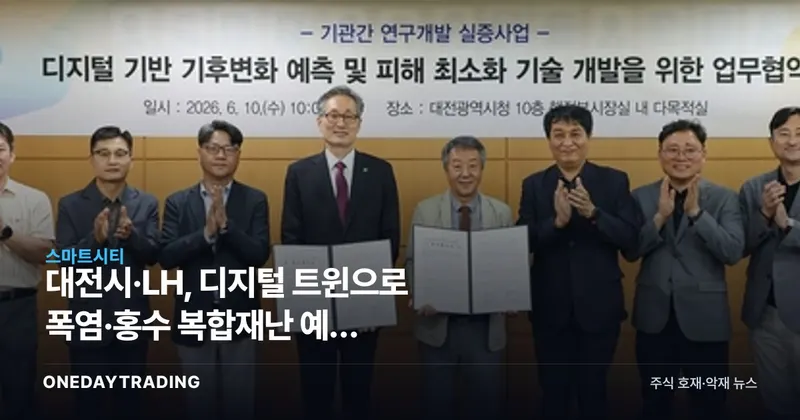
Daejeon City is partnering with the Korea Land & Housing Corporation (LH) to validate technology that uses a digital twin (a virtual model that mirrors reality exactly) to forecast and respond to compound climate disasters such as heatwaves and floods. The approach recreates city data in a virtual space, runs disaster scenarios in advance, and develops response measures accordingly. The industry is paying close attention, as it signals that public-sector demand for digital twins and smart cities is now gathering pace.
Why It Matters Now
Korea has recently seen record heatwaves and localized torrential rains occur repeatedly, raising the risk of compound disasters in which multiple events overlap rather than occurring in isolation. With the clear limits of conventional after-the-fact responses, data-driven digital-twin technology that forecasts risks in advance is emerging as an alternative.
This pilot is significant because a local government and a state-owned enterprise are directly commissioning and validating it. Digital twins have often been dismissed as remaining at the conceptual stage, but as references for real-world application in city operations and disaster management accumulate, this could lead to follow-on contracts and nationwide rollout. It also aligns with the government's Digital Platform Government and smart-city policy direction.
That said, this phase is a pilot project geared toward technology validation, so it is reasonable to view it as an early signal of market formation rather than something that will translate directly into large-scale revenue right away.
Frequently Asked Questions
- What is a digital twin — It is a technology that uses sensors and data to recreate real-world cities, facilities, and environments identically in a virtual space, allowing various scenarios to be simulated before events actually happen.
- Why use it for disaster management — By simulating the paths of heatwaves, floods, and inundation in advance, it can identify vulnerable points and optimize resource deployment, reducing damage and speeding up responses.
- What is the key takeaway from an investment perspective — As public-sector contracts increase, order opportunities expand for companies in digital-twin engineering, geospatial information, and smart-city solutions.
- Will it show up in earnings right away — As this is a pilot phase, the immediate revenue impact is limited, and the key question is whether it converts into a follow-on full-scale project.
Related Stocks & Sector Impact
- Eight (e8ight) — As Korea's leading digital-twin specialist, it is a core stock expected to benefit directly if orders for city and infrastructure simulation expand.
- POSCO DX — With capabilities in smart factories, digital twins, and industrial automation, it stands to benefit from growing demand across both public and industrial domains.
- Hancom — Through its public-sector software and smart-city/geospatial businesses, it is expected to be an indirect beneficiary of the Digital Platform Government trend.
- Smart-city & geospatial sector — As contracts from local governments and state-owned enterprises increase, this becomes a top-line growth driver across the broader solutions and engineering industry sector.
- Sensors, IoT & cloud — As essential infrastructure for building digital twins, this group benefits from rising demand for data collection and computation.
Points to Watch When Investing
- Pilot and demonstration projects contribute little revenue until they convert into full-scale projects, so expectations can be excessively priced in ahead of time.
- Many digital-twin-related stocks are small- and mid-cap KOSDAQ stocks, making them highly volatile and prone to theme-driven sharp gains (surges) and drops.
- Public-sector contracts depend on budget and policy schedules, so the timing of orders can be delayed.
- It is necessary to distinguish technology-validation results from actual orders and earnings, and to check each company's order backlog and references.
Overall Outlook
In the optimistic scenario, climate disasters become a constant fixture, public-sector investment in digital twins and smart cities expands structurally, pilots like this one spread to local governments nationwide, and related companies' order pipelines thicken. With added government policy support, this could establish itself as a medium-to-long-term growth theme. The risk, on the other hand, is that if the pilot fails to lead to a full-scale project or contracts are slow due to budget constraints, theme-driven expectations may run ahead while earnings fail to follow, increasing share-price volatility. A strategy centered on order visibility and earnings trends is more effective than chasing short-term expectations.
This article is content automatically summarized and analyzed based on the original news report. View original (Yonhap News, Industry)