
Reading the Earnings Timeline in Samsung Electro-Mechanics’ Expansion
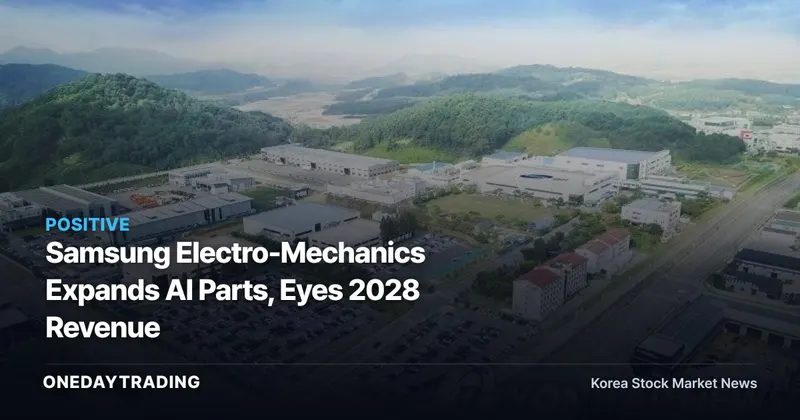
Samsung Electro-Mechanics’ plan, announced on 2026-10-28, to expand production capacity for AI data center MLCCs and FCBGAs should be assessed not only through its demand outlook but also against the timeline for contracts, mass production, and revenue contributions. The record third-quarter earnings reported by Yonhap News Securities are already confirmed, but the new production facilities are expected to contribute in separate phases next year and in 2028.
MLCCs and FCBGAs are the key product groups targeted for capacity expansion in this announcement to meet demand for AI data center components. Investors should remember one clear point: more than the scale of the announcement, the speed at which long-term supply contracts translate into mass production and revenue will determine the path of Samsung Electro-Mechanics’ future earnings.
What Long-Term Supply Contracts With About 50 Customers Mean
Samsung Electro-Mechanics said it has signed or is negotiating long-term supply contracts with about 50 customers to date, primarily for high-value-added MLCCs with features such as high capacitance and high voltage. The company expects more than half of next year’s MLCC revenue to come from long-term supply contracts. By providing both its customer-base figures and projected revenue share, the company has shown that its demand thesis is more than rhetoric.
The scale of the contracts has also been disclosed. According to Yonhap News Securities, Samsung Electro-Mechanics announced seven long-term supply contracts over the past five months covering MLCCs, silicon capacitors, and package substrates, with a cumulative value of about 4.3 trillion won. These contracts will affect earnings not when they are signed, but when the committed volumes enter mass production and are recognized as revenue.
Different Timelines for Philippine MLCC and FCBGA Investments
For MLCCs, the new Philippine plant is scheduled to begin mass-producing advanced, high-value-added products next year. The disclosed materials do not specify the exact start-up date or production capacity. Investors should therefore focus next year on whether mass production actually begins and connects with volumes under long-term supply contracts, rather than merely on the narrative surrounding plant construction.
FCBGA has a longer lead time. Last month, Samsung Electro-Mechanics decided to invest 6.78 trillion won to expand production facilities at its Sejong site and Vietnamese manufacturing subsidiary. The company plans to begin phased mass production of high-value-added substrates for AI data centers next year and expects them to begin contributing meaningfully to revenue growth in 2028.
Record Quarterly Earnings Establish the Starting Point
Samsung Electro-Mechanics’ third-quarter revenue rose 30% year over year to 3.7633 trillion won, while operating profit increased 165% to 691 billion won. According to the company, both revenue and operating profit reached all-time quarterly highs. This is why investors assessing the expansion plan should consider not only future demand but also the company’s current earnings base.
At first glance, record earnings and large-scale investment point in the same direction. Structurally, however, they are at different stages of validation. Third-quarter earnings are confirmed figures, while next year’s mass production and the 2028 revenue contribution remain company plans and projections.
Impact on Samsung Electro-Mechanics and AI Electronic Components
- Samsung Electro-Mechanics: Its long-term supply-contract customer base, new Philippine MLCC plant, and FCBGA expansions in Sejong and Vietnam form a single production-growth pathway. If contracted volumes materialize, the likelihood that new capacity translates into revenue will increase.
- Electronic components for AI data centers: Samsung Electro-Mechanics expects tight supply-demand (order flow) conditions to persist because only a limited number of suppliers can provide cutting-edge MLCCs for AI servers and capacity expansion requires considerable time. This indicates that the company’s production expansion is aligned with meeting demand.
- Camera modules for robots: Samsung Electro-Mechanics said it began mass-producing camera modules for humanoid robots for a global customer in the third quarter. The customer was not disclosed, so there is not yet enough information to assess the revenue impact by customer.
Indicators Investors Should Watch Next
- Investors should verify whether the new Philippine plant actually begins mass-producing advanced, high-value-added MLCCs next year.
- A key inflection point will be whether long-term supply contracts involving about 50 customers translate into the company’s projection that they will account for more than half of next year’s MLCC revenue.
- Investors should watch whether FCBGA production at the Sejong site and Vietnamese manufacturing subsidiary ramps up in phases beginning next year and whether the expected contribution to revenue growth in 2028 becomes more concrete.
- If requests for additional output translate into further capacity-expansion decisions, the investment amount and implementation timeline will become new factors to assess.
The Line Between a Supply Shortage Outlook and Expansion Risk
In the optimistic scenario, volumes under long-term supply contracts continue and the new production facilities enter mass production as planned. In that case, the record third-quarter earnings could be viewed not as a one-off result, but as the starting point before production expands.
The risk lies in the gap between the demand outlook and revenue recognition. The company said that even its large-scale expansion may not fully meet customer demand and that it is receiving requests for additional volumes, but whether it will expand capacity further and how much it might invest remain undecided. If next year’s mass-production schedule slips or the revenue share from long-term supply contracts falls short of the company’s projection, the earnings-growth timeline will also be delayed. The next assessment should be based not on the wording of the announcement, but on the start of mass production, the share of contract-related revenue, and clearer evidence of FCBGA’s contribution in 2028.
Samsung Electro-Mechanics Key MetricsAs of 2026-10-28
| Period Returns | 1 Week +12.33% 1 Month -12.94% |
|---|---|
| trading value · trading volume | 75.6 billion won · 1,482,859 shares |
| supply-demand (order flow) | foreign investors Net selling of 28.2 billion won institutional investors Net buying of 40.7 billion won |
| Recent News Tone | positive catalyst 4 · negative catalyst 0 |
Price and supply-demand (order flow) data are real-time figures from Korea Investment & Securities (KIS), while supply-demand (order flow) and news-tone aggregates are calculated independently by One Day Trading.
Supply-Demand (Order Flow) and Momentum Assessment🟡 neutral · Wait and See
Positive and negative signals are mixed, suggesting a wait-and-see stance.
- ▲News Flowpositive catalyst 4 vs negative catalyst 0 — positive catalysts lead
Upcoming Events to Watch
- 10.28FOMC Policy Rate DecisionHighFederal Reserve monetary policy announcement — direction of interest rates and the dollar
- 11.12Index Options ExpirationLowKOSPI 200 options expiration
- 11.26Bank of Korea Monetary Policy BoardHighBenchmark interest rate decision meeting
- 12.09FOMC Policy Rate DecisionHighFederal Reserve monetary policy announcement — direction of interest rates and the dollar
This article was automatically summarized and analyzed from the original news report. View Original Article (Yonhap News Securities)