
What Investors Should Note in the Ministry’s Security Review
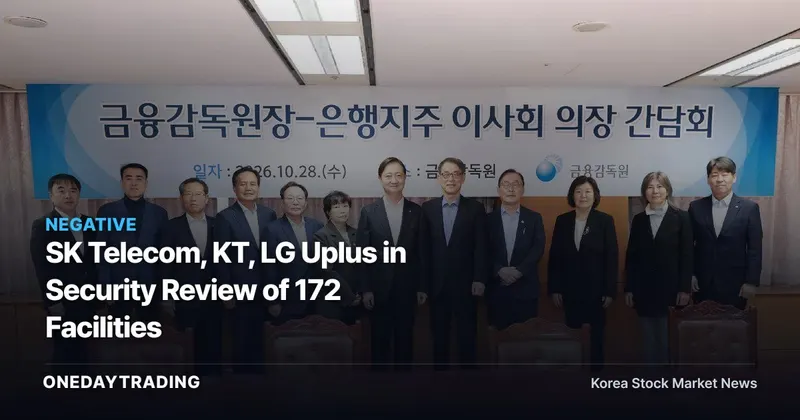
With the Ministry of Science and ICT launching a security review on the 28th, the criteria for assessing SK Telecom, KT, LG Uplus and the financial sector have also changed. Investors should focus less on the launch itself than on which vulnerabilities the tailored checklists uncover and how proactively each institution addresses them. Cybersecurity affects corporate value not only through whether an incident occurs, but also through a company’s operational ability to identify and control its IT assets.
According to Maeil Business Newspaper’s securities desk, the review covers 172 critical information and communications infrastructure facilities designated by the Ministry of Science and ICT across 111 institutions. The review is intended to identify vulnerabilities in critical private-sector networks, including telecom carriers and data centers, and determine where remediation is required. As facility-level findings have yet to be released, inclusion in the review should not automatically be interpreted as a security failure.
What Matters More Than Why SK Telecom, KT and LG Uplus Were Included
The review covers South Korea’s three mobile carriers—SK Telecom, KT and LG Uplus—as well as major domestic data centers. Rather than assessing the three companies as a single group, investors should evaluate any future disclosures by separating each institution’s vulnerabilities and required response. The available information currently provides no basis for assuming that all reviewed institutions will face the same findings or follow-up measures.
This is also where the technology narrative diverges from the potential corporate burden. Distributing tailored checklists means defining institution-specific review criteria rather than relying on broad, uniform directives. A wider review scope could change the staffing and resources required for compliance, but no company-specific investment amounts or earnings effects have been disclosed. What can be priced in now is tighter oversight; what cannot yet be calculated is the cost and damage for each company.
How the Security Review Connects With Directives to the Financial Sector
- Telecoms and data centers: The Ministry of Science and ICT plans to distribute tailored checklists to each institution. Investment assessments will become more precise once the actual findings and remedial measures are confirmed, rather than merely when the checklists are distributed.
- Financial sector: A financial-sector meeting on responses to AI security threats will be held next week, chaired by Financial Services Commission Chairman Lee Eog-weon. As the exact date has not been confirmed, investors should focus on the scope of the measures presented rather than the schedule itself.
- Governance: Financial Supervisory Service Governor Lee Chan-jin instructed South Korea’s eight major financial groups to strengthen IT security and establish autonomous defense systems. The key consideration is that cybersecurity is being elevated from an issue confined to specialist departments to one requiring board-level attention.
- Confirmed incidents: Additional hacking incidents occurred at Daishin Securities and Mirae Asset Global Investments. The perpetrators and the specific extent of the damage have not been confirmed.
Transmission Channels to Telecom and Financial Stocks
- SK Telecom, KT and LG Uplus: The direct indicators to watch are the vulnerabilities uncovered by the tailored reviews and the subsequent response. Continued remediation would provide evidence of effective operational controls, while a broader remediation scope would require investors to reassess the burden on resource allocation.
- Daishin Securities and Mirae Asset Global Investments: Although the hacking incidents have been confirmed, the absence of damage estimates makes it impossible to quantify the earnings impact. Investors should distinguish the occurrence of an incident from its financial consequences.
- Financial sector overall: Financial Supervisory Service Governor Lee Chan-jin said, “Financial companies must promptly establish autonomous defense systems under which they thoroughly manage their own IT assets and proactively identify and eliminate security vulnerabilities.” The directive shifts the focus of assessment beyond regulatory compliance toward internal capabilities to identify and eliminate vulnerabilities.
Premature Calculations Investors Should Avoid
- The 172 facilities under review should not be treated as a measure of damage at any individual company. The figure represents the scope of the Ministry of Science and ICT’s review.
- Inclusion among the reviewed institutions does not by itself confirm a security vulnerability. No detailed facility-level findings are available.
- There is also insufficient basis to immediately link the incidents at Daishin Securities and Mirae Asset Global Investments to weaker profits. Both the extent of the damage and the perpetrators remain unknown.
- The financial-sector meeting on AI security threats is still in the planning stage. Until specific measures are announced, it will be difficult to calculate how the burden may differ across segments of the industry.
The Next Turning Point: Disclosure of Findings and Execution of Autonomous Defenses
In an optimistic scenario, institution-specific reviews lead to the identification and removal of vulnerabilities, while the financial sector turns IT asset management and board-level responses into functioning systems. The market could then view the security review as a test of operational reliability rather than a one-off burden.
The opposite scenario would involve vulnerabilities being identified in follow-up reviews or further incidents occurring. The indicators that will determine the outcome are the Ministry of Science and ICT’s institution-specific findings, remediation under the tailored checklists, and the specific response measures presented at the meeting chaired by Financial Services Commission Chairman Lee Eog-weon. Until the findings are released, investors should avoid assuming a stock-specific earnings shock and instead track whether cybersecurity capabilities move from stated commitments to execution.
SK Telecom Key MetricsAs of 2026-10-28
| Period Return | 1 Week +1.10% 1 Month -10.28% |
|---|---|
| trading value · trading volume | 8.2 billion won · 1,738,901 shares |
| supply-demand (order flow) | foreign investors Net selling of 7.7 billion won institutional investors Net buying of 10.9 billion won |
Price and supply-demand (order flow) data are real-time figures from Korea Investment & Securities (KIS), while order-flow and news-tone aggregates are calculated independently by OneDay Trading.
Order Flow and Momentum Assessment🟡 neutral · Wait-and-See
With positive and negative signals diverging, this is a period to monitor.
Upcoming Events to Watch
- 10.28FOMC Policy Rate DecisionHighU.S. Federal Reserve monetary policy announcement — direction of interest rates and the dollar
- 11.12Index Options ExpirationLowKOSPI 200 options expiration
- 11.26Bank of Korea Monetary Policy BoardHighbenchmark interest rate decision meeting
- 12.09FOMC Policy Rate DecisionHighU.S. Federal Reserve monetary policy announcement — direction of interest rates and the dollar
This article was automatically summarized and analyzed based on the original news report. View original article (Maeil Business Newspaper Securities)