
Summary
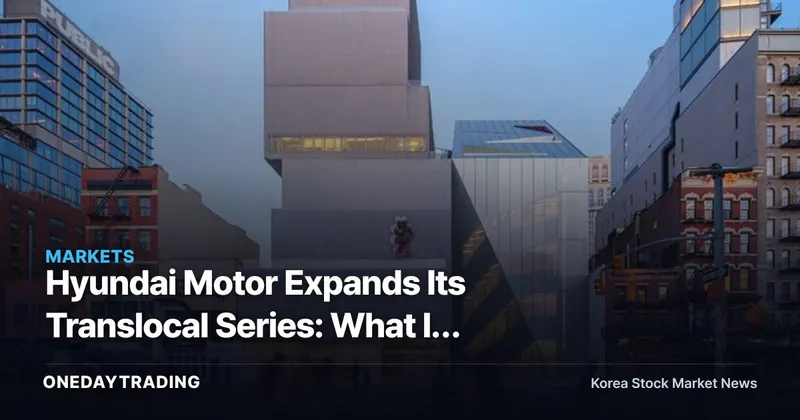
Hyundai Motor is bringing four additional institutions into its art collaboration platform, the Translocal Series, expanding art exchanges that connect Ulsan and New York, Seoul and Abu Dhabi, through 2028. Rather than a direct earnings catalyst, this is a move tied to long-term brand equity and ESG, and for auto-stock investors it reads as an accumulation of brand premium rather than a shift in fundamentals.
This kind of cultural sponsorship is far removed from short-term share-price momentum, but it is worth examining in the context of intangible-asset building by an automaker pursuing a global premium strategy.
What Happened
Hyundai Motor has newly brought four institutions, including the Ulsan Art Museum, into the Translocal Series, which it has run to expand collaboration with art institutions at home and abroad. Ulsan is home to one of Hyundai Motor's core production bases, so the partnership with a local museum also carries the meaning of strengthening ties with its manufacturing-hub city.
The scope of collaboration does not stop at the domestic level. Exhibition cooperation in New York and expanded exchanges between Seoul and Abu Dhabi are being pursued at the same time, and the participating institutions will continue joint projects through 2028. The initiative also points to exploring the potential for fusing art and technology.
This is an extension of the cultural marketing Hyundai Motor has built up through museum and biennale sponsorships and design and mobility exhibitions. A defining feature is that it is operated as a multi-year platform rather than as one-off sponsorship.
Structural Background
In the automotive industry, where product performance has converged at a high level, much of a company's pricing power hinges on brand perception. The more a company pursues a premium lineup and an electrification transition, the more building intangible assets through an image of design, culture, and technology fusion indirectly affects selling prices and residual values.
Exchanges leveraging global hubs such as Abu Dhabi and New York are an attempt to elevate brand stature at points of contact with overseas consumers; they are characterized more by gradual reflection in medium- to long-term brand positioning and ESG evaluation criteria than in short-term profit and loss.
Impact on Stocks and Sectors
- Hyundai Motor: As the sponsoring entity, it accumulates intangible brand assets, but because marketing and sponsorship costs are booked as SG&A expenses, the short-term earnings impact is limited. The key variables remain unit sales, mix, and the exchange rate.
- Kia: Since it shares a group-wide design and brand strategy, there is potential for an indirect benefit from an enhanced premium image, though the direct linkage is weak.
- Hyundai Mobis: If the art-and-technology fusion message extends into a mobility-technology image, it could indirectly support the technology branding of the group's parts affiliates.
- Entertainment, media, and exhibition sectors: An expansion of corporate-sponsored cultural projects connects with the underlying demand of the exhibition and content collaboration ecosystem, but the direct revenue effect at the level of individual listed companies is diffuse.
Bullish vs. Bearish Scenarios
On the bullish side, multi-year platformized cultural sponsorship, dovetailing with a global premium strategy and an electrification brand image, could work favorably for long-term brand value and ESG evaluation. Brand loyalty has room to translate into pricing-defense power.
On the bearish side, it is clear that this announcement is not something that translates directly into revenue or profit. Costs are recognized immediately, but the benefits are qualitative and spread out over the long term, and the share price is ultimately driven by sales volume and profitability, along with macro variables such as tariffs and the exchange rate. It is difficult to justify a valuation on cultural sponsorship alone.
Investor Action Points
- Classify this announcement as a brand-strategy event rather than a buy or sell signal, and base actual investment decisions on quarterly earnings metrics such as unit sales, average selling price, and mix.
- Check in the quarterly reports whether the trend in marketing and sponsorship costs within SG&A is pressuring the operating margin.
- Prioritize fundamental variables such as the won-dollar exchange rate, U.S. and European sales trends, and the tariff policy schedule.
- Use rating changes from ESG and brand-evaluation agencies or global brand-value rankings as long-term monitoring indicators.
Hyundai Motor in Real-Time Data
Hyundai Motor's latest closing price is 530,000 won (−8.78% versus the prior day), and the signal light that combines foreign and institutional supply-demand (order flow) with news and momentum is 🔴 Caution. With foreign investors, institutional investors, and momentum all negative, caution is warranted right now.
- ▼ Dual-front selling — foreign investors −15.98 billion won and institutional investors −85.2 billion won selling in tandem
- ▼ Trend alignment — short- and medium-term downside alignment (−8.8% on the day · −17.2% over one week · −20.4% over one month)
- ▲ News flow — 5 positive catalysts vs. 3 negative catalysts — positive catalysts in the lead
Recent related news is favorable, with 5 positive catalysts and 3 negative catalysts.
※ Price and foreign/institutional supply-demand (order flow) data are provided by Korea Investment & Securities (KIS) and are as of the time of publication.
This article is content automatically summarized and analyzed based on the original news. View original (Maeil Business Newspaper, Corporate)