
At a Glance
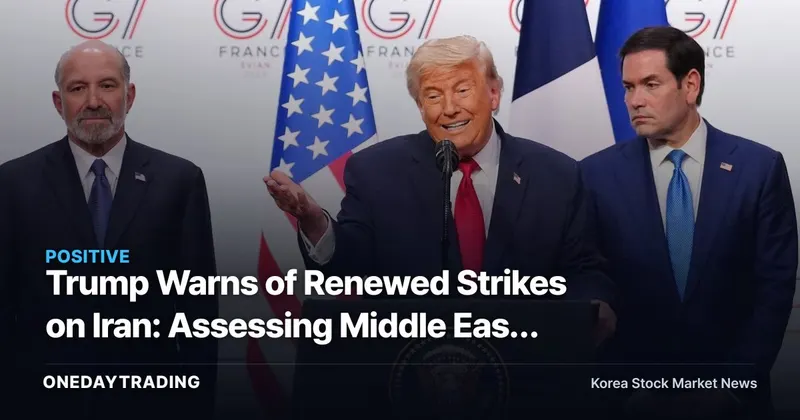
U.S. President Donald Trump made a hardline remark at the G7 summit, saying he could resume bombing Iran if he isn't satisfied with the terms of a deal. The key point isn't the substance of the deal itself, but the fact that the U.S. has put the military option back on the table as a negotiating card — a development that stokes concerns over Middle East supply disruptions and adds volatility to international oil prices and the refining, defense, and airline industry sectors.
Why It Matters Now
Remarks out of the Middle East carry heavy weight in the market because the mechanism behind them is well understood. Iran sits astride the Strait of Hormuz, a critical chokepoint for global crude oil shipments, so whenever the possibility of military conflict is raised, a supply-disruption premium gets priced into oil ahead of time. Even without an actual conflict, risk-aversion demand alone is enough to build upward pressure on oil prices.
South Korea imports nearly all of its crude oil, and depends on the Middle East for a large share of that. As a result, rising oil prices lift refining margins and inventory valuation gains for the refining and petrochemical sector, while acting as a cost burden for airlines and shipping, where fuel makes up a large portion of expenses. The fact that the same event produces opposite effects on profits across different sectors is the core of this issue.
On top of this, heightened military tension, combined with expectations of expanded global defense budgets, is stoking hopes of stronger order momentum for the defense sector. However, whether the rhetoric will actually translate into action remains uncertain, meaning the expectations already priced in also carry the risk of being unwound.
FAQ
- Why does oil react first? — Military risk in the Middle East is directly tied to concerns over crude oil supply disruptions, so a risk premium gets attached to oil prices even before any actual event occurs.
- Is this a direct blow to the Korean stock market? — It's a macro negative catalyst that stokes import prices and the trade balance, but sectors like refining and defense stand to benefit at the same time, leading to sector-by-sector differentiation rather than a uniform impact.
- How likely is an actual bombing? — The remark carries strong overtones of negotiating pressure, and whether it will be carried out remains undecided. A scenario-based response is therefore needed.
- What indicators are most sensitive to this? — International oil prices (Brent and WTI), the won-dollar exchange rate, and the intensity of tensions on the ground in the Middle East.
Related Stocks (Tickers) and Sector Impact
- Refining (S-Oil, SK Innovation, GS) — Rising oil prices could benefit these stocks (tickers) through inventory valuation gains and improved refining margins. However, the effect could be offset if demand slows at the same time.
- Defense (Hanwha Aerospace, LIG Nex1) — Escalating geopolitical tension feeds expectations of expanded global defense spending, which is favorable for order momentum.
- Airlines and shipping (Korean Air) — Since fuel accounts for a large share of costs, rising oil prices are a direct cost burden.
- Energy-intensive industry sectors such as chemicals and utilities — Margin volatility could widen amid upward cost pressure.
Investment Considerations
- There is a wide gap between rhetoric and actual action. A geopolitical premium priced in ahead of time can quickly unwind if tensions ease.
- Refining and defense stocks (tickers) that have already rallied should be checked for valuation strain. Segments that have risen purely on event expectations can be highly volatile.
- If rising oil prices spread into concerns over slowing global demand or a broader economic downturn, that becomes a headwind for risk assets overall.
- If the exchange rate and oil prices rise simultaneously, the resulting hit to the domestic economy via import prices and interest rates also needs to be watched.
Overall Outlook
If Middle East tensions actually escalate, a differentiated market could emerge, with oil prices rising and refining and defense stocks (tickers) showing relative strength while airlines and shipping come under pressure. Conversely, if the remarks turn out to be mere negotiating rhetoric and tensions ease, there is a risk of a swift reversal in the geopolitical beneficiary stocks (tickers) that saw a sharp gain (surge) in the short term. Key things to watch next are the progress of U.S.-Iran negotiations, the trend level of Brent crude oil prices, and the direction of the won-dollar exchange rate.
This article was automatically summarized and analyzed based on the original news report. Read the original article (CNBC)