
Maeil Business Newspaper Highlights Tension in November’s KOSPI Outlook
The message for investors from the November domestic stock market outlook by eight Money Doctors, reported by Maeil Business Newspaper’s securities desk on 2026-11-02, is clear. Expectations for the KOSPI have fallen, but that does not necessarily mean reducing equity exposure. For semiconductor-led AI technology stocks, investors now need to distinguish between the index outlook and stock-specific strategies.
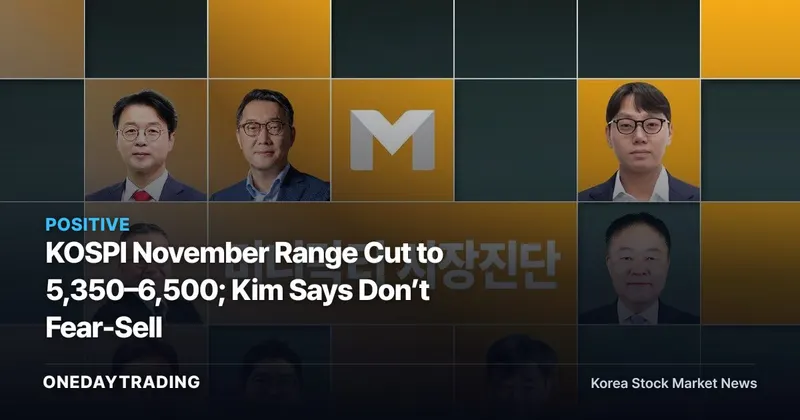
The November KOSPI forecast range reported by Maeil Business Newspaper’s securities desk is 5350~6500. Experts lowered their forecasts after the domestic stock market underwent sharp corrections in July and October. A KOSPI forecast represents the range within which the index is expected to trade over a given period; it is not a price target guaranteeing gains in an individual stock (ticker).
Expectations Fall From 7000~8000 to Around 6500
According to Maeil Business Newspaper’s securities report, bulls who had projected the KOSPI at 7000~8000 last month revised their November outlook to around 6500. The figures indicate a scaling back of expectations rather than the disappearance of optimism. Even as they lowered the upper end of their forecasts, calls to sell stocks faded, with experts instead suggesting that investors maintain or increase their equity exposure.
Separating what has been confirmed from what remains uncertain provides a clearer basis for judgment. The confirmed facts are the downgrade to the November outlook and the recommendation to maintain or increase equity exposure. It remains unclear whether the domestic stock market will actually rebound after the U.S. midterm elections or how U.S. interest rates and geopolitical risks will change.
If the KOSPI remains within 5350~6500 in November, it will be trading within the reported forecast range. If it moves outside that range, a gap will emerge between the eight Money Doctors’ outlook and the actual market. Interpreting the “forecast downgrade” alone as a sell signal without checking the index level, or treating “increased exposure” as confirmation of a rebound, would both go beyond what the data supports.
Why Kim Hak-joo Highlighted AI Tech Stocks—and the Limits
The segment identified for bargain buying is semiconductor-led AI technology stocks. Kim Hak-joo, a professor at Handong Global University, told Maeil Business Newspaper’s securities desk, “This is not the time to sell out of fear, but to steadily accumulate oversold AI technology stocks in small amounts.” His view favors a staggered approach over an abrupt shift in direction.
An easily overlooked condition in this assessment is that it refers not to “all AI technology stocks,” but specifically to those that are “oversold.” The report did not provide individual company names, earnings, valuations, or criteria for determining the extent of a decline. There is therefore no basis for immediately designating a particular company as a bargain-buying opportunity; the only verifiable investment category is the broader sector of semiconductor-led AI technology stocks.
However, the lower index outlook and the recommendation to accumulate AI technology stocks are not contradictory. The former reflects reduced expectations for the KOSPI’s November range, while the latter addresses how investors might manage equity exposure following the correction. In effect, the report combines caution toward the broader market with a selective buying approach to certain technology stocks.
Conditions Investors Should Monitor in November
- KOSPI range: Investors should monitor whether the index trades within 5350~6500 in November. This range is the most direct benchmark for assessing the forecast’s validity.
- AI technology stock selection: Semiconductor-led AI technology stocks were identified as bargain-buying candidates, but the disclosed facts do not include company-specific evidence. Investors should not convert a sector-level view into a buy case for a particular stock (ticker).
- Exposure adjustment: The stated recommendation is to maintain or increase equity exposure. Kim Hak-joo’s wording also points to steadily accumulating small amounts rather than making an all-at-once directional bet.
- Downside scenario: It remains uncertain whether a rebound will actually occur after the U.S. midterm elections. Changes in U.S. interest rates and geopolitical risks also remain unconfirmed, so expectations of a rebound should not be treated as an accomplished outcome.
The key issue for November is not simply that the KOSPI forecast has been lowered. Recommendations to maintain or increase equity exposure remain in place despite reduced index expectations, while semiconductor-led AI technology stocks have separately been identified as accumulation candidates. The next assessment will depend on how the KOSPI behaves relative to the 5350~6500 range and whether expectations of a rebound translate into actual market momentum.
KOSPI Index MetricsAs of 2026-11-02
| Performance | 1 Week +7.95% 1 Month -13.66% |
|---|
Index, commodity, and exchange rate figures are based on global markets and reflect values at the time of publication.
This article was automatically summarized and analyzed based on the original news report. View the original article (Maeil Business Newspaper Securities)