
Key Takeaways
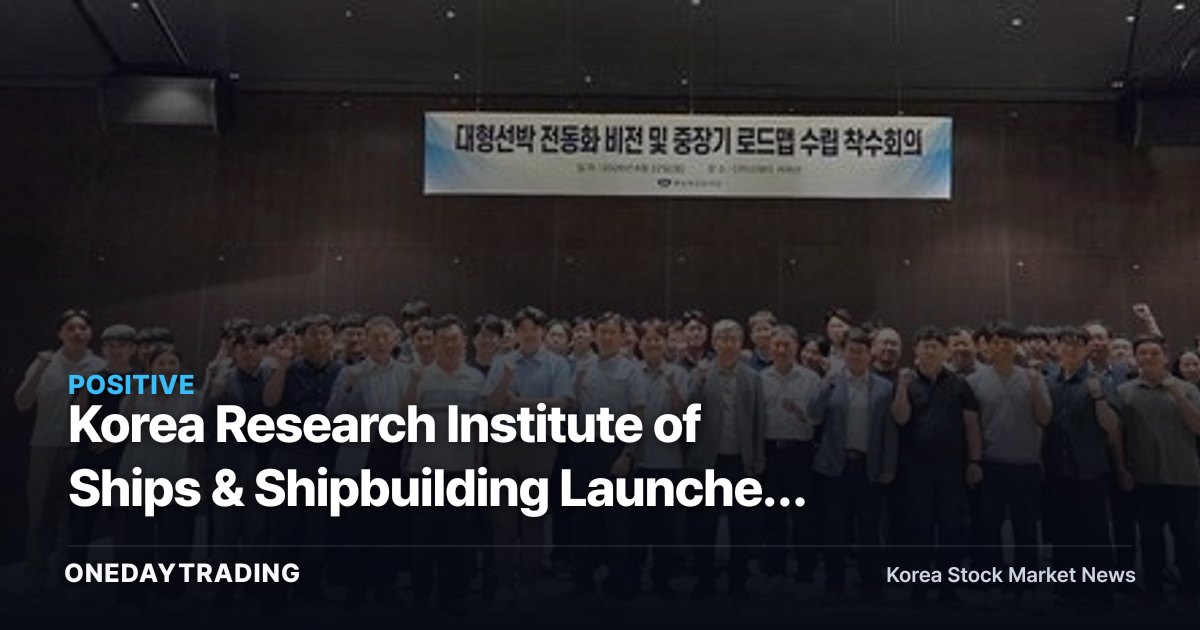
The Korea Research Institute of Ships & Shipbuilding has begun drawing up a mid-to-long-term roadmap aimed at developing core electrification technologies for large vessels and building a demonstration framework. Because it is designed to establish technical standards and demonstration infrastructure together — rather than as a one-off project — it reads as a signal of how fast Korea's shipbuilding, marine-equipment, and battery industries will shift toward eco-friendly vessels.
While its character is more about laying a mid-to-long-term business foundation than generating immediate order momentum, electrification is a variable that could reshape the mix of vessel types ordered going forward as well as the equipment value chain, leaving room for it to act as a gradual positive catalyst for related listed companies.
What Happened
The Korea Research Institute of Ships & Shipbuilding has started formulating a mid-to-long-term roadmap centered on developing core electrification technologies for large vessels and building a demonstration framework to validate them. Electric-propulsion ships are vessels that replace or supplement the conventional diesel- and heavy-fuel-oil-based propulsion system with electric motors, batteries, and power management systems.
Until now, electric propulsion has been applied mainly to small and mid-sized coastal and government vessels, but the significance of this roadmap lies in broadening its scope to large ships. Large vessels require far greater output and operating range, making battery capacity, high-voltage power conversion, and safety validation much more demanding — so both the technical difficulty and the barriers to entry are high.
The inclusion of a demonstration framework is also worth noting. Order decisions by shipowners and classification societies hinge on full-scale ship validation and standards being in place, so demonstration infrastructure serves to open the path to commercialization.
Background and Context
As the International Maritime Organization's (IMO) greenhouse-gas reduction rules tighten in stages, the center of gravity in shipbuilding is shifting from simple construction competition to competition over eco-friendly propulsion technology. Following LNG-, methanol-, and ammonia-powered vessels, electric propulsion is forming yet another axis, centered on short-range and special-purpose vessel types.
Since Korea's shipbuilding industry has secured competitiveness in high-value eco-friendly vessels, internalizing electrification technology could become a means of differentiation that avoids low-price competition with China and raises unit prices. That said, the fact that the large electric-propulsion vessel market itself is still in its early stages is a clear limitation.
Impact on the Market and Stocks
- Major shipbuilders: HD Hyundai Heavy Industries, Samsung Heavy Industries, and Hanwha Ocean are directly involved in diversifying eco-friendly propulsion vessel types. Securing electrification technology ties directly to competitiveness in winning high-priced ship orders, making it a card to defend profitability over the mid to long term.
- Marine electrical and power equipment: Electric propulsion boosts demand for power conversion, distribution, and power management systems. Marine electrical and heavy-electric firms such as HD Hyundai Electric can target component-supply opportunities in ship electrification.
- Battery cells: Samsung SDI and LG Energy Solution would be beneficiaries should large-capacity marine batteries emerge as a new downstream market. However, because marine applications carry stringent certification and safety requirements, the pace of entry may be gradual.
- Equipment and demonstration partners: Once standards and demonstration infrastructure are in place, small and mid-sized equipment firms will have opportunities to join the supply chain. Participation in the roadmap could be a turning point.
Checkpoints for Investors
- Watch for when the roadmap's concrete schedule, budget, and linkage to government projects are disclosed. The key is whether it is an abstract declaration or has reached the actual-execution stage.
- Check major shipbuilders' share of eco-friendly vessel orders and the trend in ship prices through quarterly earnings and order disclosures.
- Track commercialization milestones such as the delivery of demonstration vessels or pilot-voyage announcements related to marine batteries and power equipment.
- Also watch how the IMO's and Korea's environmental regulation timelines, along with subsidy and support policy decisions, affect ordering incentives.
Outlook
The structural trend of tightening regulations and an expanding range of eco-friendly vessel types is favorable to electrification technology. If standards and demonstrations take hold, Korea's shipbuilding, equipment, and battery value chain could secure new downstream demand. On the other hand, large electric-propulsion vessels face high technological and cost barriers and the market remains small, so it is hard to view this roadmap as leading directly to near-term earnings or orders. The time lag until commercialization and the valuation burden when expectations for related stocks run ahead are risks that must be weighed together.
HD Hyundai Heavy Industries by Real-Time Data
HD Hyundai Heavy Industries' latest closing price is 588,000 won (-7.55% from the previous day), and the traffic-light signal — combining foreign and institutional supply-demand (order flow) with news and momentum — is 🟡 Neutral · Wait-and-See. With positive and negative signals mixed, it is a zone to watch.
- ▲ Order-flow continuity — Foreign investors net buyers for 5 straight days (+4.53 billion won)
- ▼ Trend alignment — Short- and mid-term downward alignment (today -7.5% · 1 week -15.8% · 1 month -12.5%)
Recent related news is favorable, with 4 positive catalysts · 3 negative catalysts.
※ Price and foreign/institutional supply-demand (order flow) data are provided by Korea Investment & Securities (KIS), as of the time of publication.
This article is content automatically summarized and analyzed based on the original news report. View original (Yonhap News, Industry)