
At a Glance
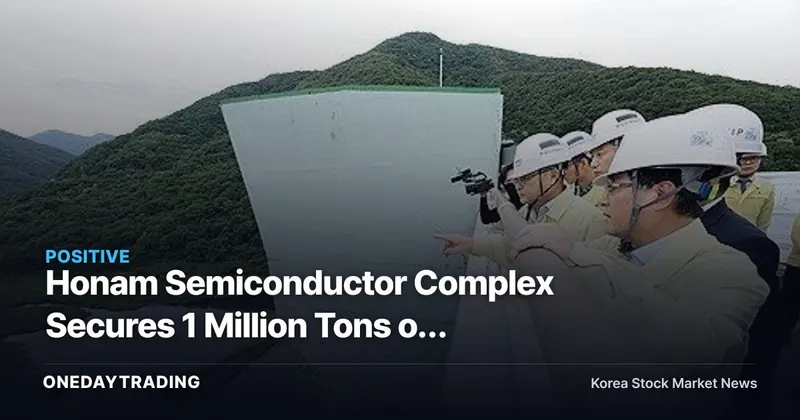
The government has stated it can secure 1 million tons of industrial water per day, addressing the water supply shortage that has been a persistent obstacle for the Gwangju-Jeonnam semiconductor industrial complex. With the key bottleneck in cluster development now potentially cleared at the administrative level, the prospect of a viable cluster could serve as a positive catalyst for ultra-pure water (UPW) and water treatment infrastructure stocks, as well as the broader value chain of semiconductor partners in the Honam region.
Why This Matters Now
Semiconductor fabs are among the most water-intensive industries, consuming massive quantities of ultra-pure water (UPW) for wafer cleaning. A single advanced fab can use as much water as a city of hundreds of thousands, making water supply capacity — alongside power — a fundamental prerequisite for site selection. This is precisely why concerns about inadequate water supply for the Honam complex have been raised repeatedly.
The government's declaration that 1 million tons per day can be secured reads as a signal intended to reduce one axis of uncertainty surrounding the cluster's development. However, this remains an administrative assessment of feasibility; actual water intake source acquisition, pipeline construction, budget allocation, and environmental review must all proceed on schedule before investment can be committed. Investors should be careful to distinguish between a policy statement and the actual breaking of ground or issuance of orders.
If the premise that the water issue has been resolved solidifies, it would provide momentum for the complex itself, which could then ripple outward in stages — through civil engineering and water infrastructure procurement, and into attracting back-end process, materials, and components suppliers. Conversely, if regional or inter-ministerial disagreements over how to secure water and allocate costs intensify, there remains a real risk of schedule delays.
Frequently Asked Questions
- Why is water so critical for semiconductors? Ultra-pure water free of contaminants is required in large volumes for wafer cleaning and cooling — without a stable supply, fab operations simply cannot function.
- Is the 1 million ton figure confirmed? This is the government's stated position on feasibility only. Water intake sourcing, pipeline routing, budget allocation, and environmental review still lie ahead before actual supply can be guaranteed.
- Which companies would move first? Infrastructure firms capable of supplying UPW and water treatment equipment and filters, as well as those handling civil engineering and pipeline construction for the complex, are cited as the primary beneficiary candidates.
- Is this a direct positive catalyst for large-cap semiconductor stocks? It remains indirect until the companies investing in and occupying the complex are identified. Supply chain and materials/components/equipment stocks may react more quickly.
Impact on Related Stocks and Sectors
- UPW and water treatment filters Companies handling semiconductor-grade UPW and industrial filters stand to benefit directly, as consumables demand will recur repeatedly once the complex is operational.
- Plant and environmental engineering Increased procurement of UPW production systems and wastewater recycling facilities would expand order opportunities for firms with water treatment EPC capabilities.
- Construction and civil engineering Pipeline work from water intake sources to the complex, water infrastructure, and site preparation civil works could flow to regional construction firms.
- Semiconductor materials, components, and equipment As the cluster takes shape, back-end process partners and materials and components suppliers will build expectations around tenancy and supply contracts — though this requires confirmation of which anchor firms will occupy the site.
- Regional industry broadly Once the complex is on track, associated infrastructure demand for power, logistics, and workforce will grow in tandem.
Key Investment Considerations
- There is a significant lag between a government statement on feasibility and actual budget allocation and groundbreaking. Earnings do not materialize on statements alone.
- Investors should also weigh risks of schedule delays stemming from variables such as cost-sharing arrangements for water supply, environmental impact assessments, and local public opinion.
- Water treatment and infrastructure theme stocks carry high volatility due to front-loaded expectation pricing — distinguish between valuation risk and the substance of actual order announcements.
- Until the firms occupying the complex and the scale of investment are confirmed, the degree of benefit for individual stocks remains uncertain.
Overall Outlook
On the optimistic side, clearing the water supply bottleneck at the administrative level could inject momentum into the Honam semiconductor cluster drive, setting UPW, water treatment, and civil infrastructure on a path toward entering a procurement cycle in stages. On the other hand, if negotiations over water intake methods, costs, and environmental approvals drag on, the conversion of policy statements into actual investment could be delayed. From an investment standpoint, a measured approach — monitoring the next concrete milestones such as water project budget inclusion, announcements of tenant companies, and water treatment and pipeline order disclosures in sequence — is the rational way to close the gap between expectation and reality.
본 글은 원문 뉴스를 바탕으로 자동 요약·분석된 콘텐츠입니다. 원문 보기 (연합뉴스 산업)