
Summary
Lee Do-yun, OnedayTrading Editorial Board
Doosan Fuel Cell's problem isn't that demand for hydrogen fuel cells has disappeared. Expectations for PAFC supply to U.S. data centers remain intact, but the current stock price has been pricing in unconfirmed volume rather than actual order backlog.
This is exactly where NH Investment & Securities' target price cut comes from. Without confirmation of order size, the path from utilization rates to revenue recognition to margin improvement breaks down.
The Full Story
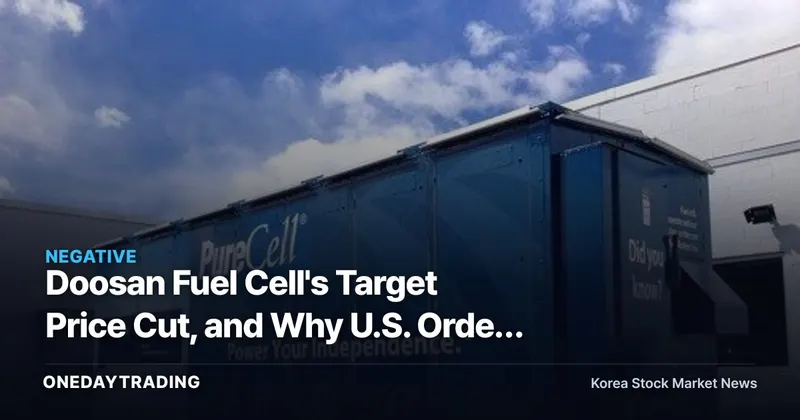
On the 28th, NH Investment & Securities lowered its target price for Doosan Fuel Cell, citing growing uncertainty over order size. Earlier, in May, the same brokerage had set a target price of 80,000 won for Doosan Fuel Cell but kept its investment rating at Hold. It acknowledged the possibility of fuel cell sales to U.S. data centers, but judged that a significant portion of that expectation was already reflected in the current stock price.
Market expectations grew quickly. In May, Doosan Fuel Cell disclosed a fuel cell system supply contract with Samchully ES worth 52.9 billion won, equivalent to 20.28% of its recent revenue of 260.9 billion won. As a domestic supply contract for a roughly 17MW-class fuel cell power plant, it eased concerns about a gap in new orders.
The problem is that the domestic 17MW contract and a large-scale U.S. data center order are fundamentally different in nature. The U.S. market represents an opportunity shaped by power shortages, AI data center expansion, and demand for rapid installation. But without clarity on the actual contracted MW, delivery schedule, and pricing terms, there is insufficient basis to raise earnings estimates.
Structural Background
For fuel cell stocks, order backlog drives utilization rates, utilization rates lower the fixed-cost burden, and only then does margin move. Doosan Fuel Cell's business consists of power-generation fuel cell equipment and long-term maintenance services. It takes time for new orders to be recognized as core equipment revenue, and when SOFC mass production ramps up alongside depreciation burdens, profitability can waver even before top-line growth materializes.
U.S. data center power demand is a clear long-term trend. The longer grid interconnection delays persist, the more bargaining power alternative power sources such as distributed generation, fuel cells, and gas engines gain. That said, while PAFC has strengths in waste-heat utilization and combined heat and power, it must compete with SOFC on generation efficiency alone. The investment case for Doosan Fuel Cell needs to be validated not through a single technological edge, but through a combination of delivery lead time, installation convenience, heat utilization, and pricing terms.
Impact on the Stock and Industry Sector
- Doosan Fuel Cell: The key variable is the actual contracted MW for the U.S.-bound deal. Expectations alone cannot sustain the valuation, but if an order is confirmed, a recovery in utilization and an increase in core equipment revenue could be reflected at the same time.
- Doosan Enerbility: This supports the Doosan Group's broader power-infrastructure narrative, but order-specific uncertainty at Doosan Fuel Cell could act as a pacing factor for the group's overall power theme.
- Vinatech: Interest in the fuel cell materials and components value chain remains intact. However, order expectations for component suppliers will only translate into concrete numbers once the system maker's contract size is confirmed.
- Hydrogen fuel cell industry sector: The AI data center power crunch opens up medium- to long-term demand. However, once a theme-driven rally has run its course, the pace of order disclosures and earnings reflection is what separates individual stock (ticker) performance within the sector.
Bull vs. Bear Scenarios
The bull scenario involves the initial U.S. data center supply quickly converting into a formal contract. If an initial order of around 20MW is confirmed along with additional options attached, the market could interpret it not as a one-off deal but as the start of a capacity-expansion cycle. In this case, the key is not revenue itself but recurring orders.
The bear scenario involves prolonged negotiations and a contract size smaller than the market expects. Since the stock price has already moved on the possibility of a large-scale data center order, delays in securing that order could trigger multiple compression. If falling fuel cell prices, SOFC depreciation, and low utilization all persist together, profitability improvement will lag behind top-line growth.
Investor Action Points
- Investors should check the next disclosure for the U.S.-bound order's MW, contract value, and delivery timeline separately. Volume matters more than the headline.
- In quarterly earnings, watch the share of core equipment revenue and whether the operating loss is narrowing. Maintenance revenue alone won't be enough to drive a re-rating.
- Keep an eye on the results of domestic general-hydrogen bidding and the pace of project financing. Domestic volume provides downside support, but it's overseas orders that open up upside for the valuation.
- Also monitor the delivery lead times and pricing terms of competing SOFC makers. The data center power market isn't a hydrogen theme play — it's a competition among power sources that can actually deliver supply.
Doosan Fuel Cell: Real-Time Data Snapshot
Doosan Fuel Cell's most recent closing price was 28,650 won (-4.50% from the previous day), and the composite signal combining foreign/institutional supply-demand (order flow) with news and momentum reads 🔴 Caution. With foreign investors, institutional investors, and momentum all negative, caution is warranted at this time.
- ▼ Supply-Demand (Order Flow) Continuity — Foreign investors net sold for a third straight day (−15.5 billion won)
- ▼ Combined Selling — Foreign investors −15.5 billion won and institutional investors −11.9 billion won selling in tandem
- ▼ Trend Alignment — Short- and medium-term downtrend alignment (day -4.5% · 1 week -26.5% · 1 month -50.3%)
- ▼ 52-Week Range Position — Near the 52-week low, at the 8th percentile
※ Price and foreign/institutional supply-demand (order flow) data are provided by Korea Investment & Securities (KIS) and reflect conditions as of the time of publication.
This article was automatically summarized and analyzed based on the original news report. View original (Yonhap News, Securities)