
Key Takeaways
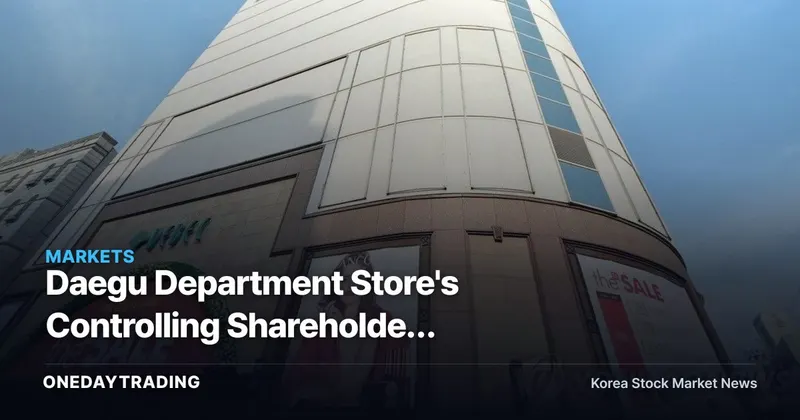
The largest shareholder of Daegu Department Store, long known as the last local department store in Daegu, has been replaced by an investment-related firm. On the surface, this looks like a simple change in shareholding, but underneath it lies two distinct implications: the structural decline of regional department store retailing, and a potential re-rating of real estate asset value. Whether the company continues operating as a department store or repurposes its landholdings will determine two entirely different paths for the stock and the business.
What Happened
Daegu Department Store is the last retailer in the Daegu region to have kept the local department store banner alive. Control has now passed to an investment-related firm, changing the company's governance structure. Taken at face value, the announcement reads as a routine disclosure of a change in the largest shareholder. However, in the retail industry, when the largest shareholder shifts from a department store operator to an investment-purpose entity, it is typically interpreted in one of two ways: either the new owner intends to revive the store network and goodwill for a turnaround, or it is focused on the asset value of the prime downtown land and buildings the company holds.
Either way, what investors need to verify is not the wording of the press release but the follow-up disclosures. The key question is whether the acquiring party announces plans to maintain retail operations, or instead signals a path toward asset re-valuation, sale, or repurposing. In many cases, the store-level revenue and operating profit of regional department stores alone cannot explain the logic behind this kind of equity transaction.
Background and Context
Regional department store retailing has faced a dual squeeze in recent years. The spread of online shopping has reduced offline foot traffic, while large Seoul-based retailers' expansion into regional markets and the growth of complex shopping malls have eroded local market share. In regional cities with pronounced population decline, it becomes especially difficult to sustain both spending per visit and visit frequency. Against this backdrop, cases in which control of long-standing local department stores passes to investment-related firms rather than core retail operators have been a recurring pattern in the industry.
Impact on the Market and Related Stocks (Tickers)
- Daegu Department Store — As the direct party to the change in the largest shareholder, this stock (ticker) faces the greatest share price volatility depending on whether a future business plan is announced.
- Shinsegae, Lotte Shopping — If the competitive landscape within the Daegu retail market shifts, nearby stores could see changes in the distribution of foot traffic.
- Regional retail and REIT-related stocks (tickers) — If this case leads to a broader re-rating of asset value, the market's valuation yardstick for other regional retailers holding similarly aging stores could shift in tandem.
- Local commercial leasing and real estate development companies — Should land repurposing become a reality, participation in the related development project could draw investor interest.
Investor Checkpoints
- Review the original disclosure specifying the new largest shareholder's equity stake and stated purpose for the acquisition
- Watch for the timing of any announcement on whether department store operations will continue, or whether asset sale/repurposing plans will be unveiled
- Track how revenue and operating profit trends shift in the next quarter's earnings, before and after the ownership change
- Monitor whether financial regulators and the exchange require follow-up filings or inquiry disclosures related to the change in the largest shareholder
Outlook
In the optimistic scenario, the new largest shareholder revives the brand and store network with a renewal strategy tailored to the local market. In this case, the symbolic value of being a local department store could be reinterpreted as a marketing asset. Conversely, if the investment purpose centers on realizing asset value, department store operations could be scaled back as real estate utilization takes priority. Since neither scenario has been confirmed through an official business plan yet, it would be risky to predict the direction based on share price movement alone, without further disclosures.
Daegu Department Store: A Look at the Real-Time Data
Daegu Department Store's most recent closing price was 5,870 won (up 5.96% from the previous session), and the signal combining foreign investor/institutional investor supply-demand (order flow) with news and momentum is 🟡 neutral / wait-and-see. With positive and negative signals mixed, this is a stock (ticker) to watch closely.
- ▲ Trend Alignment — Short- and medium-term trends aligned to the upside (intraday +6.0% · 1-week +62.2% · 1-month +29.3%)
※ Price and foreign/institutional investor supply-demand (order flow) data are provided by Korea Investment & Securities (KIS) and reflect figures as of the time of publication.
This article was automatically summarized and analyzed based on the original news report. View original article (Yonhap News Agency, Securities)