
At a Glance
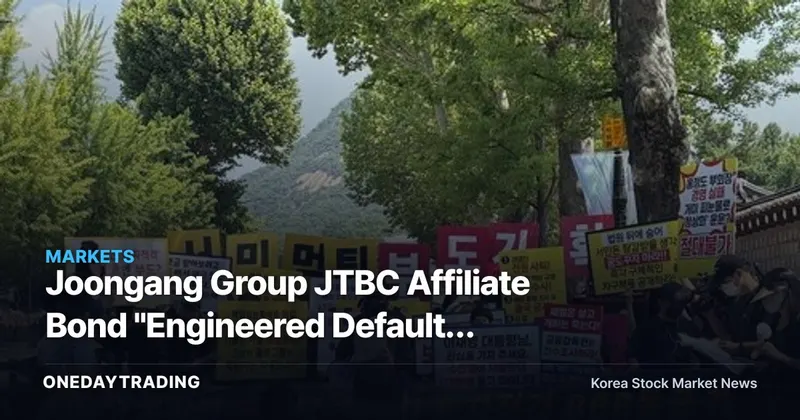
Retail investors who purchased bonds issued by Joongang Group affiliates — including JTBC — have announced plans to file a petition with the presidential office and other authorities, alleging a suspected engineered default and demanding a thorough investigation. Unlike listed equities, corporate bonds and private placement bonds issued by unlisted companies offer little transparency in pricing and recovery procedures, making this case more than an isolated group dispute — it serves as a broader warning for retail investors engaged in private credit investing.
Why This Matters Now
The primary concern for investors here is not a particular stock (ticker)'s share price, but rather the recoverability of retail funds exposed to bonds issued by unlisted companies. Neither Joongang Group nor JTBC is listed on any exchange, meaning their financial health is not continuously priced by the market. This makes it structurally difficult for distress signals to be reflected in prices in advance — losses only become apparent after events such as missed maturities or interest payment defaults.
The core allegation raised by bondholders — framing this as an engineered default and a scheme to defraud ordinary investors — is that the company intentionally pursued default proceedings despite having the capacity to repay, thereby shifting losses onto retail bondholders. For this claim to hold, key facts must be established: evidence of asset transfers, the priority of claims in repayment, and whether collateral was properly secured. While petitions and investigations are ongoing, bond recovery is effectively frozen; the longer legal proceedings drag on, the more uncertain both the recovery rate and recovery timeline become.
At the macro level, this case connects to a broader trend: the risks embedded in retail capital that flowed into unlisted bonds and private placements during a period of elevated interest rates — chasing higher nominal yields — are now coming to the surface. This dispute serves as a timely reminder that a high coupon rate can itself be a signal of elevated credit risk on the part of the issuer.
Frequently Asked Questions
- Does this news have a direct impact on listed stocks? Since Joongang Group and JTBC are unlisted, there are no listed stocks (tickers) directly linked to this situation. However, it may affect market sentiment toward private credit investments overall.
- What is an engineered default? The term refers to allegations that a company deliberately triggered a default despite having the capacity to repay, thereby offloading losses onto creditors. Whether this actually occurred must be determined through investigation.
- Can retail investors recover the corporate bonds they purchased? Recovery depends on the presence of collateral, repayment priority, and remaining assets. If legal disputes are prolonged, both the recovery rate and timing become highly uncertain.
- How do these differ from listed bonds? Unlisted and private placement bonds have no continuously quoted market price, meaning distress is only revealed after the fact, and liquidity is significantly lower.
Related Stocks and Industry Sector Impact
- Media and Broadcasting Industry Sector: While the Joongang Group case is an individual dispute, it may raise the bar for how the market scrutinizes the financial health of media companies exposed to a softening advertising cycle.
- Securities and Credit Rating Firms: If scrutiny falls on private bond underwriting and distribution practices, as well as suitability obligations for retail sales, firms with a heavy concentration in unlisted credit products will face heightened regulatory and reputational risk that warrants close monitoring.
- High-Yield Private Product Distribution Channels: Across distributors that marketed unlisted bonds to retail investors, the prospect of tightened regulatory oversight around suitability principles and disclosure obligations is a key variable to watch.
- Listed Bond ETFs and Investment-Grade Corporate Bonds: Should aversion to opaque private credit intensify, a relative flight-to-quality into more transparently priced listed bonds could become more pronounced.
Key Investment Considerations
- Unlisted and private placement bonds offering coupon rates materially above prevailing market levels may carry commensurately higher embedded credit risk — always verify the issuer's cash flow position and debt structure first.
- Without reviewing collateral, repayment priority, and guarantee structure at the contract level, investors risk being subordinated in any default recovery process.
- This matter is currently at the investigation and litigation stage; recovery rates cannot be determined before the proceedings conclude. Track the petition filing, investigation and trial schedule, and any asset preservation orders as follow-on indicators.
- Do not generalize this individual dispute into a sector-wide negative catalyst for the media industry sector. For listed companies, assess credit quality separately using publicly disclosed financial statements and credit ratings.
Overall Outlook
If the investigation proceeds swiftly and asset preservation and repayment procedures operate normally, partial recovery for retail bondholders is possible — along with the institutional byproduct of improved sales practices in the private credit market. In the adverse scenario, prolonged legal proceedings delay the recovery timeline, retail investor market sentiment toward unlisted high-yield bonds deteriorates, and the associated primary issuance market risks a meaningful cooldown. Given the limited direct link to any listed stock (ticker), investors would be well-served to treat this case not as a specific share-price catalyst, but as a risk-check signal for unlisted private credit investing overall.
This content was automatically summarized and analyzed based on the original news article. View original article (Yonhap News Industry)