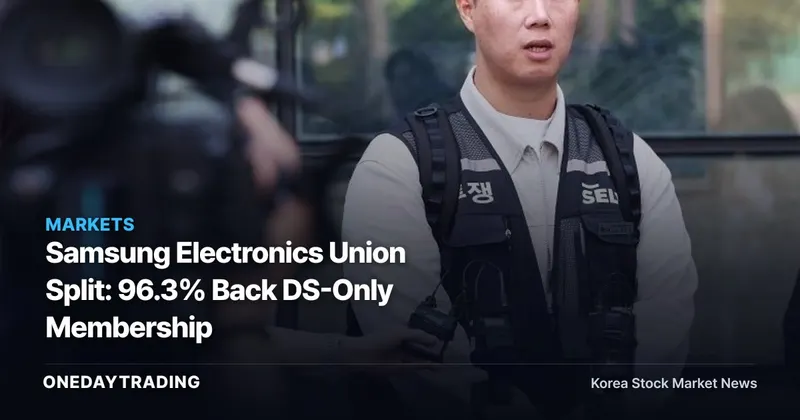

What Samsung Electronics’ Union Restructuring Means for Investors
The Samsung Electronics chapter of the Samsung Supra-Enterprise Union is becoming an organization open only to employees in the DS (semiconductor) division, separating the structure that had coordinated DS and DX interests within a single union. According to a Sept. 20 report by Maeil Business Newspaper’s corporate news desk, both the proposed bylaws amendment and no-confidence motions against DX division officials passed votes at the general meeting. The immediate takeaway for investors is not a change in the share price or earnings, but a shift in the scope of representation for wage negotiations and collective bargaining.
The union’s restructuring highlights the difficulty of combining demands from the semiconductor business and set businesses such as mobile devices, TVs, and home appliances into a single proposal. However, the materials do not quantify the impact of this change on Samsung Electronics’ cost structure or operating profit. It is therefore more accurate to view the development as a procedural variable affecting which division represents which issues in future wage negotiations, rather than immediately linking it to the direction of earnings.
Membership Scope Changed by Bylaws Amendment
At the fifth general meeting of 2026, 27,618 of the 28,680 members who voted approved a proposal limiting eligibility to join the supra-enterprise union to employees in the DS division. The approval rate was 96.3%. The union, which previously represented employees across both the DS and DX divisions, will now become a DS-only union.
The supra-enterprise union said it would “accept semiconductor employees only.” Under the bylaws, this language refers to a change in membership eligibility. The specific effective date and the number of existing DX employees who will be required to leave have not been confirmed. Until those figures are disclosed, there is no basis for calculating how much the organization will shrink or be reshaped.
No-Confidence Votes Against DX Officials and Dispute Over Responsibility
Tensions between DS and DX surfaced alongside calls for an N% performance bonus during Samsung Electronics’ wage negotiations in May. No-confidence motions against Vice Chair Lee Song-yi and Gwangju Branch Head Lee Won-il, both from the DX division, passed with approval rates of 95.7% and 96.2%, respectively.
The vote results show that the two officials’ positions within the organization have changed, but the parties disagree over the reasons for the no-confidence motions. The supra-enterprise union has said it introduced the motions because it believed the two officials had tipped off outside parties about a contract for supplies used to prepare a rally related to Chair Choi Seung-ho. It also alleged that the two discussed a plan to remove the chair to prevent a DS-focused restructuring of the organization. The materials do not indicate whether either allegation has been conclusively established.
Donghaeng Union Is Also Splitting Within DX
Samsung Electronics’ Donghaeng Union, which is composed mainly of DX division employees, suspended the duties of branch heads nationwide on Sept. 18 and issued notices of planned disciplinary action, including dismissal and expulsion, to its secretary-general and some delegates. The Donghaeng Union will hold its next chair election from Sept. 21 to 28.
Ahead of the election, allegations emerged that some candidates had failed to pay union dues and had not met minimum eligibility periods, while disagreements over the application of election rules led to disciplinary proceedings. The suspended officials filed a petition with the Ministry of Employment and Labor on Sept. 17 concerning the acting chair’s management of the union. Those notified of planned disciplinary action are also reportedly preparing responses, including seeking an injunction against the acting chair.
How the Development Could Affect Samsung Electronics’ Shares and Business
- Bargaining representation: If the DS union and the DX-focused Donghaeng Union submit different demands, wage and benefits negotiations could be conducted through separate channels. However, no negotiation outcomes or increases or decreases in costs have yet been announced.
- Differences in divisional interests: DS comprises the semiconductor business, while DX includes mobile devices, TVs, and home appliances. As demands over divisional performance and compensation standards diverge, a unified message from a joint union may weaken, but any actual change in bargaining power must be assessed through subsequent proceedings.
- Samsung Electronics stock: Currently disclosed facts provide no figures on total wages or production disruptions that would justify adjusting earnings forecasts or valuation. Share-price assessments should consider future negotiations and business operating indicators, not merely the union restructuring itself.
Risks for Investors to Monitor
- The specific effective date of the supra-enterprise union’s bylaws amendment has not been disclosed, leaving the timing of the membership eligibility change unclear.
- The number of DX employees required to leave has not been confirmed, preventing an assessment of changes in the organization’s size and bargaining representation.
- Until the result of the Donghaeng Union’s Sept. 21–28 chair election is known, it will be difficult to determine the future direction of the DX division’s union.
- The duration of the internal dispute may depend on how the suspended officials’ petition to the Ministry of Employment and Labor and their subsequent responses are resolved.
Next Indicators to Watch and the Bottom Line
Samsung Electronics investors should monitor, in order, the announcement of the bylaws’ effective date, the number of departing DX employees, the result of the Donghaeng Union chair election, and how each division presents its demands in the next wage negotiations. If bargaining proceeds smoothly after the union split, the impact on the business may be limited. The assessment would change, however, if the dispute becomes prolonged and develops into production or workforce-management issues. The key question at this stage is whether the organizational declaration to “accept semiconductor employees only” translates into measurable earnings effects.
Samsung Electronics Key MetricsAs of 2026-09-21
| Period Return | 1 Week +0.19% 1 Month -4.06% |
|---|---|
| Trading Value · Trading Volume | 70.9 billion won · 24,067,181 shares |
| Supply-Demand (Order Flow) | Foreign Investors Net selling of 367.3 billion won (8 consecutive days) Institutional Investors Net buying of 836.5 billion won |
| Recent News Tone | 1 Positive Catalyst · 1 Negative Catalyst |
Price and supply-demand (order flow) data are real-time figures from Korea Investment & Securities (KIS), while supply-demand (order flow) and news-tone tallies are calculated independently by OneDayTrading.
Supply-Demand (Order Flow) and Momentum Assessment🟡 Neutral·Wait and See
Positive and negative signals are mixed, warranting a wait-and-see approach.
- ▼Supply-Demand (Order Flow) TrendForeign investors posted net selling for 8 consecutive days (−367.3 billion won)
Upcoming Dates to Watch
- 10.08Index Options ExpirationLowKOSPI 200 options expiration
- 10.22Bank of Korea Monetary Policy BoardHighBenchmark interest rate decision meeting
- 10.28FOMC Policy Rate DecisionHighU.S. Federal Reserve monetary policy announcement — direction of interest rates and the dollar
- 11.12Index Options ExpirationLowKOSPI 200 options expiration
This article was automatically summarized and analyzed based on the original news report. View the original article (Maeil Business Newspaper—Companies)