
Key Takeaways
A humanoid refers to the human-shaped hardware itself, while physical AI denotes the software and computational intelligence that enables a robot to perceive the physical world and make autonomous decisions. This distinction is more than a terminology exercise — it is the dividing line that determines which companies capture real value within the robotics theme.
From an investor's perspective, companies that control training data, simulation platforms, and inference chips sit at the critical chokepoint of profitability — ahead of those with mere hardware assembly capabilities. Even among robotics stocks (tickers), the valuation logic differs significantly depending on what a company actually sells.
What Is Happening
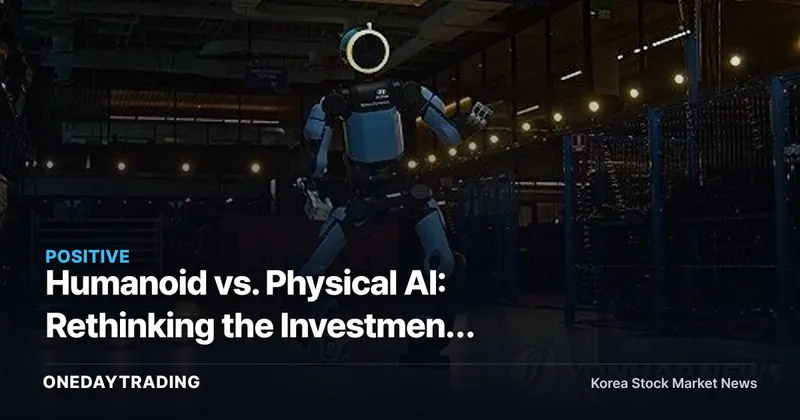
As bipedal, arm-equipped humanoid robots have moved into the spotlight, the terms "humanoid" and "physical AI" have increasingly been used interchangeably. However, the two operate at different layers. A humanoid is the physical body — composed of legs, joints, and actuators — while physical AI is the intelligence layer that interprets input from cameras and sensors to determine the next action.
Physical AI applies equally to autonomous vehicles, logistics robots, and collaborative robotic arms — not just humanoids. In other words, the humanoid is merely one vessel in which physical AI is implemented, and the real competition in the market is taking place inside the brain, not the body.
This concept is directly tied to simulation-based learning — training robots through countless iterations in virtual environments before transferring behavior to physical machines — as well as large-scale inference computing. The result is a structure where data and computational infrastructure, rather than hardware form factor, constitute the true barriers to entry.
Background and Context
The robotics industry was long the domain of precision mechanical engineering, but since the advent of generative AI, the center of gravity has shifted toward trained models that generate motion. Converging labor shortages and demand for manufacturing automation have positioned humanoids as viable substitutes on factory floors and in logistics facilities.
That said, real-world constraints — mass-production unit costs, safety certification, and battery runtime — remain substantial. The gap between the conceptual appeal and the actual pace of commercialization should not be overlooked.
Market and Stock (Ticker) Implications
- NVIDIA: Simultaneously supplying the simulation platform for physical AI training and the inference chips that power it, NVIDIA is structurally positioned to benefit as computing demand grows in lockstep with the number of robot body manufacturers.
- Tesla: Attempting to extend real-world data and chip design capabilities — accumulated through its own humanoid program and autonomous driving — into robotics, Tesla is one of the few players pursuing both the hardware and the intelligence layer.
- Rainbow Robotics / Doosan Robotics: Both possess domestic humanoid and collaborative robot hardware capabilities, but where and how they source or internalize the physical AI brain will ultimately determine their margins and competitive differentiation.
- Samsung Electronics (005930) / LG Electronics: Through robotics investment and integration with home appliance and manufacturing operations, both companies have channels to apply physical AI and maintain touch points on both the components and finished-robot sides of the market.
Investor Checkpoints
- When evaluating robotics stocks (tickers), first examine revenue composition: is the company selling robot bodies, learning and inference intelligence, or key components (actuators, sensors)?
- Track the timing of humanoid mass-production cost announcements and real-world deployment case studies, as well as shifts in the robotics segment's revenue share within corporate earnings reports.
- Because demand is linked to AI inference chip consumption, monitor major semiconductor companies' datacenter and robotics chip guidance in parallel.
- Stocks (tickers) where thematic expectations are already priced in carry elevated valuation risk — use actual order announcement disclosures as a filter to separate substance from hype.
Outlook
As physical AI extends its reach into autonomous driving, logistics, and manufacturing, the earnings visibility of companies controlling computational infrastructure and critical components could improve significantly. Conversely, if humanoid commercialization is delayed by certification hurdles or unit cost challenges, body-centric stocks (tickers) that have run ahead of fundamentals risk heightened volatility. Ultimately, the key task for investors is distinguishing companies that have a clear path from concept to revenue.
This article is automatically summarized and analyzed based on the original news source. View original article (Yonhap News – Industry)