
Key Takeaways
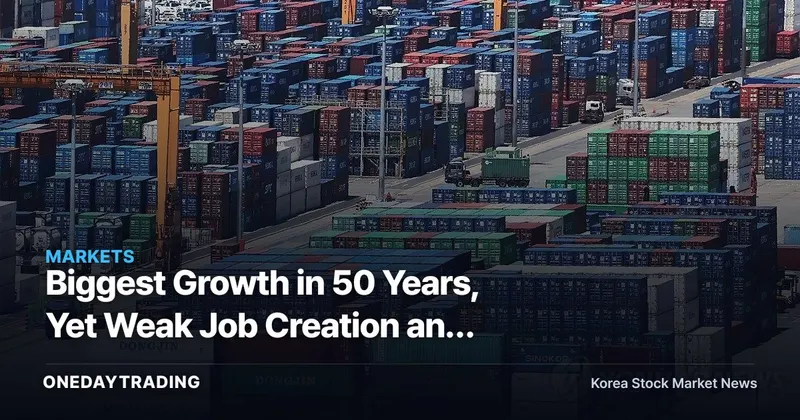
Korea's economy has logged its largest gross domestic product expansion in half a century, but beneath the headline number lies low-employment growth — expansion that isn't translating into job creation — along with polarization across income groups and industries. While the top-line figures look strong, structural challenges around the quality of growth, distribution, and volatility are becoming increasingly apparent.
What Happened
According to a newly released economic assessment, Korea's growth rate reached a level rarely seen over a long-term horizon. However, this robust growth has not sufficiently translated into job creation — a pattern often described as jobless growth.
With growth momentum concentrated in a handful of advanced export industries and large conglomerates, the spillover into domestic demand, small and mid-sized enterprises, and the services sector has been limited, the assessment notes. As a result, while aggregate indicators look favorable, the recovery in the real economy and the labor market has been slower to materialize.
At the same time, the report points to rising volatility in growth swings, a byproduct of Korea's export-driven structure, which is highly sensitive to external conditions. This means quarterly performance can swing significantly depending on the global economic cycle, the exchange rate, and the semiconductor industry cycle.
Background and Context
Korea's economy has long relied heavily on exports and manufacturing, particularly semiconductors. During boom periods, this structure drives rapid growth, but when a particular industry's cycle turns down, it becomes a weakness that drags the entire set of indicators down with it.
Combined with an aging population, expanding automation, and the capital-intensive nature of high-value-added industries, the old formula in which growth directly translated into large-scale job creation has weakened. The trend of polarization — in which the fruits of growth are increasingly concentrated among asset-holding groups and advanced industries — is closely tied to this structural shift.
Impact on Markets and Stocks (Tickers)
- Semiconductors: The core engine behind the growth surge. With large export names such as Samsung Electronics (005930) and SK Hynix (000660) driving the headline figures, KOSPI as a whole is likely to remain closely linked to swings in the industry cycle.
- Large export names: Auto and machinery exporters such as Hyundai Motor (005380) see their growth contribution diverge based on global demand and the exchange rate, with the won's movement acting as a key variable for earnings.
- Domestic demand/consumer stocks (tickers): If employment and the real economy recover slowly, earnings improvement at retail and services-related stocks (tickers) could remain limited, weighing on them amid the broader polarization.
- Financials: Bank stocks (tickers) such as KB Financial Group (105560) are exposed simultaneously to growth, interest rates, and household/corporate credit health, putting them directly in the path of macro volatility.
- Small and mid-cap stocks (tickers): If the benefits of growth remain concentrated among large corporations, small and mid-cap names could continue to be relatively left behind.
Investor Checkpoints
- Look beyond the headline growth rate — check employment data and the pace of domestic demand recovery together to assess the quality of growth.
- Keep in mind that the semiconductor cycle, export data, and exchange-rate trends are the key drivers of KOSPI volatility.
- Watch for widening earnings divergence between large exporters and domestic-demand stocks (tickers), and check your portfolio for concentration risk.
- Since quarterly growth swings can be large, focus on the underlying trend rather than overreacting to short-term data.
Outlook
Under an optimistic scenario, continued strength in key export industries such as semiconductors, combined with policy support for redistribution and employment, could gradually spread the benefits of growth into domestic demand and jobs, improving the overall quality of the indicators. In that case, KOSPI's headline growth and corporate earnings could rise in tandem.
That said, the risks are real. A global economic slowdown, a downturn in the semiconductor cycle, or sharp swings in the exchange rate and interest rates could amplify volatility inherent to Korea's export-dependent structure. If low employment and polarization go unresolved, the imbalance of a domestic economy with a weak foundation but an inflated headline could become entrenched. Investors need a balanced perspective that separates the headline scale of growth from its underlying quality.
This article was automatically summarized and analyzed based on the original news report. View original (Yonhap News Agency, Securities)