
Three-Line Briefing
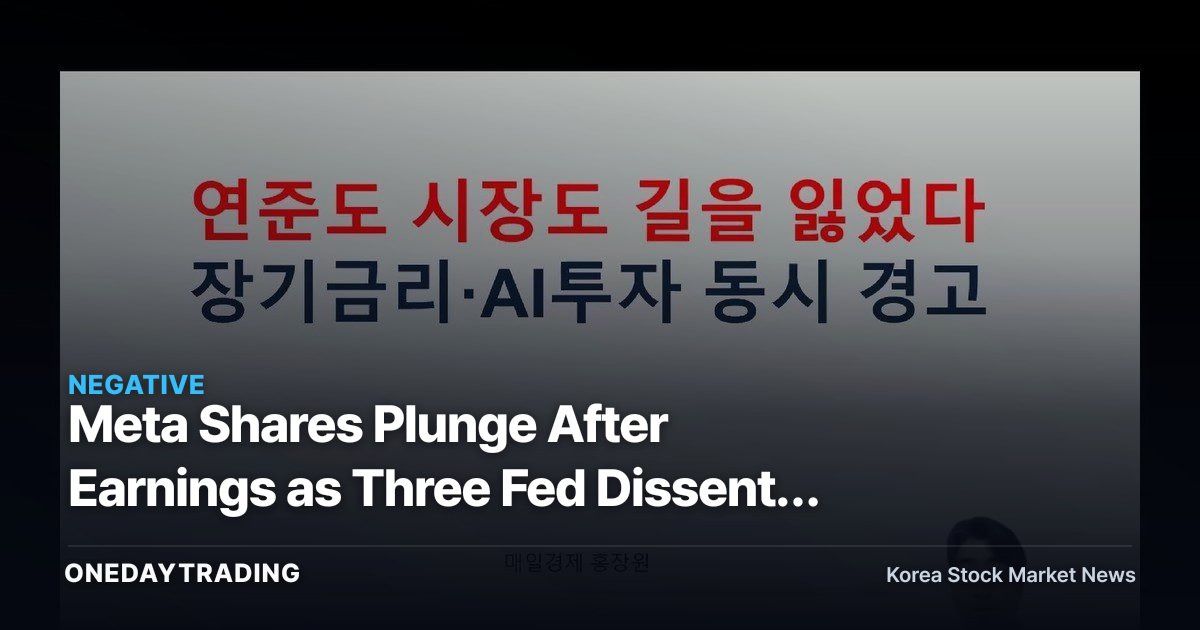
- The Fed held its benchmark interest rate steady, but three committee members dissented, breaking an unusually unanimous streak.
- Even though the rate was held steady, long-term government bond yields surged instead — the market priced in the hawkish rift more heavily than rate-cut expectations.
- Meta's shares plunged even after its earnings report, as heavy AI investment spending drew attention to thinning cash flow.
What's Changing
The decision to hold the benchmark rate steady itself was within market expectations. The real variable was hidden behind the statement. The fact that three committee members dissented signals that cracks have surfaced within the Fed over the future pace of rate cuts. The market had already priced in much of a gradual easing cycle, and when that assumption was shaken, it was long-term rates — not short-term rates — that actually moved.
Rising long-term government bond yields mean the discount rate used to translate future cash flows into today's value is rising too. When the discount rate rises, the first companies to feel it are those whose earnings are still largely ahead of them — companies pouring more money into future growth than they generate in free cash flow right now. Meta was exactly in that position. Its shares collapsed after earnings not because the income statement was weak, but because its cash position, already stretched thin from ramping up AI infrastructure investment, collided head-on with the rise in the discount rate.
In other words, this correction is not a matter of any single company's earnings — it's a valuation issue, in which cash-burning companies get repriced first whenever rates rise. The same logic applies just as directly to Korea's high-valuation growth stocks.
Numbers in Context
Three dissenting votes among Fed committee members may look small in number, but the implications are not small at all. Disagreement of this scale on a monetary policy decision is unusual, and it reads as a signal that the committee is losing consensus on the future pace of rate cuts. The market reacted more strongly to why the vote split this way than to the fact that rates were held steady, and that reaction showed up as a sharp gain in long-term yields.
Meta's situation tells a similar story. The fact that its shares collapsed despite an earnings release — typically a positive catalyst event — means investors weighed the scale of future AI investment and the resulting cash-flow pressure more heavily than this quarter's numbers. Valuation is a function of the discount rate before it's a function of earnings.
Winners and Losers
- Meta (META) — With free cash flow already thin from expanding AI infrastructure investment, the added rise in long-term rates has pushed the discount-rate burden directly onto its valuation.
- SK Hynix (000660) and Samsung Electronics (005930) — The overall direction of AI data-center investment by Big Tech, including Meta, remains intact, so the demand path for HBM and server memory still holds. However, order size and timing could be tied to Big Tech's cash-flow constraints.
- Domestic bank stocks (KB Financial Group (105560), Shinhan Financial Group (055550), etc.) — Rising long-term rates are favorable for lending margins, but they're a double-edged catalyst, since mark-to-market losses on bond holdings grow at the same time.
- High-valuation domestic internet/platform stocks (Naver (035420), Kakao (035720), etc.) — When the discount rate rises, stocks that have priced in future growth most aggressively are also the most exposed to multiple-compression pressure.
Risk Check
- Whether the three dissenting votes are a one-off disagreement or a signal of a future hawkish pivot will need to be confirmed through the next meeting's minutes and dot plot.
- If long-term rates rise further, the valuation reset could spread beyond Meta to growth stocks broadly that share its heavy cash-burn profile.
- If the point at which Meta's AI investment converts into revenue and earnings is delayed, the cash-flow burden could carry over into the next quarter.
- A rise in U.S. long-term rates is typically dollar-positive, so it could also ripple through the KRW/USD exchange rate and domestic supply-demand (order flow).
Bottom Line
It's too early to read this correction as a collapse of the AI investment narrative itself. What's happening now is a repricing that starts with cash-burning companies whenever the discount rate rises, and where it goes from here depends on the next FOMC dot plot and whether Meta's free cash flow improves next quarter.
This article is automatically summarized and analyzed based on the original news report. View original (Maeil Business Newspaper, Securities)