
3-Line Briefing
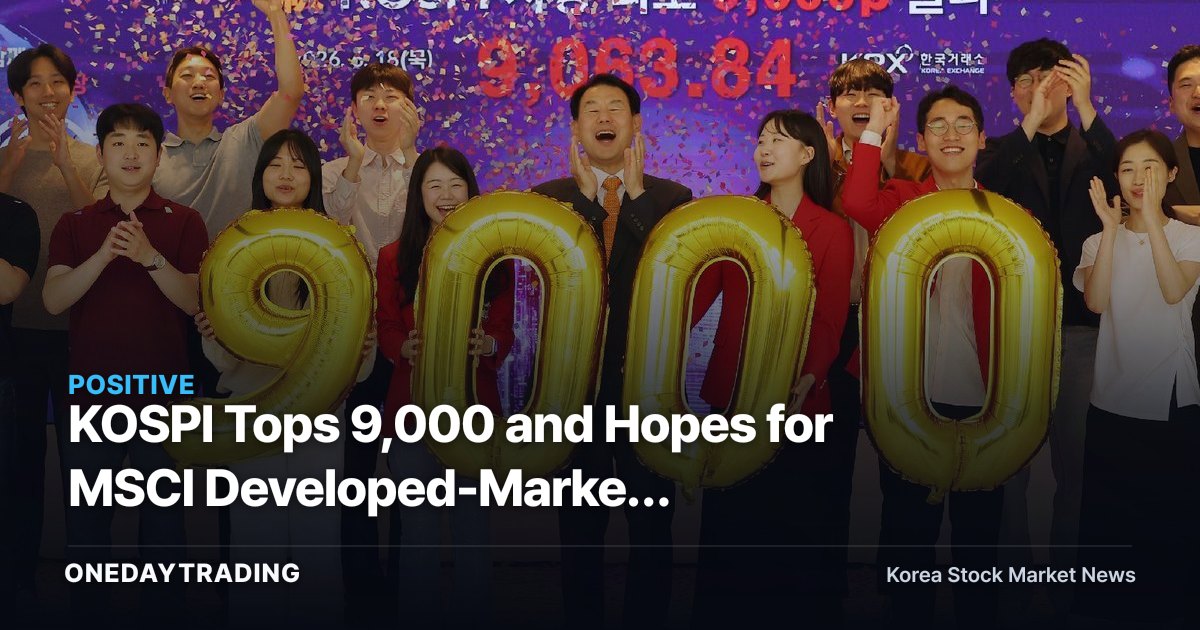
- With the KOSPI clearing the 9,000 level and bringing 10,000 points into view, more investors are looking beyond the headline index level to reassess the standing of Korea's stock market itself.
- The key variable is whether Korea is reclassified into the MSCI Developed Markets index. Shedding the emerging-market label would change the benchmark for global passive money and reshape the supply-demand (order flow) dynamics for large caps.
- That said, inclusion is not a one-off event but a multi-year process predicated on regulatory reforms in areas such as foreign exchange and short selling, so any phase that lifts valuations on expectations alone can amplify volatility.
What Changes
For investors, the essence of this issue is not that the index has climbed another notch, but that the nature of the money flowing in changes depending on which group Korea's market is classified into. Korea currently sits in the MSCI Emerging Markets (EM) index, where it carries one of the larger weightings. If it moves to the Developed Markets (DM) index, it would lose money that tracks EM but become a new inclusion target for the far larger pool of DM-tracking funds.
What matters here is how passive money works. Many global pension funds and ETFs do not pick individual stocks but mechanically allocate capital according to the composition of a benchmark index. A reclassification therefore directly affects the supply-demand (order flow) for top market-capitalization stocks with large index weightings, such as Samsung Electronics and SK hynix. Conversely, temporary selling pressure can overlap during the process of reducing the EM weighting, so the transition period can produce stretches where the same stock sees inflows and outflows pulling in opposite directions.
The hurdles are clear as well. MSCI has repeatedly flagged market-accessibility items for Korea, including restrictions on offshore conversion of the won, the way short selling is operated, and foreign investor registration and data access. Until these conditions are judged to have been met, not even the interim step of being placed on the watchlist for review is guaranteed. In other words, while the expectation itself is a positive catalyst, it needs to be viewed separately from the long timeline to actual realization.
Reading the Numbers in Context
In terms of indicators, the KOSPI's break above 9,000 is a psychological inflection point. A level that sounded unrealistic not long ago has become reality, and 10,000 points is being cited as the next target. Yet what drove that advance matters more than the index level itself. A rally accompanied by a recovery in large-cap semiconductor earnings and foreign net buying can be read as fundamentally driven, but the portion where some large caps have taken on a premium as MSCI inclusion expectations are priced in ahead of time carries the risk of a pullback should regulatory progress lag.
Stocks to Benefit or Suffer
- Samsung Electronics and SK hynix — As the most heavily weighted stocks in the index, they would most directly enjoy the effect of fresh allocations from DM-tracking passive money upon developed-market inclusion.
- Brokerage stocks (Mirae Asset Securities, Samsung Securities, etc.) — Rising trading value and broader foreign participation translate into brokerage and asset-management revenue, acting as earnings leverage across the brokerage sector as a whole.
- Large financial holding companies (KB Financial, Shinhan Financial Group, etc.) — As flagship value stocks with high foreign ownership and dividend appeal, they become a key conduit for foreign supply-demand (order flow) during a market re-rating phase.
- KOSPI 200 ETFs and index products — The stronger the expectations for an index reshuffle, the more they serve as the first destination for incoming passive money.
- Small- and mid-cap growth stocks — These cut both ways, as they could be relatively sidelined in supply-demand (order flow) terms if money concentrates in large index-constituent stocks.
Risk Check
- Developed-market inclusion is a multi-year process, and if the schedule from watchlist designation to formal inclusion is delayed, the pre-priced expectations can unwind.
- During the transition as the EM weighting is reduced, temporary selling can occur in some Korean assets, increasing short-term volatility.
- If regulatory improvements in areas such as won conversion, short selling, and foreign investor registration fail to meet the assessment criteria, the inclusion discussion itself gets pushed back.
- If global interest-rate and exchange-rate swings overlap while index-level concerns are already elevated, valuation-adjustment pressure works on both fronts at once.
Bottom Line in One Sentence
A reclassification is a structural positive catalyst with the potential to change the weight class of Korea's market supply-demand (order flow), but because realization is far off and hinges on regulatory variables, the sensible approach during a phase of pre-priced expectations is to separately verify large-cap supply-demand (order flow) and the timeline of regulatory progress.
This article is content automatically summarized and analyzed based on the original news report. View original (Maeil Business Newspaper, Securities)