
3-Line Briefing
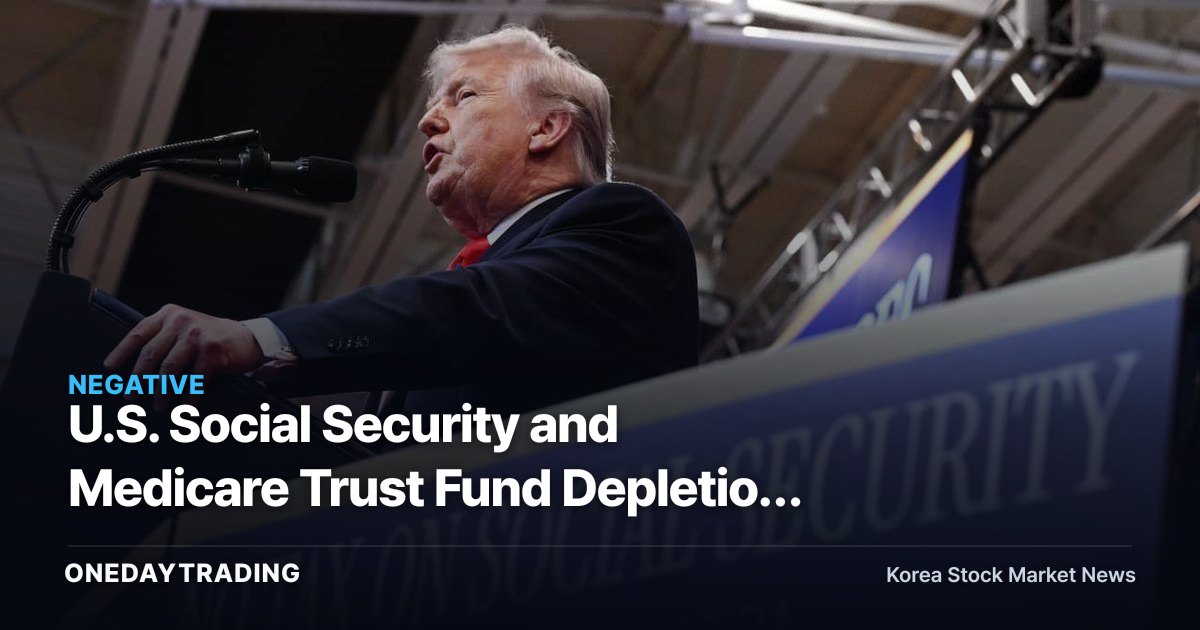
- The U.S. Social Security and Medicare trustees' report once again warned of the trust funds' depletion dates, bringing the prospect of automatic future benefit cuts into focus as a fiscal risk.
- The key point is not a simple welfare debate, but rather how this is tied to the earnings base of U.S. health insurers that draw a large share of revenue from Medicare, as well as to the path of U.S. government bond yields.
- DOGE-driven savings, tax exemptions on Social Security, and immigration variables all cut both ways on the funds' balance, adding to the uncertainty.
What's Changing
The center of gravity in this report is not the size of the deficit itself, but the timing. Once a trust fund is depleted, the statutory structure requires that benefits be paid only within the limits of incoming payroll-tax revenue, so absent separate legislation, benefit payouts are automatically cut by a set percentage. This is not a political choice but an accounting imperative — which is precisely why it is a variable the market cannot easily ignore.
Layered on top of this are several policy variables. Reducing or eliminating taxes on Social Security benefits would increase disposable income for recipients, but that tax revenue was itself a source that had been flowing back into the trust funds, so it could move up the depletion date. Immigration inflows expand the economically active population paying payroll taxes, which works favorably for the funds' near-term balance; if immigration policy tightens, the funds' base weakens along with it. It is also worth noting that the so-called efficiency savings are limited in scale — administrative costs make up only a small share, so they fall well short of plugging the structural deficit in the funds themselves.
By the Numbers and in Context
Medicare is a massive program covering most of the U.S. population aged 65 and over, and within it, Medicare Advantage is the segment that private insurers operate with government subsidies. Many large health insurers have business structures in which government programs (Medicare and Medicaid) account for close to half — or more — of total revenue. As a result, if pressure on the funds leads to lower subsidy rates or tighter payment criteria, loss ratios and margins will buckle before top-line revenue does. At the same time, concerns over a widening fiscal deficit also affect U.S. Treasury issuance burdens and the path of long-term yields, which are transmitted to the Korean market through the indirect channels of the won-dollar exchange rate and foreign investors' order flow.
Beneficiary and Affected Stocks
- UnitedHealth (UNH): As the top Medicare Advantage operator, its earnings are the most sensitive to changes in subsidy rates and medical reimbursement ratios. If policy tightens, the risk of margin pressure is significant.
- Humana (HUM): With very high revenue dependence on Medicare Advantage, its exposure to rate adjustments is structurally large.
- CVS Health (CVS) and Centene (CNC): As integrated insurance-and-pharmacy businesses with a large share of government programs, passing on costs is not easy when payment criteria tighten.
- Domestic medical and healthcare-related stocks: A slowdown in U.S. Medicare spending could act as a conservative demand-side variable for medical-device and bio-contract manufacturing segments that have U.S.-bound revenue.
- U.S. government bonds and rate-sensitive assets: The deteriorating-fiscal narrative connects to upward pressure on long-term yields, indirectly affecting growth stocks and the exchange rate.
Risk Check
- Depletion-date estimates change every year depending on assumptions for economic growth, employment, and wages, so a single report should not be taken as a definitive scenario.
- Actual benefit cuts are likely to be averted through legislation, so the timing and intensity of the impact will shift with the political calendar.
- Insurers' earnings hinge not only on subsidy rates but also on healthcare utilization rates and loss ratios, so it is hard to call the direction based on a single policy variable.
- On valuation, large health insurers react strongly to regulatory headlines, which carries a burden of near-term volatility.
One-Line Conclusion
The fund-depletion warning itself is less an immediate shock than a signal for gauging the direction of U.S. fiscal and health-insurance policy; a reasonable approach is to monitor Medicare-dependent insurance stocks alongside the rate path, while watching for the next policy calendar and subsidy-rate guidelines.
This article is auto-summarized and analyzed content based on the original news report. View Original (MarketWatch)