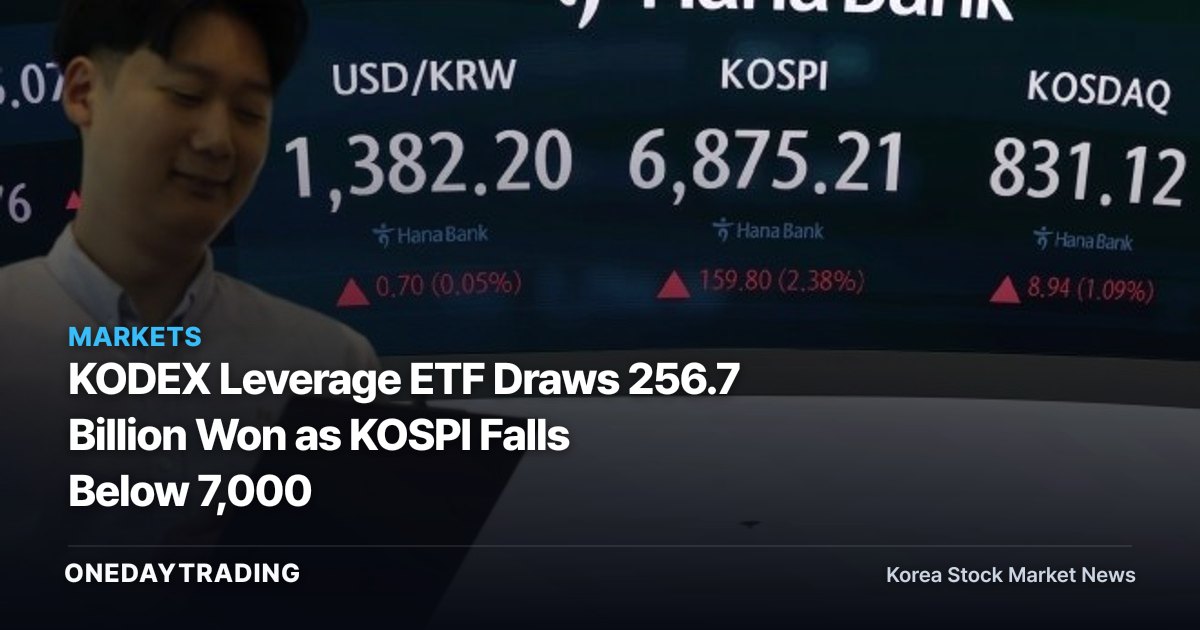

Retail Investors Pour 256.7 Billion Won Into KODEX Leverage
According to data from the Korea Exchange (KRX) and Koscom reported by Maeil Business Newspaper on the 18th, KODEX Leverage, which seeks twice the daily return of the KOSPI 200 Index, ranked first in retail investors’ net ETF purchases over the past week as the KOSPI struggled to rebound below 7,000. Net purchases totaled 256.7 billion won, exceeding the combined 211 billion won purchased in the second-ranked TIGER Dividend Covered Call Active and third-ranked KODEX 200 Target Weekly Covered Call. This figure signals more than simple bargain-hunting sentiment. Retail investors were betting not on the index’s direction but on the “speed” of a rebound, meaning the success of this wager depends on how quickly the KOSPI can reclaim 7,000.
Retail Investors Reversed Their Directional Bet in Two Days
This flow is the exact opposite of what it was just two days earlier. As of September 16, the top two retail net purchases were KODEX Inverse and KODEX 200 Futures Inverse 2X. As the KOSPI slid into the 6,600s, retail investors bet on further declines, then switched into leverage products betting on gains two days later. These same two inverse products also ranked first and second in retail net selling over the same period. Rather than being unable to choose a direction, investors appear to have repeatedly shifted into the opposite position whenever the index moved, pursuing short-term responses. Maeil Business Newspaper’s phrase, “It’s below 7,000, but it will definitely rise further,” captures the psychology behind this reversal.
Returns Are Already Negative — The Structural Trap of Leverage
The problem is the performance of this bet. KODEX Leverage returned -10.01% over one week, while KODEX KOSDAQ150 Leverage, which ranked fourth in net purchases, returned -7.88%; both were negative. Leverage products are designed to track twice the “daily” return of the KOSPI 200 Index. In a range-bound market where the index repeatedly rises and falls, daily compounding can erode the product’s price even if the index returns to the same level several days later. The losses over the past week can be viewed as a direct illustration of this feature. If the KOSPI keeps fluctuating without a clear direction, buying leverage carries the risk that even a rise in the index will not translate into profits.
Why Is the KOSPI Staying Below 7,000?
The KOSPI began declining after setting a record high last June. On July 29, it fell as low as 5,262.77 intraday, while its market capitalization, which had reached nearly 8,000 trillion won in June, lost more than 2,000 trillion won over three months. Foreign investors led the decline. From September 14 through 18, foreign investors recorded 9.1817 trillion won in net selling, while institutional investors recorded 669.4 billion won in net selling. During the same period, retail investors made 2.7222 trillion won in net purchases, supporting the index almost single-handedly. Selling by foreign investors and institutions was therefore locked in a tight contest with retail buying.
On the Morning of the 18th, the Supply-Demand Leaders Changed
However, this setup reversed as trading began on the 18th. The KOSPI opened at 6,885.70, up 170.29 points, or 2.54%, from the previous session, led by foreign investors, who posted 549.4 billion won in net purchases, and institutional investors, who posted 497.3 billion won in net purchases. Retail investors, by contrast, recorded 1.7199 trillion won in net selling. Retail investors, who had supported the index throughout the previous week, took profits and exited just as the rebound began. This is the key question in determining whether their leverage bets were advance purchases of a rebound that had not yet arrived or short-term trades aimed at capturing only the gains once the rebound started. The market has already priced in the one-day return of foreign and institutional buying on the 18th; what remains uncertain is whether that return was a one-day supply-demand event or the start of a trend reversal.
Investor Checkpoints
- Check whether foreign and institutional net buying was limited to the 18th or continued into the next trading session. Continued buying would increase confidence in the rebound, while a return to net selling after one day would leave the 18th’s rise as a one-off bounce.
- Watch whether the KOSPI reclaims 7,000. A recovery would give retail investors’ leverage bets from the past week room to move out of loss territory, but continued trading below that level could deepen losses through volatility decay.
- See whether retail money remains in leverage products in the next ranking of top net purchases. A renewed shift into inverse products could signal that retail investors themselves lack confidence in this rebound.
- The more-than-2,000-trillion-won gap in market capitalization from the June peak can be assessed only by tracking foreign investors’ supply-demand trend. Retail buying alone is unlikely to close the gap.
Outlook — One-Day Rebound or Start of a Trend Reversal?
The optimistic scenario is that foreign and institutional net buying on the 18th marked the first sign of a shift away from selling, and that continued buying would eventually reward retail investors’ leverage bets. The opposing scenario is that the one-day buying volume was small compared with the more than 9 trillion won in accumulated foreign net selling, leaving the 18th rebound as merely a technical bounce. If the KOSPI then resumes moving sideways below 7,000, volatility-decay losses in leverage products will grow. Ultimately, the two scenarios will be distinguished by whether foreign investors continue net selling for several more days or ended it on the 18th.
KOSPI Index MetricsAs of 2026-09-18
| Period trend | 1 week -0.48% 1 month +0.35% |
|---|
Index, commodity and exchange rate data are based on global market standards and reflect values at publication.
This article is automatically summarized and analyzed based on the original news report. View original article (Maeil Business Newspaper Securities)