
Key Takeaways
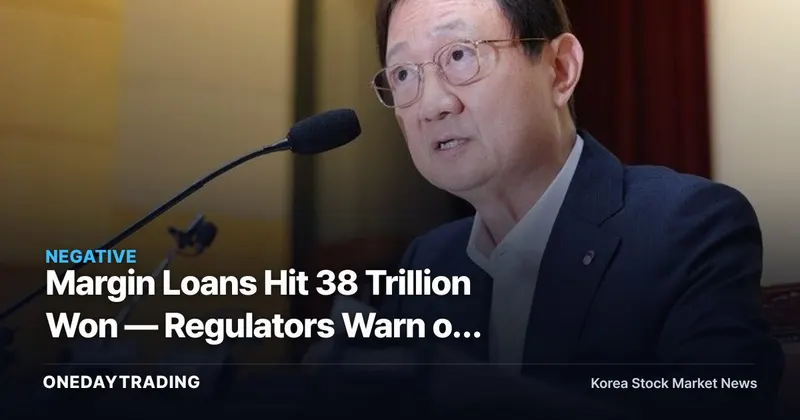
Margin loan balances have ballooned to 38 trillion won, running nearly twice the five-year average, prompting financial regulators to issue a direct public warning. Leveraged buying boosts brokerage interest income in the short term, but if tighter regulation coincides with a market correction, forced liquidations could amplify volatility — making margin lending a double-edged sword.
What's Happening
Margin loan balances — funds that retail investors borrow from brokerages to buy stocks — have recently expanded to approximately 38 trillion won. That figure represents nearly double the five-year average, underscoring the persistent appetite among retail investors for leveraged buying.
The head of the Financial Supervisory Service (FSS) publicly stated that the regulator is taking this trend seriously and has stepped up monitoring. The fact that authorities have openly flagged concerns is widely read as a signal that direct and indirect regulatory measures may follow — including caps on credit extension limits, adjustments to margin requirements, and financial soundness reviews.
Background and Context
Margin loans allow investors to purchase stocks by putting up a portion of the total cost as collateral and borrowing the remainder from a brokerage. Brokerages charge annual interest on these loans, generating interest income that grows in proportion to the outstanding balance. However, if a stock's value falls below the required maintenance margin ratio, brokerages are entitled to execute forced liquidations — selling the investor's holdings without consent.
A balance running at twice the historical average means there is a substantial overhang of potential selling pressure beneath the market. Should the index slide to a certain level, a chain reaction of forced liquidations could ensue, structurally amplifying the downside — a vulnerability that has grown considerably.
Market and Stock Implications
- Retail-focused brokerages: Firms such as Kiwoom Securities, which carry a high share of retail investors' margin loan balances, benefit from elevated interest income that lifts near-term earnings. However, if regulators directly constrain credit limits or interest rates, this revenue stream could be capped — making the policy outlook a two-sided factor.
- Large-cap brokerages (Mirae Asset Securities, Samsung Securities, NH Investment Securities): With meaningful exposure to brokerage commissions and interest income, these firms enjoy significant earnings leverage during periods of rising trading value and margin balances. Conversely, a market correction exposes them to higher provisioning costs and forced-liquidation losses.
- Financial holding companies (Korea Investment Holdings, etc.): Holding companies with brokerage subsidiaries will see changes in the margin loan environment flow directly into consolidated earnings.
- KOSDAQ and small-to-mid-cap theme stocks: Stocks with a high proportion of margin-financed positions are most vulnerable to forced-liquidation selling pressure, and could see amplified volatility under regulatory tightening or a corrective phase.
Investor Checklist
- Track the daily margin loan balance data published by the Korea Financial Investment Association (KOFIA) to determine whether balances continue to rise or have peaked and are beginning to moderate.
- Monitor whether the FSS or the Financial Services Commission (FSC) formally implement higher margin requirements or credit limit regulations, and watch for any related policy announcements.
- In quarterly earnings releases from brokerages, review trends in interest income contribution and provisions related to margin loan balances.
- During episodes of sharp market decline, watch for any increase in forced-liquidation volume statistics and assess whether KOSPI and KOSDAQ are breaking key support levels.
Outlook
If the equity market rally and trading activity continue, expanding margin loan balances could remain a positive catalyst for brokerage interest income. However, should the regulator's warning translate into concrete policy measures — or if global headwinds destabilize the index — the accumulated leverage could rapidly reverse into a negative catalyst, accelerating any downturn through forced liquidations. Given that the elevated level of leveraged buying is itself a variable amplifying market volatility, investors need to weigh signals of slowing balance growth alongside the intensity of regulatory action.
Kiwoom Securities — Real-Time Data Snapshot
Kiwoom Securities' most recent closing price was 306,500 won (−9.19% vs. the prior day). The composite signal incorporating foreign investor and institutional investors supply-demand (order flow), news, and momentum reads 🔴 Caution. Foreign investors, institutional investors, and momentum are all negative — exercise caution at this time.
- ▼ Dual-sided selling — foreign investors −600 million won · institutional investors −6.1 billion won, both net sellers
- ▼ Trend alignment — short- and medium-term trends both pointing lower (day: −9.2% · 1 week: −11.4% · 1 month: −21.6%)
- ▲ News flow — positive catalysts 3 vs. negative catalysts 0 — positive catalysts dominant
Recent related news shows 3 positive catalyst items and 0 negative catalyst items — a favorable news backdrop.
※ Price and foreign investor/institutional investors supply-demand (order flow) data are provided by Korea Investment & Securities (KIS) and reflect conditions at the time of publication.
This content was automatically summarized and analyzed based on the original news article. Read the original article (Maeil Business Newspaper — Economy)