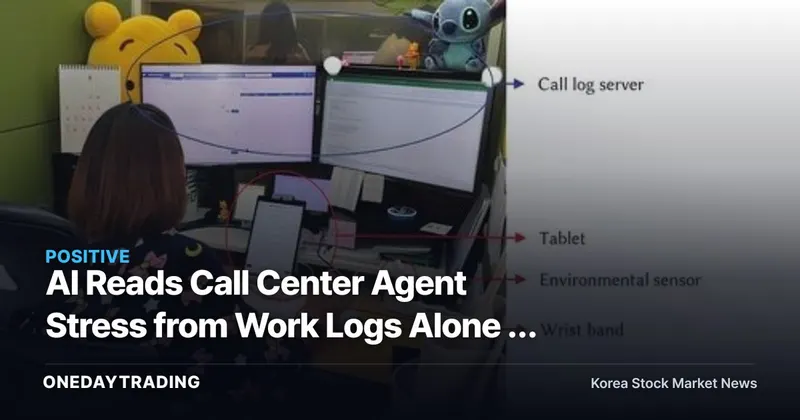

The idea of inferring a call center agent's psychological state from structured work logs — call volume, average handle time, and break frequency — rather than recorded conversations signals more than a labor welfare issue. It points to emerging demand across AI contact centers (AICC) and emotional labor care, a genuinely new market vertical. The key insight is that stress signals can be detected without a dedicated voice analysis infrastructure or the collection of privacy-sensitive call recordings, which simultaneously lowers deployment costs and privacy barriers — reducing the adoption threshold for corporate customers. From an investment standpoint, the impact diverges across AICC solution providers, voice and text analytics AI firms, and contact center business process outsourcing (BPO) operators managing large agent workforces.
3-Line Briefing
- Korean researchers have proposed an AI model that estimates emotional stress in call center agents using only work log data — no call recording analysis required.
- The log-based approach, which operates without audio transcription, offers a meaningful advantage by reducing privacy concerns and infrastructure costs.
- Combined with the trend toward mandatory emotional labor management regulations, this development could serve as a demand momentum catalyst for the AI contact center, voice AI, and BPO industry sectors.
What Changes
Traditional agent care has relied on after-the-fact surveys or supervisory monitoring, offering little real-time visibility. Call recording analysis has been an alternative, but storing and processing voice data carries both privacy compliance burdens and infrastructure costs. The approach presented in this research is significant precisely because it leverages structured logs — handle counts, processing times, pause patterns — that already accumulate within existing call center systems.
In other words, stress signals can be captured from existing data without adding microphones or voice engines. For corporate customers, this lowers the difficulty and cost of deployment and opens a path to using the tool to satisfy obligations under the Occupational Safety and Health Act to protect emotional labor workers. That said, this remains an academic research result — it should not be conflated with a near-term revenue contribution from a commercial solution.
Numbers and Context
This development carries the character of a research publication rather than a corporate disclosure accompanied by specific earnings or contract figures. It is therefore more reasonable to interpret it as one facet of a policy and technology environment in which upstream demand for emotional labor care and AI contact centers is expanding — rather than drawing a direct line to near-term earnings for any specific stock (ticker). Domestic call center and customer service operations continue to invest in AICC migration, led by major clients in financial services, telecommunications, and distribution, making it appropriate to assess the implications of this research within the context of a gradual growth trajectory for related solution revenue.
Potential Beneficiaries and Risk Exposures
- 셀바스AI (Selvs AI): With capabilities in speech recognition, speech synthesis, and AI analytics, the company is positioned on the upstream demand side if the market for emotion and stress analysis solutions based on agent data expands.
- 브리지텍 (Bridgetek): Operating in call center and contact center system integration (CTI/IVR), the company stands to benefit from revenue growth in solutions if AICC upgrade investment accelerates.
- 효성ITX (Hyosung ITX): Running large-scale contact center BPO operations, the company could see agent care and productivity management tools translate into operational efficiency gains and new service differentiation.
- 코난테크놀로지 (Conan Technology): Holding text and voice AI analytics capabilities, the company is a potential beneficiary of growing demand to analyze agent logs and conversational data.
- 솔트룩스 (Saltlux): With conversational AI and language model-based customer interaction solutions, the company is positioned to align with the broader AICC market expansion trend.
Risk Check
- As a research-stage result, there is a significant lag before commercialization and revenue contribution, and the actual scale of adoption remains uncertain.
- Concerns around agent surveillance and labor rights could trigger social resistance or regulatory variables that complicate deployment.
- Many AI-related stocks (tickers) carry high valuation multiples relative to earnings, meaning theme-driven expectations alone can amplify volatility.
- If the accuracy and reliability of stress estimation are not validated, field adoption may remain limited.
One-Line Conclusion
This is a signal stimulating structural demand in emotional labor care and AI contact centers — but the research-stage limitations and per-stock (ticker) valuation burdens must be weighed together, with actual solution contract announcements and deployment disclosures serving as the key indicators to watch.
Real-Time Data: Selvs AI
셀바스AI (Selvs AI)'s most recent closing price is ₩7,040 (−5.88% vs. prior day). The composite signal incorporating foreign investor and institutional investor supply-demand (order flow) alongside news and momentum reads 🟢 Buy-Bias. Foreign investors and institutional investors are showing positive signals, warranting attention.
- ▲ Supply-Demand (Order Flow) Continuity — Foreign investors: 5 consecutive sessions of net buying (+500 million won)
- ▲ Dual-Sided Buying — Foreign investors +500 million won · Institutional investors +0 won, concurrent net buying
- ▼ Trend Alignment — Short- and medium-term downward alignment (day: −5.9% · 1 week: −20.9% · 1 month: −33.3%)
- ▼ 52-Week Position — Near 52-week low, within 1% of the bottom
※ Price and foreign investor/institutional investor supply-demand (order flow) data are provided by Korea Investment & Securities (KIS) and are as of the time of publication.
This content has been automatically summarized and analyzed based on the original news article. View Original Article (Yonhap News — Industry)