
At a Glance
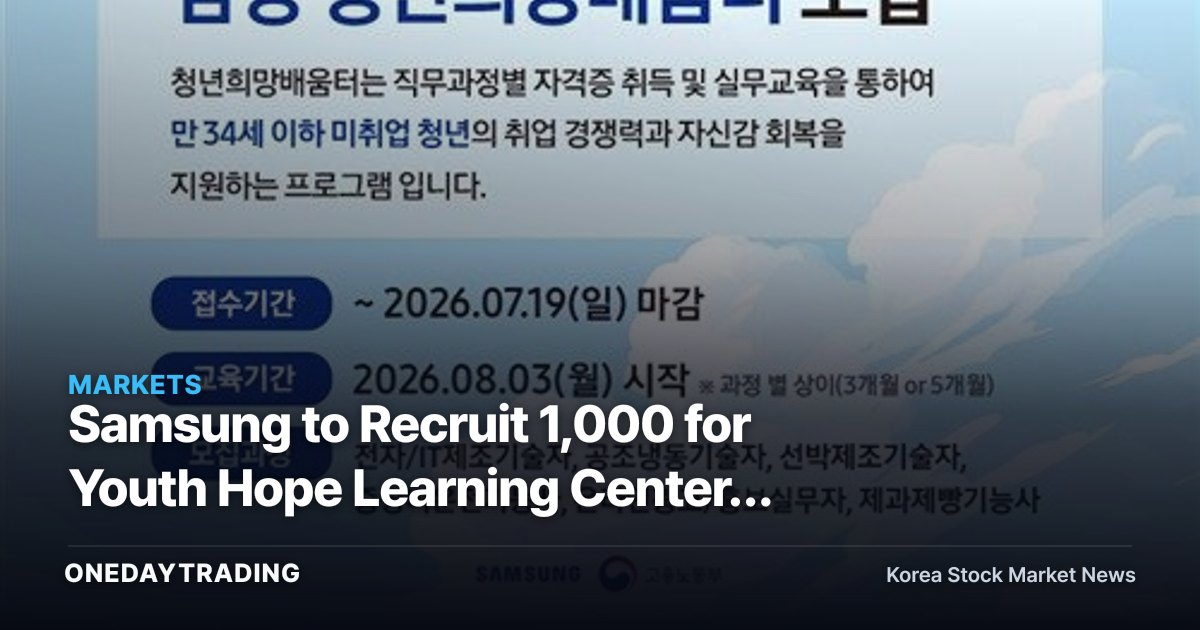
Samsung announced on the 18th that it is launching the Youth Hope Learning Center, a job-training program for 1,000 unemployed young people, and is accepting applications for trainees through the 19th of next month. This is a philanthropic talent-development program rather than a hiring-linked initiative, and it is not an issue that serves as a direct catalyst for near-term earnings or the share price. That said, its implications for strengthening the youth employment base and for corporate reputation are worth noting.
Why It Matters Now
The key point of this announcement is not corporate spending but the talent-ecosystem perspective. Support for youth job training can be seen as an effort to deepen the pool of pre-hire prospective talent in an industrial environment where demand for highly skilled workers in fields such as semiconductors and software is structurally rising. With the recruitment scale set at 1,000 people, this looks less like a one-off event and more like a medium- to long-term talent pipeline.
From an investment standpoint, there is effectively no direct change to revenue or profit. Philanthropic and educational spending is recorded on the income statement as selling and administrative expenses or as donations, and its scale is not large enough to affect company-wide earnings. Therefore, this news is more accurately read in the context of building ESG and reputational capital, and of keeping pace with the government's youth-employment policy stance, rather than as a factor for re-rating corporate value.
What deserves more attention, instead, is the signal that a major conglomerate is moving to directly fill the gap in young people's job skills. This is also evidence that there is a shortage of practical workers who can be deployed immediately on the industrial front line, and it can serve as a supplementary indicator for gauging demand trends in education and human-resources-related industries.
Frequently Asked Questions
- Does this program affect Samsung Electronics' share price — The direct impact is minimal. The cost scale is small and the initiative is not tied to confirmed hiring, so it is hard to view as an earnings variable.
- Does it lead to employment — Based on the announcement alone, the focus is on job-training support, and there is no confirmation of any hiring guarantee. Whether it becomes hiring-linked is the key variable going forward.
- Why a scale of 1,000 — This is a scale weighted toward medium- to long-term talent development rather than a short-term event, and is interpreted as a response to demand for highly skilled workers.
- Will it spread to other companies — Youth employment support is tied to the policy trend, so the possibility of similar programs at other major conglomerates is worth watching.
Impact on Related Stocks and Sectors
- Samsung Electronics — The program's sponsor, but the educational spending has minimal impact on earnings and amounts only to a qualitative effect on the ESG and reputation front.
- Semiconductor and software sectors — Industries with fierce competition to secure highly skilled workers, where cultivating prospective talent could be a favorable factor in terms of long-term labor costs and turnover rates.
- Education and human-resources-related industries — The expansion of company-led job training is a supplementary signal pointing to the direction of industry demand.
Points to Watch When Investing
- Do not directly interpret a philanthropic announcement as a positive catalyst for earnings — the impact on profit and loss is effectively nil.
- The key to judging the share price is the semiconductor industry cycle, memory prices, and the demand cycle, which are variables separate from this news.
- It is worth checking whether disclosures emerge on hiring linkage or the scale of follow-up investment.
- The reflection of ESG ratings is long-term and gradual, making it hard to use as a basis for short-term trading.
Overall Outlook
On the positive side, expanding youth job training lays the groundwork for solidifying the industry's labor base and building corporate reputational capital. However, this is not a catalyst that determines the share price's short-term direction, and Samsung Electronics' corporate value still hinges on fundamental variables such as the pace of recovery in memory prices, foundry competitiveness, and global IT demand. A balanced perspective that separates philanthropic news from fundamental variables is needed.
Samsung Electronics in Real-Time Data
Samsung Electronics' latest closing price is 351,000 won (+1.30% from the previous day), and the signal light combining foreign and institutional investor order flow with news and momentum is 🟢 Buy-Favored. With news and momentum looking positive, it is worth keeping an eye on.
- ▲ Trend Alignment — Short- and mid-term upward alignment (intraday +1.3% · 1 week +16.0% · 1 month +29.8%)
- ▲ 52-Week Position — In the upper 94% of the 52-week range — new-high territory
- ▲ News Flow — Positive catalysts 26 vs negative catalysts 8 — positive catalysts prevail
Recent related news is favorable, with 26 positive catalysts and 8 negative catalysts.
※ Price and foreign/institutional investor order-flow data are provided by Korea Investment & Securities (KIS), as of the time of publication.
This article is content automatically summarized and analyzed based on the original news. View original (Yonhap News)