
3-Point Briefing
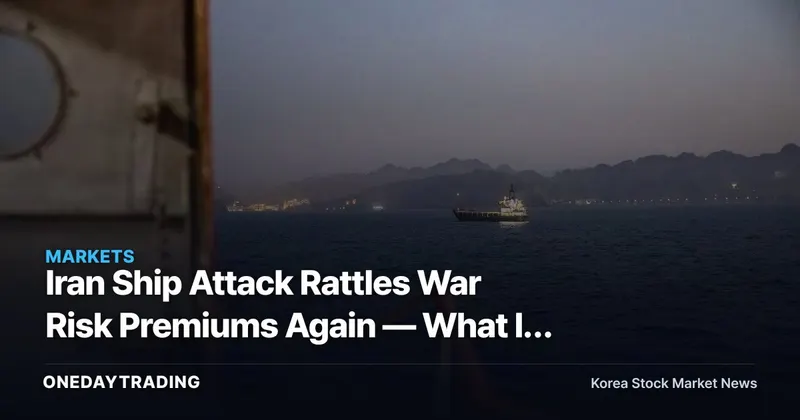
- A ship attack in Middle Eastern waters is once again applying upward pressure on war risk premiums (war risk surcharges) that had been narrowing rapidly in recent weeks.
- Because premiums are ultimately an operating cost borne by shipowners, the increase is likely to be passed through to ocean freight rates and the landed cost of Middle Eastern crude oil and LNG imports.
- Domestically, this acts as a cost variable for shipping, refining, and aviation — and as a double-edged variable for certain non-life insurers, for whom rising premium rates cut both ways.
What Has Changed
The critical point is not the price level itself, but that the direction of volatility has reversed. Until recently, the market had been pricing in a de-escalation of Middle East tensions, steadily bringing war risk surcharges down. Falling premiums meant carriers faced a lighter cost burden when transiting high-risk zones and had greater incentive to return to shorter routes rather than lengthy diversions.
This attack has the potential to reverse that trend. War risk insurance is repriced on a per-voyage basis, making rates most sensitive immediately following an incident. If insurers and reinsurers redesignate a specific sea lane as a high-risk zone, vessels transiting that corridor will once again face surcharges calculated as a percentage of the ship's insured value.
From here, the path diverges. If the premium spike proves to be a one-off and no further attacks occur, rates could normalize within weeks. Conversely, if attacks recur or safe transit through the Strait of Hormuz and the Red Sea comes into question, carriers may once again opt to divert around the Cape of Good Hope — adding sailing days and fuel costs, and structurally lifting effective freight rates.
By the Numbers
War risk premiums had narrowed considerably before this incident, and may now reverse course. Specific rates vary by insurer, vessel type, and route, making a single figure impossible to generalize — but the market's focal point is clear. A wider surcharge zone raises fixed costs per voyage for carriers, and this feeds through — with a lag — into container, bulk, and tanker freight indices, as well as the delivered price of Middle Eastern crude imports.
Stocks to Watch — Beneficiaries and Headwinds
- Shipping stocks (HMM and other container/bulk carriers): Rising voyage costs are a near-term headwind, but if diversions and port congestion reduce available capacity, freight rates could rise and support revenue — a double-edged dynamic. The key variable is carriers' ability to pass costs through to rates.
- Refining stocks (S-Oil, SK Innovation, GS): High dependence on Middle Eastern crude means rising import freight and insurance costs are a negative catalyst on the cost side, while geopolitical risk-driven refining margin swings can move near-term earnings in either direction.
- Non-life insurance stocks (Samsung Fire & Marine, DB Insurance): Higher marine insurance rates are favorable from an underwriting standpoint, but are accompanied by the risk of increased claims payouts in the event of incidents.
- Aviation stocks (Korean Air): If oil prices rise in tandem, the direct pressure on profitability in air cargo and passenger operations — where fuel costs represent a large share of expenses — could be significant.
Risk Checklist
- The premium surge may prove transitory — absent further attacks, rates could normalize quickly.
- Higher freight rates do not automatically translate to higher shipper profits — fuel costs and diversion expenses may offset rate gains.
- Oil price direction remains uncertain — supply disruption fears and slowing global demand could push prices in opposite directions simultaneously.
- Policy and diplomatic wildcards — any signal of de-escalation could rapidly unwind the risk premium.
Bottom Line
The renewed rise in war risk premiums is a double-edged variable that presents both costs and opportunities simultaneously for shipping, refining, and non-life insurance sectors. The appropriate response — and its intensity — should be calibrated by monitoring safe transit conditions through the Strait of Hormuz and the Red Sea, whether further attacks materialize, and the directional signals from freight rate and oil price indicators.
HMM in Real-Time Data
HMM's most recent closing price is KRW 18,310 (−1.88% vs. the prior day). The signal integrating foreign investor and institutional investor supply-demand (order flow), news, and momentum reads 🟡 neutral · wait-and-see. Positive and negative signals are mixed, suggesting a period of observation is warranted.
- ▼ Supply-demand (order flow) continuity — Foreign investors have net-sold for 7 consecutive sessions (−KRW 4.9 billion)
- ▼ Trend alignment — Short- and medium-term downtrend alignment (day: −1.9% · 1 week: −9.1% · 1 month: −7.2%)
- ▼ 52-week position — Within 5% of 52-week low
- ▲ News flow — Positive catalysts 6 vs. negative catalysts 0 — positive catalyst tilt
Recent related news shows 6 positive catalyst items and 0 negative catalyst items — a favorable news backdrop.
※ Price and foreign investor/institutional investor supply-demand (order flow) data are sourced from Korea Investment & Securities (KIS) and reflect conditions at the time of publication.
This content is an automated summary and analysis based on the original news article. View original article (MarketWatch)