
Key Takeaways
At 170 billion won, the fund isn't large enough to single-handedly determine the fate of any one new drug, but it is a policy signal that could lower the discount rate applied to Korean biotech stocks. If the market reads this news as a positive catalyst, the reason isn't the fund manager selection itself, but the fact that the government and private sector have begun jointly filling the Phase 3 clinical trial funding gap.
That said, the selection criteria and pace of execution matter more for this fund than the adjectives in the press release. Since at least 60% of total commitments must go to companies actually conducting Phase 3 trials, and the fund is expected to be narrowed down to roughly 10 companies, the benefits are likely to be selective rather than broadly distributed.
What Happened
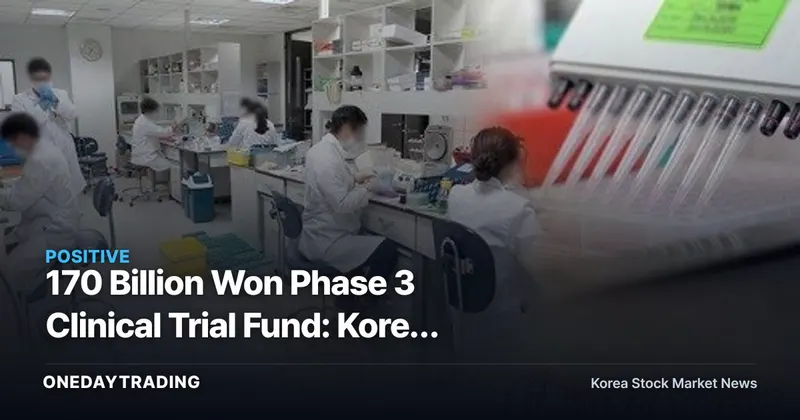
On July 27, the Ministry of Health and Welfare selected Korea Investment Partners as the lead manager of Korea's first fund dedicated to Phase 3 clinical trials. The initial target fund size was 150 billion won, but Korea Investment Partners proposed a target of 170 billion won. Four asset managers took part in the public offering held from May 11 to June 5, and the final manager was chosen after document review, on-site due diligence, and presentation evaluations.
The fund's core condition is clear. At least 60% of total commitments must be invested in pharmaceutical and biotech companies that hold innovative new drug or biobetter pipelines and are actually conducting Phase 3 trials. Once 120 billion won — 80% of the target fund size — is secured, the fund can begin early investment through a first-close structure.
The structure of the policy capital also offers investors an important clue. The government is contributing 70 billion won, while IBK Industrial Bank and the Export-Import Bank of Korea are each contributing 10 billion won, bringing public capital alone to 90 billion won. Combined with the existing K-Bio & Vaccine Fund, total resources reach 949.6 billion won. The headline figure of a "1 trillion won mega-fund" is largely symbolic, but for late-stage clinical companies, it represents real capital that extends their runway.
Background and Context
Phase 3 is where the gap between a biotech company's announcements and its income statement widens the most. Even when Phase 1 and Phase 2 trials show signals of efficacy, Phase 3 involves larger patient populations, more countries, and more complex control-group designs. Costs rise and the payback period lengthens. As a result, private VCs are willing to invest at the early stage when licensing-out potential is visible, but they attach a much higher risk premium to funding a full Phase 3 trial.
Currently, 57 new drug pipelines in Korea are known to be undergoing Phase 3 trials. Splitting 170 billion won across roughly 10 companies is not a mechanism to rescue every pipeline. Rather, it acts as a filter that selects candidates with robust trial designs, a track record of engagement with regulators, and remaining commercial market potential.
Impact on the Market and Individual Stocks
- Korea Investment Holdings: The selection of Korea Investment Partners as fund manager is, at the parent-company level, an event that builds a track record in biotech-focused asset management. However, since it isn't large enough to transform group earnings on its own, the impact on the share price is likely to come more from reputation and the potential for follow-on fund expansion than from management fees.
- Biotech companies with Phase 3 pipelines: Lower fundraising risk could ease some of the pressure to issue new shares. Late-stage clinical companies' stocks are often discounted less because of the underlying technology than because of the pace of cash burn — and this policy fund targets exactly that weak link.
- Large pharmaceutical companies: For companies with their own cash flow, what matters more than direct funding is the environment for co-development and licensing negotiations. If the fund screens Phase 3 candidates, large pharma companies gain more options to bring in validated pipelines.
- Biotech venture investor sentiment: With a combined 949.6 billion won formed together with the K-Bio & Vaccine Fund, concerns about a sector-wide funding crunch should ease. However, because at least 60% of commitments must go to later-stage companies, the warming effect on early-stage platform companies will be limited.
- CROs and clinical trial infrastructure: Once actual investments are executed, demand should follow for clinical trial outsourcing, data management, and hospital networks. The benefit will be confirmed not by fund-formation news but by the pace of trial initiation and patient enrollment.
Investor Checkpoints
- Investors should track when Korea Investment Partners secures 120 billion won or more. The news only becomes real investment once the first close is completed.
- Look at the clinical stage, primary endpoints, and patient enrollment rates of the roughly 10 companies selected for investment. Simply being labeled a "Phase 3" company does not by itself raise the probability of success.
- Check whether selected companies are receiving fund capital instead of raising money through common stock issuance. For existing shareholders, the dilution ratio matters more than the pipeline itself.
- Whether the trial design has been agreed upon with the FDA, EMA, or Korea's Ministry of Food and Drug Safety is critical. In late-stage trials, even with money in hand, value can be damaged instantly if the endpoints falter.
Outlook
The optimistic scenario is clear. If more than 120 billion won is raised quickly and investment targets narrow to companies actually engaged in global Phase 3 trials, the late-stage funding gap — the biggest weakness of Korea's biotech sector — would ease. In that case, the market could place a higher value on the likelihood of completing trials than on expectations of licensing deals.
The opposite scenario should also be kept in mind. 170 billion won is not enough to support all 57 pipelines, and Phase 3 failure risk cannot be eliminated simply through a funding mechanism. The next things to watch are the timing of the fund's final close, the list of first-invested companies, and those companies' likelihood of meeting their primary endpoints. In the end, it is data — not announcements — that drives biotech stock prices over the long run.
Korea Investment Holdings: Real-Time Data
Korea Investment Holdings's most recent closing price was 211,500 won (-0.70% versus the previous day), and the composite signal combining foreign/institutional investor supply-demand (order flow) with news and momentum reads 🟡 Neutral / Wait-and-see. Positive and negative signals are mixed, making this a stock worth watching closely.
- ▲ Supply-Demand (Order Flow) Continuity — Foreign investors have been net buyers for 7 consecutive days (+11.5 billion won)
- ▼ Trend Alignment — Short- and medium-term downward alignment (same-day -0.7% · 1-week -2.3% · 1-month -1.2%)
Recent related news shows 1 positive catalyst and 0 negative catalysts, a favorable balance.
※ Price and foreign/institutional investor supply-demand (order flow) data are provided by Korea Investment & Securities (KIS), as of the time of publication.
This article is automatically summarized and analyzed content based on the original news report. View original (Yonhap News Agency, Markets)