
At a Glance
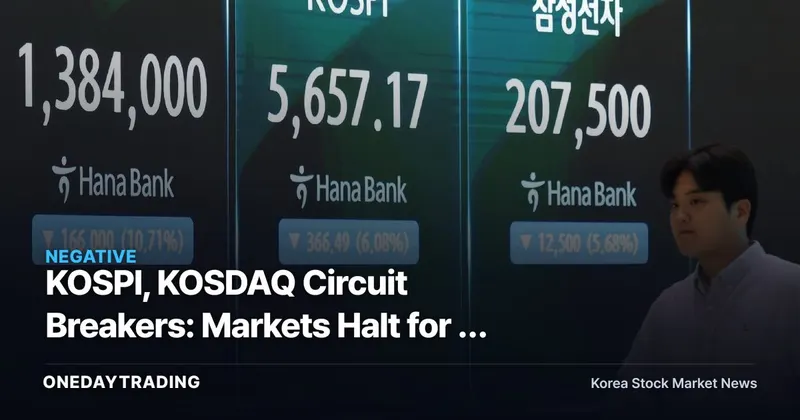
More important than the fact that the market halted is that price levels capable of absorbing sell orders disappeared. This marks the first time ever that circuit breakers have been triggered in both KOSPI and KOSDAQ on consecutive days. What this really signals is not fear, but a crack in liquidity.
Korea Exchange (KRX) halted intraday trading on the KOSDAQ for 20 minutes at 12:19 p.m. on the 29th. KOSPI's circuit breaker followed the same day. This means both major markets have now halted trading on consecutive days.
Why It Matters Now
A circuit breaker is not a device to stop prices from falling. It's a mechanism that buys the market time when the order book thins out sharply. What investors should watch, therefore, is not how much the index recovered after the halt, but whether trading value and bid-ask spreads return to normal once trading resumes.
Framed in terms of interest rates, the interpretation becomes clearer. When the discount rate on risk assets rises or exchange-rate volatility increases, highly-valued growth stocks are the first to lose their multiples. The pattern of KOSDAQ wobbling first and KOSPI halting afterward reflects this sequence. The market has not yet seen a change in earnings — it is lowering the very benchmark used to price assets.
The challenge is distinguishing fear that's already priced in from losses that have not yet been reflected. The event of trading halts on two consecutive days means much of the fear itself may already be priced in. However, second-order supply-demand (order flow) shocks — such as forced selling of margin loans, fund redemptions, and rising hedging costs for foreign investors — are only confirmed after the market close and on the next trading day. That part remains a matter of probability.
Frequently Asked Questions
- Does a circuit breaker signal a market bottom? Not on its own. A 20-minute trading halt only slows an overheated pace of selling — it doesn't mean new buyers have stepped in.
- Why is the shock bigger on KOSDAQ? KOSDAQ has a higher weighting of growth stocks and retail investor order flow, making it sensitive to shifts in interest rates, the exchange rate, and margin balances. Once multiple compression begins, its declines widen first.
- Are KOSPI large-cap stocks safe? They have relatively better liquidity, but they're not a safe haven. If foreign selling moves in tandem with the exchange rate, even large export-oriented stocks (tickers) will struggle to keep defending the index for long.
- What should be confirmed to expect a rebound? Trading value after resumption, a shift to foreign net buying, won stabilization, and absorption of margin-loan overhang all need to align simultaneously.
Related Stocks (Tickers) and Sector Impact
- Brokerage stocks. The trading halt itself is brief, but heightened volatility could boost retail trading volume. However, if margin-loan risk grows, provisioning burdens and damaged investor sentiment tend to arrive together.
- KOSDAQ growth stocks. This is the segment hit first by a rising discount rate. Stocks valued more on expected revenue than on earnings visibility face heavy multiple-compression pressure.
- Large-cap semiconductor stocks. Their heavy index weighting makes them a conduit for foreign passive flows. In the short term, the exchange rate and global risk-off sentiment can matter more for share prices than industry fundamentals.
- High-dividend defensive stocks. When the market prioritizes cash flow over volatility, their relative returns can improve. Still, they can't be expected to provide absolute protection against market-wide redemption pressure.
Points to Watch for Investors
- Don't chase the first rebound. A bounce after a circuit breaker may just be short covering or short-term bargain hunting. Watch the closing price and the following morning's order flow before drawing conclusions.
- Check margin-loan balances. Forced-selling volume matters more than price. If forced liquidations remain outstanding, any technical rebound is likely to be short-lived.
- Watch the exchange-rate level alongside prices. Foreign investor flows react to the won's direction before they react to share prices. If won weakness doesn't settle down, buying interest in KOSPI large-caps will stay weak too.
- Separate earnings-backed stocks from theme stocks. Even within the same downturn, companies with real cash flow recover at a different pace than those propped up by expectations alone.
Overall Outlook
The optimistic scenario is straightforward. If trading normalizes after the 20-minute halt, the intensity of foreign selling eases, and KOSDAQ margin-loan overhang is absorbed quickly, the market may price in fear first and then move into a technical rebound. In that case, market leadership would emerge first from large-caps with strong earnings visibility, not from oversold theme stocks.
The trigger for the bearish scenario is the exchange rate and forced selling. If won weakness persists and margin-loan liquidations spread into the next trading day, the circuit breaker won't be a one-day event but the starting point of a broader valuation reset. The next triggers to watch are post-close margin-loan volume, foreign futures positioning, and whether the won-dollar exchange rate stabilizes.
This article is automatically summarized and analyzed content based on the original news source. View Original (Maeil Business Newspaper - Stock)