
Key Takeaways
Greenspan's death is not in itself an event that will change the direction of the stock market. That said, his 19-year approach to running monetary policy — the so-called "Greenspan put" and his deliberately ambiguous rhetoric ("Fedspeak") — remains worth revisiting for investors, since it serves as a starting point for interpreting the Fed's market communication and rate expectations today. The crux is that an era's textbook on how central bank credibility, liquidity, and asset prices interlock has now closed.
What Happened
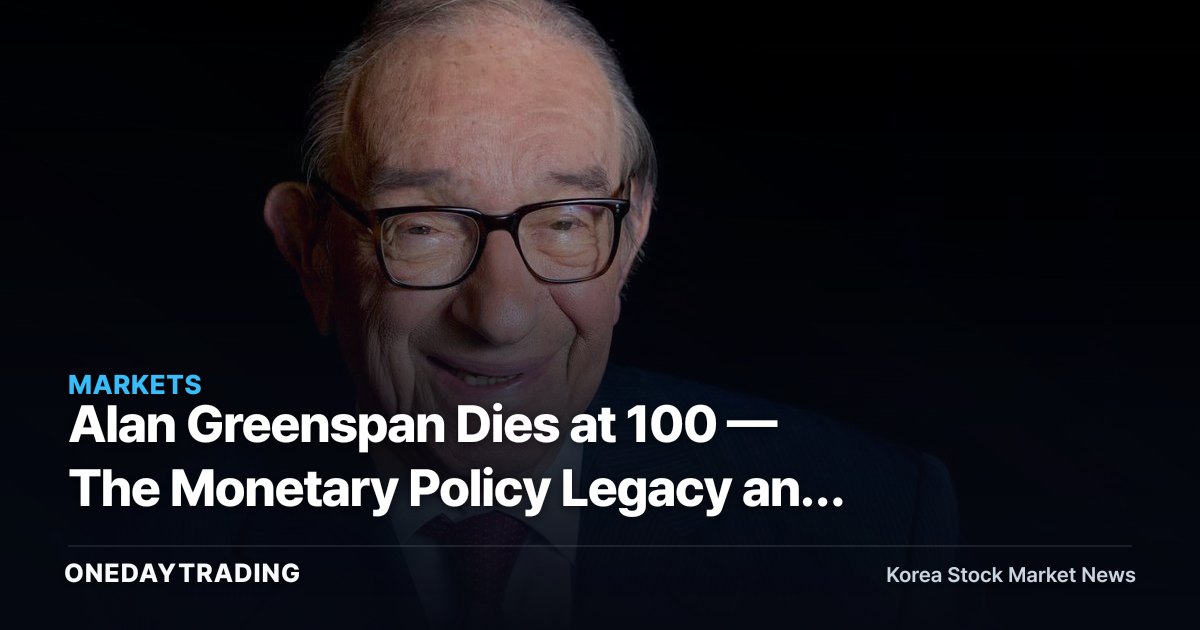
According to CNBC, former Federal Reserve (Fed) Chairman Alan Greenspan has died at the age of 100. He served as chairman for roughly 19 years from 1987 to 2006, overseeing U.S. monetary policy across the terms of four presidents: Reagan, Bush Sr., Clinton, and Bush Jr.
Greenspan was also famous for a rhetorical style that deliberately left room for interpretation — the so-called "Fedspeak." It was a mode of communication that strategically deployed ambiguity instead of clear-cut statements, so as to prevent the market from tilting too far in any one direction, and it became the archetype for later debates over central bank communication.
His tenure overlapped with a turbulent stretch that began with crisis management in the immediate aftermath of the 1987 Black Monday crash, ran through the information technology (IT) boom of the 1990s, and extended into the low-rate phase of the early 2000s.
Background and Context
Assessments of Greenspan are two-sided. The term "Greenspan put" arose from the way he supplied liquidity in every crisis to prevent the market from collapsing, but he is also criticized for a policy of keeping rates low for too long, which provided the soil for the mid-2000s housing bubble and the 2008 global financial crisis.
What investors should focus on today is less the man himself than the framework he established. The questions of how far a central bank should intervene against falling asset prices, and how it should manage market expectations, carry directly over to the Fed under Jerome Powell.
Impact on the Market and Stocks
- Financials and Banking Sector — The monetary policy regime is directly tied to net interest spreads. A prolonged Greenspan-style easing compresses net interest margins (NIM), while a tightening phase improves bank profitability — a reminder of this structural sensitivity.
- Growth and Tech Stocks — Low rates and abundant liquidity raise the present value of future cash flows, propping up valuation multiples. The learning effect of the "Greenspan put" is the mechanism that has fed appetite for risk assets.
- Bond Market — The clarity of the Fed's communication governs long-term rate volatility and the term premium. The evolution from Fedspeak to the dot plot and forward guidance is itself a variable for bond prices.
- Commodities and Gold — The channel through which demand for gold as a store of value comes to the fore when real rates and confidence in the currency are shaken is likewise a continuation of the debates of the Greenspan era.
Investor Checkpoints
- At the next Federal Open Market Committee (FOMC) meeting, check how far Chairman Powell's rhetoric differs from the past Fedspeak-style ambiguity, and whether the dot plot distribution diverges from market expectations.
- Using the level of the U.S. 10-year Treasury yield and real rates as a baseline, gauge the relative strength of growth stocks versus financials.
- As a gauge of the liquidity environment, watch the pace of the Fed's balance sheet reduction (QT) alongside changes in credit spreads.
- Re-examine the risk premium to see whether the expectation that the central bank will intervene in asset prices (the "market put") is excessively priced in.
Outlook
On an optimistic reading, the crisis-response playbook and communication techniques Greenspan refined remain accumulated assets for the current Fed, leaving room to contribute to market stability during shocks. On the other hand, just as the lesson left by his era — that prolonged low rates inflate bubbles — suggests, valuations resting solely on expectations of easing can unwind quickly when the rate path shifts. This obituary is more reasonably read not as a buy or sell signal for any particular stock, but as a signal to re-examine the premises of a portfolio built atop monetary policy assumptions.
This article is content automatically summarized and analyzed based on an original news report. View original (CNBC)