
3-Line Briefing
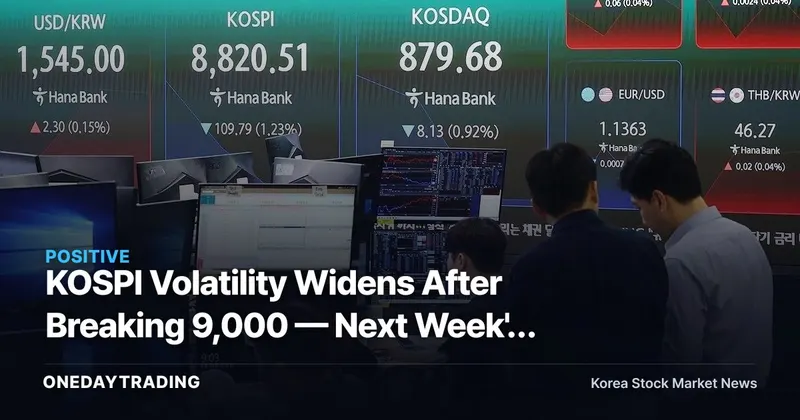
- Since climbing above the 9,000 level, the KOSPI has been swinging sharply higher and lower day after day, entering a phase of widening volatility.
- Brokerages have set their expected upside target for next week at 9,500, citing positive corporate earnings outlooks.
- The core of any response strategy lies not in tracking the broad index but in selectively positioning around leading stocks backed by solid earnings.
What Has Changed
With the index surpassing 9,000, the yardstick investors use to make decisions is shifting. The period of buying on undervaluation appeal is over; the market has moved into a valuation-check phase where participants scrutinize whether further upside can be justified by earnings. This means that even at the same index level, the price trajectories of industry sectors with genuine earnings growth are beginning to diverge from those whose multiples have simply expanded.
This is precisely why brokerages, even as they set a 9,500 upside target, are emphasizing a strategy centered on leading stocks rather than broad index exposure. For the index to climb another leg higher, large-cap stocks — particularly those in industry sectors with live earnings momentum — must provide additional lift. Conversely, if leading stocks take a breather, the index could be stuck churning with sharp swings within a tight trading range.
The widening volatility is itself a signal. Directionless sharp swings indicate that profit-taking supply and fresh buying demand are clashing at the same level, illustrating a zone where elevated index levels and earnings expectations are pulling in equal and opposite directions.
By the Numbers
The key figure is the gap between the current 9,000 level and the projected upside target of 9,500. By simple math, roughly 5% of additional upside remains to the ceiling — and it is critical to note that this room rests entirely on positive earnings expectations. In other words, the case for the upper bound is a hypothesis that must be validated through actual earnings releases; if results fall short of expectations, 9,500 could function not as a resistance level but as a short-term ceiling.
The higher the index climbs into record territory, the more the pace of earnings growth must keep pace with the burden of further upside — making quarter-over-quarter earnings growth rates the key variable that will determine whether the top of the band is reached.
Stocks to Watch — Winners and Losers
- Samsung Electronics: As the top stock by market capitalization on the KOSPI, it has the single largest influence on index direction. Memory cycle conditions and earnings momentum are the first test of the case for the 9,500 upper bound.
- SK Hynix: Directly exposed to AI and memory demand, it is the core driver of the semiconductor leader rally. Earnings visibility is the channel through which the index ceiling gets pushed higher.
- Large-cap semiconductor and IT value-chain stocks: The more the index is driven by leading stocks, the more back-end process and component stocks benefit in tandem — but without earnings support, they face greater volatility exposure.
- Financials (banks and brokerages): Rising trading value and elevated index levels leave room for brokerage earnings to improve, though they also face profit-taking pressure when volatility spikes.
- High-valuation growth and theme stocks: When elevated index concerns come to the fore, stocks with weaker earnings foundations are comparatively more likely to see selling emerge first.
Risk Check
- The 9,500 upper bound is a hypothesis premised on strong earnings; if actual results disappoint, it could become a short-term ceiling.
- The valuation pressure characteristic of index peaks, combined with profit-taking supply, could amplify sharp-drop volatility.
- The more concentrated the index becomes in leading stocks, the greater the concentration risk that the entire index will lurch when those leaders stumble.
- External variables — including the exchange rate, interest rates, and foreign investor supply-demand (order flow) — could simultaneously shake both the upper and lower ends of the trading range.
Bottom Line
If positive earnings expectations hold, upside potential to 9,500 remains open — but that number is a conditional target that must be revalidated each time against actual earnings and leading-stock momentum, while volatility near the index peak has expanded in both directions.
This content is an automatically summarized and analyzed article based on the original news source. View Original (Maeil Business News Korea — Securities)