
Summary
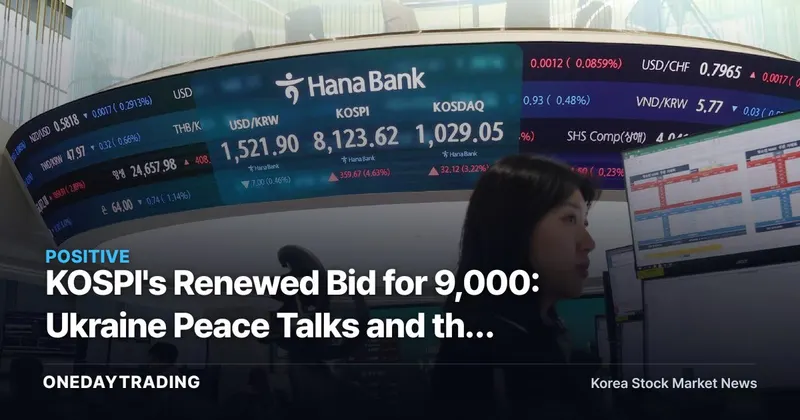
The KOSPI has settled above the 8,100 line, stoking expectations of a fresh all-time high and a renewed attempt at the 9,000 mark. This reflects the simultaneous convergence of possible progress in Ukraine peace talks, easing Middle East geopolitical risk, and early signs of improved foreign investor supply-demand (order flow). However, discord in the negotiations or the outcome of the FOMC meeting scheduled for the 18th could significantly widen near-term volatility, making confirmation of direction essential.
What Happened
The domestic stock market has recently been lifted by a revival in foreign buying. The market has begun pricing in expectations that a Ukraine ceasefire agreement may be imminent, stirring risk-on sentiment across global assets. The logic is that if a ceasefire materializes, stabilizing energy prices, normalizing supply chains, and reconstruction demand could all come into focus, creating a broadly favorable environment for risk assets.
However, another variable drawing market attention is uncertainty in the negotiation process. While talk of a ceasefire signing has emerged, if the parties fail to narrow their differences, expectations could quickly reverse. Should the agreement fail to proceed smoothly, disappointment-driven selling could emerge in proportion to the expectations already priced in, potentially widening volatility.
Layered on top of this is the U.S. Federal Open Market Committee meeting scheduled for the 18th. Depending on how the rate path and future monetary policy signals are presented, foreign fund flow, the value of the won, and equity market valuations could all be affected simultaneously. With the ceasefire issue and the FOMC — two major events — converging in the same week, a wait-and-see sentiment favoring confirmation over directional bets also coexists in the market.
Structural Background
Behind the recent KOSPI strength lies improved foreign investor supply-demand (order flow) and earnings expectations centered on major export sectors such as semiconductors. When the global liquidity environment, exchange rate, and geopolitical risk all move into an easing phase simultaneously, markets like Korea's — with a high share of exports and strong foreign investor influence — tend to gain relatively greater momentum.
Conversely, the Korean stock market also carries the weakness of high sensitivity to external variables. Because the index tends to swing sharply on externally determined events such as ceasefire negotiations or the FOMC, in a phase where positive catalysts have already been priced in, even a minor disappointment can trigger a larger price correction.
Impact by Stock and Sector
- Semiconductors: A direct beneficiary of improved foreign supply-demand (order flow) and risk-asset appetite, and a key pillar driving the index higher.
- Construction & Machinery: If the Ukraine war ends, expectations of reconstruction demand could come into focus, improving investor sentiment toward related stocks.
- Refining & Chemicals: A ceasefire and easing Middle East risk would lead to oil price stabilization, affecting cost burdens and margin volatility.
- Banking & Finance: A sensitive sector whose net interest margin and fund flow are directly shaped by the FOMC's rate path.
- Automobiles: A leading export sector tied to exchange rate movements and global economic recovery expectations, heavily influenced by foreign supply-demand (order flow).
Bullish vs. Bearish Scenarios
The bullish scenario is one in which the ceasefire agreement proceeds smoothly and the FOMC delivers a market-friendly signal. In this case, the combination of resolved geopolitical risk and liquidity expectations could strengthen foreign buying and add momentum to the KOSPI's renewed bid for the 9,000 level. The bearish scenario, on the other hand, involves discord in the negotiations collapsing expectations, or the FOMC being interpreted as hawkish. There is a risk that previously priced-in expectations get reversed, leading to a sharp drop (plunge) and expanded volatility in the near term. Both scenarios are realistic, and this week is likely to remain a period in which direction is hard to determine until the outcomes are confirmed.
Investor Action Points
- Monitor headline risk in real time, including whether a ceasefire is signed and statements from the parties involved.
- Adjust position sizing after checking the August 18 FOMC outcome, the rate dot plot, and the tone of the Chair's remarks.
- Use the continuation of foreign net buying and the won-dollar exchange rate trend as key gauges for assessing supply-demand (order flow).
- For stocks where expectations have already been priced in, consider scaling in and out gradually to prepare for a phase of expanding volatility.
This article is automatically summarized and analyzed content based on the original news source. View original (Maeil Business Newspaper)