
At a Glance
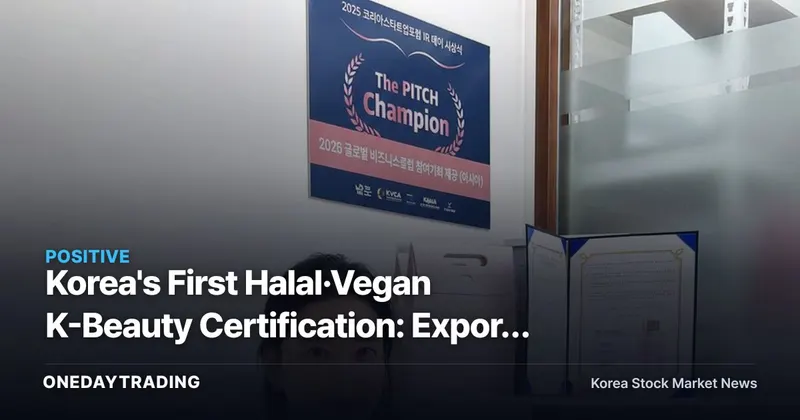
LadyKay has become the first Korean cosmetics company to secure dual halal and vegan certification, establishing a bridgehead for its push into the Muslim markets of the Middle East and Southeast Asia. More noteworthy than the individual company's certification itself is what it signals: a structural shift in which the K-beauty export market is broadening from its established North American and Greater China bases into the Muslim world.
Why It Matters Now
The significance of this development for investors goes beyond a single-stock positive catalyst. Until now, K-beauty exports have been heavily dependent on China, leaving earnings prone to swings from slowing Chinese consumption or variables like the THAAD dispute and group-tourism restrictions. The world's roughly 2 billion Muslims represent an untapped frontier that K-beauty has yet to penetrate in earnest, and halal certification serves as a de facto mandatory passport for entering this market. For companies that clear the certification barrier, market entry itself becomes a point of differentiation.
After securing domestic and duty-free demand through domestic online channels such as Coupang and Musinsa and a listing at Lotte Duty Free, LadyKay is now heading toward populous nations such as Indonesia and Malaysia via the establishment of a Southeast Asian subsidiary. Southeast Asia is a market with both a dense Muslim population and a low average age, where new demand for color cosmetics and skincare is growing rapidly.
That said, there is a time lag between obtaining certification and an actual contribution to revenue. Building local distribution networks, marketing costs, exchange rates, and customs and logistics variables can pressure early profitability, so it is premature to conclude that earnings will improve on certification news alone.
Frequently Asked Questions
- Why does halal certification matter: Muslim consumers base their purchasing decisions on whether pork-derived ingredients, alcohol, and the like have been excluded, making sales effectively impossible without certification. Adding vegan certification on top allows companies to also target Western eco-conscious consumers.
- Can it replace dependence on China: A full near-term replacement is difficult, but diversifying export destinations is expected to help spread the risk tied to any single country.
- Is this only LadyKay's story: No. The entire K-beauty value chain, including ODM and distribution firms, stands to be an indirect beneficiary of the expanding Muslim market.
- Is it already reflected in earnings: Certification and channel listings are stages that precede revenue recognition, and confirmation will require future quarterly export data.
Impact on Related Stocks and Sectors
- Silicon2: As an export platform that handles overseas distribution for K-beauty brands, it has a clear channel to benefit from expanded handling volumes as more new brands enter the Muslim world.
- Cosmax · Kolmar Korea: As ODM companies that produce halal and vegan formulations, they can expect order diversification effects if demand for certification-compliant products grows.
- Amorepacific: With local production and distribution infrastructure in Southeast Asia, it has room to enjoy economies of scale during the Muslim-market expansion phase.
- Clio: As a color-cosmetics-focused brand, it could align with new demand in the low-average-age Southeast Asian market.
Points to Watch When Investing
- Certification and channel-listing news does not translate immediately into revenue. The change in next quarter's export figures and overseas revenue share must be confirmed with actual metrics.
- K-beauty-related stocks tend to post short-term sharp gains (surges) on thematic expectations, so investors should be mindful of valuation burdens and volatility.
- The won-dollar exchange rate and local currency movements directly affect export profitability.
- Post-entry variables such as intensifying local competition and changes in customs and regulations are also worth monitoring.
Overall Outlook
The optimistic scenario is one in which the Muslim market, as a new source of demand, eases K-beauty exports' over-reliance on China, while the companies and value-chain players that clear the certification barrier first enjoy a first-mover advantage. Conversely, if early entry costs combine with exchange-rate and competition variables, there is a risk that profitability fails to materialize in the short term as much as hoped. Ultimately, the key is the speed at which the certification "ticket" is converted into actual revenue, and investors will need to separate the wheat from the chaff based on quarterly overseas revenue trends and channel-expansion disclosures.
Silicon2 by Real-Time Data
Silicon2's latest closing price is 32,000 won (-4.76% from the previous day), and its signal light—combining foreign and institutional investor order flow with news and momentum—is 🟡 Neutral · Wait-and-See. With positive and negative signals mixed, it is a phase to watch closely.
- ▼ Trend Alignment — Short- and mid-term downward alignment (intraday -4.8% · 1-week -5.3% · 1-month -15.9%)
- ▼ 52-Week Position — Bottom 1% of the 52-week range
Recent related news is favorable, with 1 positive catalyst · 0 negative catalysts.
※ Price and foreign/institutional investor order-flow data are provided by Korea Investment & Securities (KIS), as of the time of publication.
This article is content automatically summarized and analyzed based on the original news. View original (Maeil Business Newspaper, Corporate)