
Summary
The robot soccer matches at RoboCup 2026 in Incheon drew attention for their flashy ball control and curving-shot maneuvers, but this is a research and exhibition event that doesn't register as commercial revenue. What investors should watch isn't the match score, but the time lag before this technology migrates into actual commercial robot product lines — and the component and software supply chain that precedes it.
What Happened
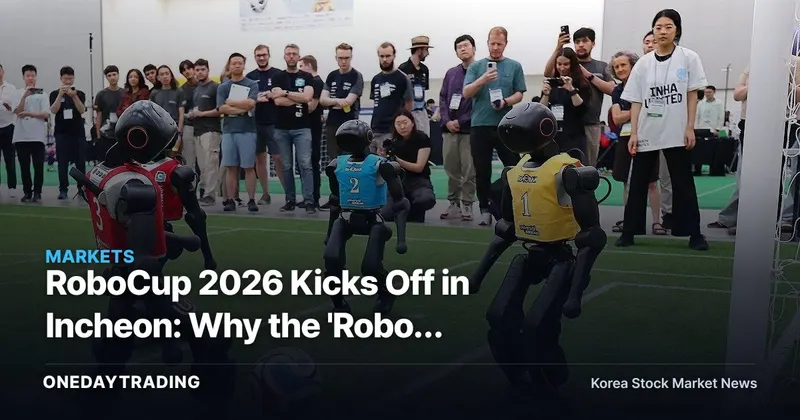
As the referee's whistle blew, the RoboCup 2026 arena in Incheon saw robots jostling for the ball and bending their shot trajectories one after another. It looks like simple robot soccer on the surface, but each of these movements represents a high-difficulty control problem being solved in real time: tracking the ball's position through real-time video recognition, and changing direction without losing balance using inertial measurement units (IMUs) and motor control algorithms.
Beyond robot soccer, RoboCup encompasses multiple leagues including disaster rescue and industrial automation, and most participating teams belong to universities and research institutes rather than companies. In other words, the technical achievements from this competition are less about contracts or orders tied directly to any listed company's quarterly earnings, and more about the accumulation of foundational robotics technology broadly. Missing this distinction risks misreading the feel-good RoboCup headlines as an immediate buy signal for robotics stocks (tickers).
Structural Background
RoboCup is an international robotics competition that began in 1997, with research teams from around the world gathering annually to compete on algorithms under the long-term goal of having a fully autonomous robot soccer team face off against a human World Cup champion team by 2050. The fact that Korea hosted this event is, in itself, a symbolic milestone reflecting the government's intelligent robotics industry promotion policies and the depth of university robotics research — underscoring the standing of the domestic robotics ecosystem.
Stock (Ticker) and Sector Impact
- Robotis: A company that has supplied Dynamixel-series actuators used in robot joints to the research and education robotics market, it sits close to the standard component supply chain used in RoboCup-style competitions. However, the event itself does not represent a contract that directly registers as revenue.
- Rainbow Robotics: Korea's leading humanoid robot developer. The advances in balance control and walking algorithms showcased at RoboCup ultimately point in the same direction as the company's roadmap for commercializing bipedal robots.
- Doosan Robotics: A collaborative robot (cobot) manufacturer. The precision control technology validated in the industrial automation league is linked in the long run to improving cobot work precision, but this too is separate from direct order wins.
- Yujin Robot: A company that has built up sensor fusion and autonomous navigation technology in the service and logistics robot space, classified as an industrial application case for the recognition algorithms validated in robot competitions.
Bullish vs. Bearish Scenarios
The bullish scenario is one where this kind of international event reignites policy and capital-market interest in the domestic robotics industry. If the government's robotics industry promotion stance converges with large-conglomerate capital inflows — such as Samsung Electronics' equity investment in Rainbow Robotics and Hyundai Motor Group's expansion into the robotics business — it could foster a favorable mood across the robotics theme as a whole. Conversely, the bearish scenario is one where such exhibition-style events fail to translate into actual earnings improvement and merely trigger theme-driven buying. With many robotics-related stocks (tickers) already pricing in future growth and carrying heavy valuation burdens, a widening gap between news exposure and actual order/revenue growth could lead to increased short-term volatility.
Investor Action Points
- Check the change in humanoid and cobot segment revenue share at Rainbow Robotics' and Doosan Robotics' next quarterly earnings releases.
- Monitor the schedule and budget scale of follow-up announcements on the government's intelligent robotics industry promotion policy.
- Watch for industrial order disclosures from component and actuator makers like Robotis beyond the research-institute and education markets.
- Track whether technologies showcased at RoboCup are subsequently transferred into actual commercial robot products (technology transfers, licensing deals).
Rainbow Robotics: A Real-Time Data Snapshot
Rainbow Robotics's most recent closing price was 492,500 won (+1.55% versus the previous session), and the signal combining foreign investor/institutional investor supply-demand (order flow) with news and momentum reads 🟢 Buy-leaning. Foreign investor flows, news, and momentum are all positive, making this one worth watching.
Recent related news skews favorable, with 1 positive catalyst versus 0 negative catalysts.
※ Price and foreign/institutional investor supply-demand (order flow) data are provided by Korea Investment & Securities (KIS) as of the time of publication.
This article is automatically summarized and analyzed content based on the original news report. View original article (Yonhap News Industry)