
At a Glance
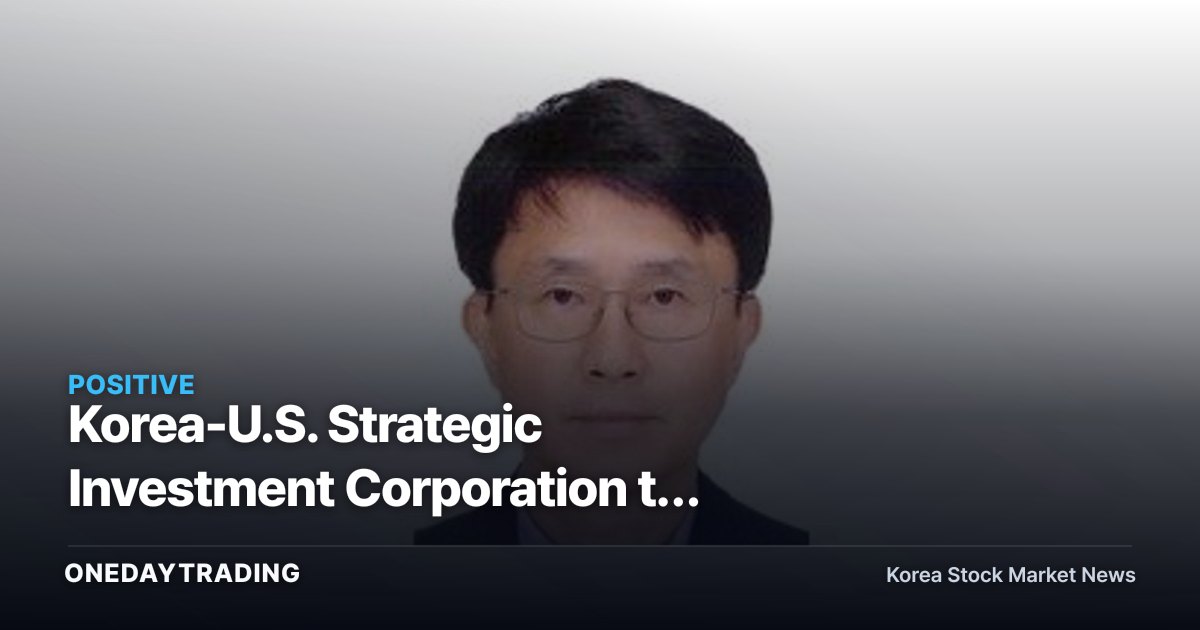
The Korea-U.S. Strategic Investment Corporation officially launches on the 18th, with Park Jong-won, former Trade Deputy Minister at the Ministry of Trade, Industry and Energy, named as its first president. This institution serves as the executing body for the U.S. investment package agreed upon in the Korea-U.S. trade negotiations. Because the industries the funds flow into are directly tied to the earnings of domestic listed companies, this carries significance well beyond a simple personnel announcement.
Why It Matters Now
The key issue is the direction of the money rather than the person. The U.S. investment package is structured to concentrate on strategic industries such as shipbuilding, semiconductors, batteries, nuclear power and critical minerals, and who executes it — and with what priorities — will determine the pace of order wins and capacity expansion in the beneficiary sectors. The fact that a figure with extensive hands-on trade experience has taken the first president's seat suggests that the sector-by-sector allocations agreed in the negotiations may take concrete shape quickly.
Shipbuilding, in particular, has been a sector where cooperation on construction and maintenance within the U.S. has been a core agenda item. With U.S. domestic capacity to build commercial vessels and naval ships having weakened, if Korean shipbuilders' technology and workforce connect to local yard operations and maintenance volumes, this would create a foundation for stable, recurring revenue that goes beyond simple exports. For semiconductors and batteries, local plant investment and subsidy structures, and for nuclear power, small modular reactors (SMRs) and equipment supply chains, could become the channels for fund execution.
Frequently Asked Questions
- What does the Korea-U.S. Strategic Investment Corporation do — It is the institution responsible for executing and managing the U.S. investment funds under the Korea-U.S. agreement, and its core function is determining how much is allocated to which industries.
- Why does a personnel appointment matter to the market — The launch and the naming of its head signal that fund execution is entering a real, actionable phase, improving the earnings visibility of the industries set to receive allocations.
- Which sectors will see benefits materialize first — Shipbuilding, where the U.S. has cited a gap in its own capacity, along with semiconductors, batteries and nuclear power, where incentives for local production are strong, are cited as priorities.
- Will it be reflected in earnings right away — No. There is a time lag before investment execution and order disclosures, so expectations are priced into share prices in advance and then verified through actual contracts.
Related Stocks and Sector Impact
- Shipbuilding — Once cooperation on construction and maintenance within the U.S. gets underway in earnest, order diversification through local yard operations and equipment supply. Hanwha Ocean has already secured a local foothold through its acquisition of the Philly Shipyard in the U.S., giving it a strong direct link.
- Shipbuilding — HD Hyundai Heavy Industries has room for top-line growth if cooperation volumes expand, given its naval and commercial vessel construction capabilities and production capacity.
- Semiconductors — Samsung Electronics and SK hynix could become direct recipients of funding and policy support within the U.S. local investment and subsidy structures, raising the possibility of eased capital expenditure burdens.
- Nuclear power — Doosan Enerbility could see order momentum form if Korea-U.S. cooperation takes concrete shape in the SMR and large-scale nuclear equipment supply chains.
- Batteries — If incentives for expanding local production grow, there is room for the U.S. revenue share of cell and materials makers to rise further.
Points to Watch When Investing
- Execution lag — The launch and personnel appointment are only a starting point; actual fund allocation and contracts could take several months or more, creating the risk that valuations run ahead on expectations alone.
- Allocation uncertainty — With the size and terms of allocations by industry and by company not yet finalized, the strength of the benefit could vary widely from stock to stock.
- Policy and exchange rate variables — Institutional changes on the U.S. side, subsidy terms, and the won-dollar exchange rate trend will alter the actual scale of the benefit.
- Pre-pricing burden — Some sectors, such as shipbuilding and nuclear power, have already priced in a considerable portion of the expectations, so volatility could increase once the catalyst is exhausted.
Overall Outlook
In the optimistic scenario, the execution framework takes shape quickly under a head well-versed in hands-on trade matters, with concrete order and investment disclosures following one after another centered on shipbuilding, semiconductors and nuclear power, raising the earnings visibility of the beneficiary sectors. Conversely, if the allocation size and schedule are delayed or the terms fall short of expectations, the pre-priced expectations could unwind, expanding volatility in the related stocks. The checkpoints are clear. The practical benchmarks for review are to track — along with their timelines — the institution's release of sector-by-sector investment guidelines, U.S. order disclosures in areas such as shipbuilding and nuclear power, and fund execution announcements tied to local semiconductor and battery investments.
Hanwha Ocean Through Real-Time Data
Hanwha Ocean's latest closing price is 138,900 won (+7.51% versus the previous day), and the signal light — combining foreign and institutional investor supply-demand (order flow) with news and momentum — is 🟢 Buy Bias. With news and momentum being positive, it is worth watching.
- ▲ Trend Alignment — Short- and medium-term upward alignment (same day +7.5% · 1 week +26.0% · 1 month +17.6%)
Recent related news is favorable, with 1 positive catalyst · 0 negative catalysts.
※ Price and foreign/institutional investor supply-demand (order flow) data are provided by Korea Investment & Securities (KIS), as of the time of publication.
This article is content automatically summarized and analyzed based on the original news report. View original (Yonhap News)