
At a Glance
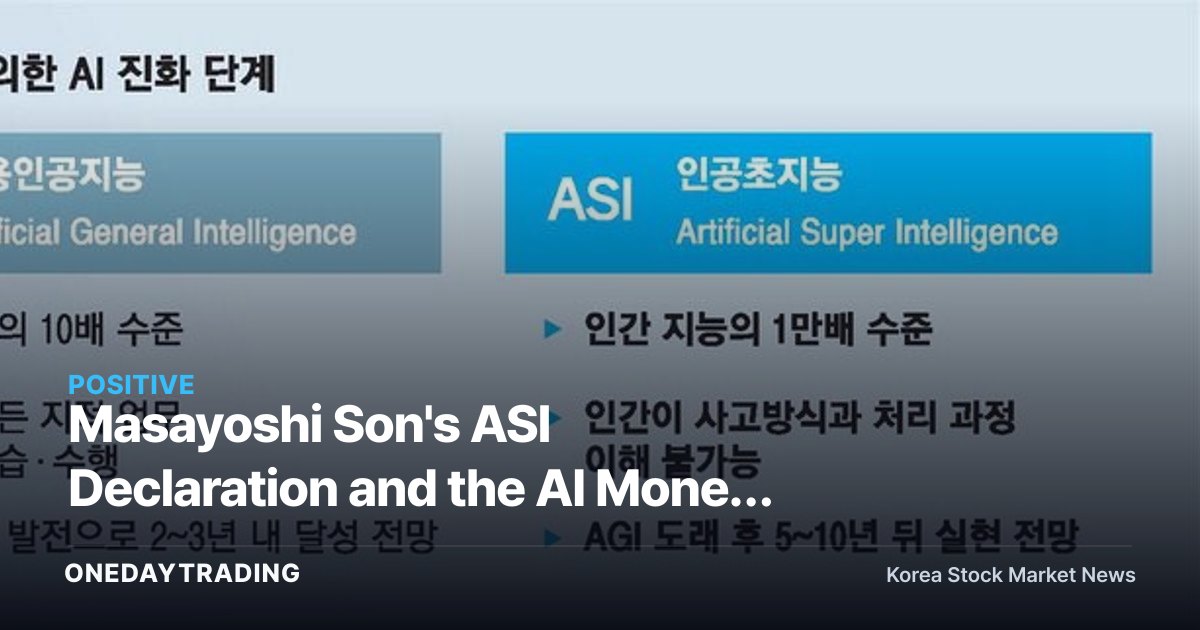
SoftBank Chairman Masayoshi Son has forecast that within a decade an artificial superintelligence (ASI) — one 10,000 times more capable than humans — will emerge, signaling a coming large-scale investment race. This goes beyond a simple look at the future; it reads as a sign that the so-called "money war," in which global capital floods into AI infrastructure and semiconductors, is beginning in earnest. For Korean investors, the key thing to watch is the potential for medium-to-long-term gains across the HBM, memory, and data center value chain.
Why It Matters Now
The ASI that Son describes refers not to existing AI that merely mimics human-level performance on specific tasks, but to a stage that overwhelms human intelligence across every domain. He emphasized the gap by saying it would make humans look like goldfish by comparison. What matters more than the rhetoric itself is that SoftBank is pouring actual capital into the infrastructure for building ASI — through its stake in ARM, its investment in OpenAI, and data center projects.
Such mega-scale investment translates directly into demand for the semiconductors that underpin AI computation. As large language models and inference workloads grow, demand rises in tandem for high-performance GPUs, the high-bandwidth memory (HBM) that supports them, and server DRAM. Because Korean memory makers effectively lead the global HBM market, expanded AI capital spending by global Big Tech and SoftBank is structurally tied to the earnings of Korean semiconductor firms.
That said, there is a gap between the expectations the word "ASI" generates and the actual pace of commercialization. Rather than being swept up in grand narratives, investors need to take an approach that distinguishes who is actually positioned in the value chain that generates revenue and profit.
Frequently Asked Questions
- What is ASI? It is a superintelligence stage that surpasses humans across all domains — a far more ambitious concept than today's commercial AI.
- Does Son's statement directly affect stock prices? It does not translate into immediate earnings, but expectations of expanded AI infrastructure investment stimulate market sentiment toward semiconductor and data center-related stocks.
- What does this have to do with Korean companies? Expanded global AI investment boosts demand for HBM and server memory, which works in favor of Korean memory semiconductor makers.
- Will earnings increase right away? Capital spending is reflected with a time lag, and short-term volatility can be significant.
Affected Stocks and Sectors
- SK hynix — As a leader in the HBM market, it is expected to be a direct beneficiary of growing demand for AI accelerators.
- Samsung Electronics — Spanning HBM, server DRAM, and foundry, it has potential to benefit from the AI memory cycle.
- Semiconductor equipment and materials stocks — As investment in memory capacity expansion grows, the trickle-down effect could spread to back-end process and materials firms.
- Data centers and power infrastructure — The explosion in AI computation drives up demand for power, cooling, cabling, and other infrastructure.
- AI software and platforms — The trend toward more advanced models raises growth expectations for related solution providers.
Points to Watch When Investing
- ASI is a long-term vision, and one must account for the substantial time lag between it and near-term quarterly earnings.
- AI themes frequently price in expectations ahead of time, bringing along short-term volatility and valuation burdens.
- The capital spending cycle can swing with memory prices and demand, so monitoring industry conditions is necessary.
- Rather than grand narratives, investors should separate the wheat from the chaff, focusing on the value chain that actually generates revenue and profit.
Overall Outlook
In the optimistic scenario, the global race to invest in AI infrastructure continues for several years, structurally expanding demand for HBM and high-performance memory, and the Korean semiconductor value chain enjoys those benefits over the long term. On the risk side, variables remain — delayed ASI commercialization, bubble concerns from overheated AI investment, memory price volatility, and US-China technology regulation. In conclusion, while the direction is favorable, during periods of theme overheating, a phased approach should go hand in hand with confirmation of earnings.
This article is content automatically summarized and analyzed based on the original news report. View original (Maeil Business Newspaper, Corporate)