
Summary
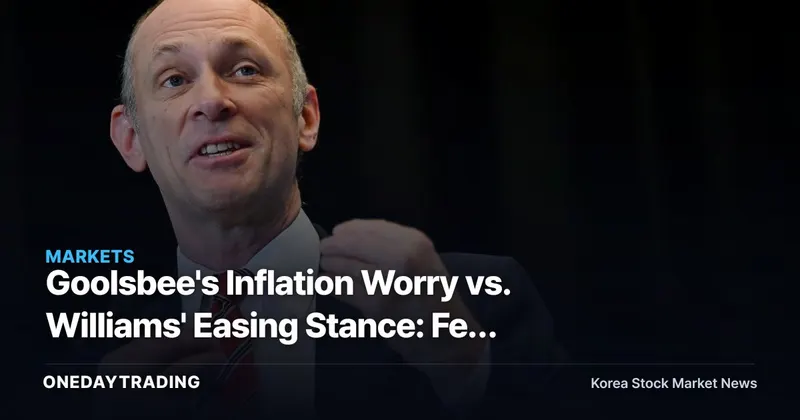
With key Fed officials diverging in their assessments of inflation, uncertainty has grown over the timing of rate cuts. Chicago Fed President Goolsbee warned that inflation is still high, while New York Fed President Williams judged that price pressures are easing. This gap in views is a variable that could sway the near-term direction of the won-dollar exchange rate as well as Korean export and financial stocks.
What Happened
These remarks matter to Korean investors because the Fed's rate decisions feed directly into KOSPI supply-demand (order flow) through the won-dollar exchange rate and foreign investors' fund flow. If rate cuts come faster, a weaker dollar and stronger won would stimulate buying by foreign investors; but if cuts are delayed on concerns about reignited inflation, a prolonged high-rate environment would weigh on growth stocks and borrowing-dependent industry sectors.
In an interview conducted in his own district, Goolsbee maintained a cautious stance, declining to give a direct answer on where rates are headed. His emphasis that inflation remains high relative to the target is read as a sign of wariness toward premature easing.
Williams, by contrast, assessed that price pressures are gradually softening. The setup—one side stressing the risk of entrenched inflation and the other an easing trend, both looking at the same data—is a signal that consensus within the Fed is not yet firm.
Structural Background
When the Fed sets monetary policy, it aggregates the individual judgments of its members. A single official's remark therefore does not settle policy, but where the center of gravity tilts—between the hawks (Goolsbee-style caution) and the doves (Williams-style easing)—shapes market expectations. In a phase like the current one, where assessments diverge, it is easy for a volatile market to persist, with the exchange rate and rate futures swinging on every data release and comment.
Impact on Stocks and Sectors
- Large-cap exporters (Samsung Electronics, Hyundai Motor): If delayed cuts keep the dollar strong and the won weak, that is favorable in terms of near-term currency gains, though concerns over slowing global demand act as an offsetting factor.
- Banks and financials (KB Financial, Shinhan Financial Group): A prolonged high-rate environment is favorable for net interest margin (NIM), but rising expectations of a pivot to cuts would bring margin-compression concerns to the fore.
- Growth and tech stocks (Naver, Kakao): This is the quintessential rate-sensitive sector, where a retreat in rate-cut expectations raises discount rates and increases valuation pressure.
- Construction and real estate-related stocks: Sensitive to borrowing costs, these face a prolonged funding burden if cuts are delayed.
Bullish vs. Bearish Scenarios
The bullish scenario is one in which upcoming U.S. inflation data support Williams' easing assessment. If rate-cut expectations revive, there is room for foreign investors' funds to flow into the KOSPI and for growth stocks to rebound. The bearish scenario is one in which, as Goolsbee cautions, inflation turns sticky again, pushing the timing of cuts back and potentially triggering corrections in high-valuation growth stocks and rate-sensitive sectors. Either way, no single remark determines the trend, and until the actual data is confirmed, the weight lies on volatility rather than direction.
Investor Action Points
- In the next U.S. Consumer Price Index (CPI) and Personal Consumption Expenditures (PCE) releases, check whether the inflation-slowdown trend aligns more closely with Goolsbee's or Williams' assessment.
- Monitor the won-dollar exchange rate level to gauge whether the larger impact falls on export stocks (currency gains) or rate-sensitive stocks (funding costs).
- Watch the dot plot and the chair's remarks at the next FOMC meeting for signs that the gap in views among members is narrowing.
- If your portfolio is heavily weighted toward high-valuation growth stocks, review its rate sensitivity to prepare for the risk of delayed cuts.
This article is content automatically summarized and analyzed based on the original news. View original (CNBC)