
At a Glance
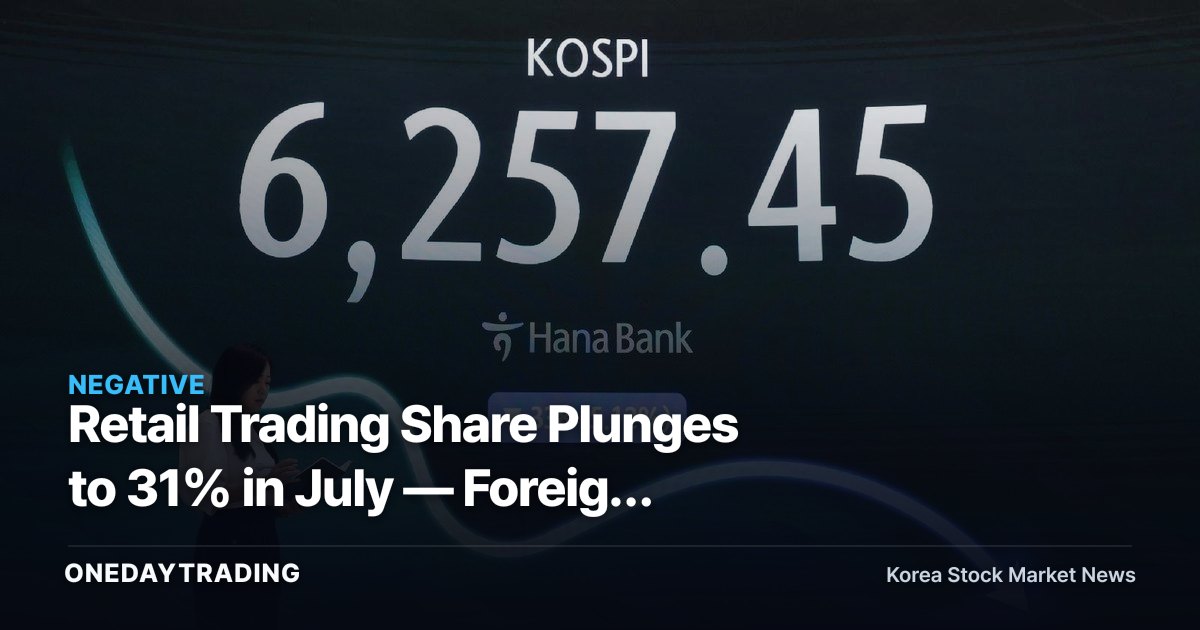
Retail investors' share of KOSPI trading has slipped into the low-31% range in July. The seat once occupied by retail investors, who had a real voice in the market just six months ago, is now being filled by foreign investors. Because this shift is unfolding alongside a decline in overall trading value, it reads not as a simple rotation but as a signal that retail money is leaving the market altogether.
Why It Matters Now
A single trading-share figure doesn't tell you direction — it tells you where the power is shifting. The fact that retail's share is falling and total trading value is contracting at the same time means retail investors aren't just selling and watching from the sidelines — they're pulling their capital out entirely. In this phase, what determines KOSPI's direction isn't retail buying sentiment but foreign investors' currency-gain calculus and valuation judgment. If a KOSPI rally is being built on foreign supply-demand (order flow) alone rather than a return of retail investors, that rally is also exposed to a correspondingly larger reversal the moment the KRW/USD exchange rate or U.S. interest rate levels shift.
What the market has already priced in is the simple fact that retail investors are absent. What hasn't been priced in yet is how well this foreign-dominated order flow can hold up against the earnings season and monetary-policy variables ahead. A market with thinner trading value is more vulnerable to volatility — meaning even a one-sided rush of buy or sell orders can swing the index sharply.
Frequently Asked Questions
- Does a decline in retail trading share mean KOSPI itself will fall? Not necessarily. Trading share and index direction are separate matters. It does mean, however, that the driver of gains has shifted from retail to foreign investors, making any rally more vulnerable to volatility.
- What does the decline in trading value mean? It means the amount of capital actually participating in the market has shrunk. Thinner liquidity creates conditions where even small sell orders can swing the index sharply.
- Will foreign investors' growing influence continue? That depends on the direction of the KRW/USD exchange rate and U.S. interest rates. If the incentive from currency gains disappears, foreign supply-demand (order flow) could reverse direction quickly.
- Where has retail money gone? The article doesn't confirm this directly, but in phases like this, a decline in brokerage deposits is typically accompanied by a shift toward safe-haven assets or overseas investment.
Related Stocks (Tickers) and Sector Impact
- Kiwoom Securities: A retail-focused brokerage with an overwhelmingly high share of retail investors, making the decline in trading value a direct downward pressure on its brokerage commission revenue.
- NH Investment & Securities, Samsung Securities, and other large brokerages: These firms are also exposed to the pullback in trading value given their substantial brokerage revenue, but their relatively large wealth-management and investment-banking segments help spread out the impact.
- Foreign-favored industry sectors among KOSPI large-caps: Sectors such as semiconductors, where foreign supply-demand (order flow) is concentrated, benefit more from index gains, but this leaves them in an asymmetric structure where declines are also steeper if foreign investors pull out.
- KOSDAQ and small/mid-cap stocks: KOSDAQ, where retail investors' share is relatively higher, sits directly in the line of fire from the pullback in retail trading, and its decline in trading value could outpace KOSPI's.
Investment Considerations
- When trading value is thin, the influence of a small number of market participants grows larger. Investors should keep in mind that a rally dependent solely on foreign supply-demand (order flow) can also reverse just as quickly.
- Keep an eye on the KRW/USD exchange rate level as well. If expectations for currency gains fade, foreign net buying flows could shift.
- Whether retail trading share recovers should be used only as a sentiment gauge — it's not sufficient on its own as a basis for trading decisions.
- Since the concentration of foreign supply-demand (order flow) varies by industry sector, it's worth examining the supply-demand structure of individual sectors separately rather than relying on the index as a whole.
Overall Outlook
In the optimistic scenario, foreign capital continues to flow in on the strength of KOSPI's valuation appeal, with retail investors gradually returning to follow that trend. In this case, trading value would naturally increase as well. Conversely, if the KRW/USD exchange rate comes under renewed depreciation pressure, or expectations for U.S. rate cuts recede, the foreign supply-demand (order flow) driving the current rally could be the first to falter. In that scenario, a market thinned out by the absence of retail capital risks a rise in volatility. The next Monetary Policy Board rate decision, the upcoming U.S. CPI release, and how the KRW/USD exchange rate moves around the 1,300 won level are the next indicators to watch for whether this pattern holds.
This article is auto-summarized and analyzed content based on the original news report. View Original (Maeil Business Newspaper Securities)