
Key Takeaways
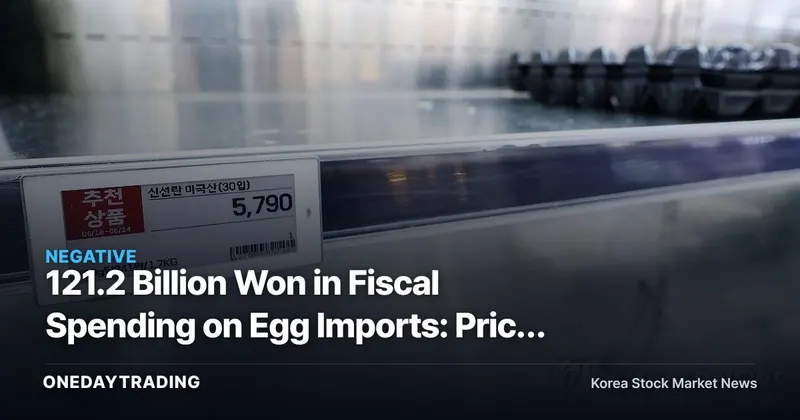
The government is allocating 121.2 billion won to import 231.39 million fresh eggs through August this year in an effort to stabilize egg prices. While imported eggs serve as a short-term inflation defense measure, they simultaneously act as a price pressure factor for domestic laying-hen and poultry-related stocks by capping wholesale price ceilings.
With the industry pointing to regulations as the source of its high-cost structure, this issue risks expanding beyond a simple supply-demand (order flow) concern into a broader policy variable — namely, whether farming environment and distribution regulations will be reformed.
What Is Happening
The government has earmarked 121.2 billion won to import a total of 231.39 million fresh eggs from abroad, under the stated objective of stabilizing domestic egg prices. Imports will continue through August, with the intent of injecting external supply during shortage periods to curb sharp gains (surges) in wholesale prices.
The production industry, however, argues that the root cause of rising prices lies not in temporary supply-demand (order flow) imbalances but in structural costs. Regulations governing stocking density, culling, quarantine, and distribution channels have driven up per-unit production costs, compounded by the burden of feed expenses — resulting in an entrenched cost base. The argument is that suppressing prices through imports will have limited effect if the underlying cost structure remains unchanged.
Background and Context
Eggs are a staple inflation indicator, making price management in this category directly tied to the government's consumer price index targets. Whenever avian influenza (AI) outbreaks have led to mass culling of laying hens in the past, egg prices have surged sharply, and import injections have been a recurring policy response. However, the partial effectiveness of imported eggs — limited by freshness concerns and consumer preference — has consistently been a complicating variable.
Market and Stock (Ticker) Impact
- Harim: As South Korea's leading poultry and food company with significant exposure to the poultry segment, a government-driven expansion of imports that caps wholesale price upside could pressure margins in the poultry division.
- Easy Holdings: With a structure spanning feed and livestock subsidiaries, a deterioration in laying-hen farm profitability could simultaneously affect feed demand and affiliate earnings.
- Manikker & Cherrybro: Primarily broiler-focused, but indirectly exposed to policy-driven supply-demand (order flow) shifts through their linkage to poultry prices and consumer market sentiment.
- Hanil Feed & Sajo Dongawon: Feed companies' earnings are driven by grain prices and the number of livestock on farms; a decline in farm profitability could translate into slower feed sales volumes.
- Distribution and Food Processing Stocks: Processed food and foodservice companies that use eggs as a raw material stand to benefit from cost stabilization for margin defense — pointing in the opposite direction.
Investor Checkpoints
- Monitor the actual customs clearance and release pace of imported volumes alongside weekly domestic farm-gate and wholesale egg price trends via agricultural price data.
- Track AI outbreaks and laying-hen flock size statistics — a renewed supply shock would be the key variable that offsets the impact of imports.
- Watch grain and exchange rate trends as drivers of feed costs, and monitor quarterly earnings for changes in poultry and feed segment margins at relevant companies.
- Assess whether discussions on reforming farming environment and distribution regulations make it onto the policy agenda — the inflection point for the structural cost changes flagged by the industry.
Outlook
A near-term easing of egg prices driven by expanded imports could be favorable for food processors with egg-based input costs. However, from the perspective of laying-hen and poultry-related companies, a prolonged period of suppressed wholesale price ceilings risks delaying any earnings recovery. Conversely, should a new supply shock such as an AI outbreak emerge, or feed costs rise again, the impact of imports would be diluted and price volatility could increase. Ultimately, the key question is whether the gap between the short-term remedy of imports and the structural cost issues raised by the industry can be narrowed through policy action.
Harim — A Real-Time Data Snapshot
Harim's most recent closing price was 2,585 won (–2.45% vs. the prior day). Its composite signal — incorporating foreign investor and institutional investor supply-demand (order flow) alongside news and momentum — reads 🔴 Caution. Foreign investor flows and momentum are both negative, warranting a cautious stance at this time.
- ▼ Trend Alignment — Bearish alignment across short and medium-term timeframes (day: –2.5% · 1 week: –7.2% · 1 month: –11.3%)
- ▼ 52-Week Position — Within 2% of the 52-week low
※ Price and foreign investor/institutional investor supply-demand (order flow) data are provided by Korea Investment & Securities (KIS) and reflect conditions at the time of publication.
This content was automatically summarized and analyzed based on the original news article. View original article (Yonhap News)