
What Samsung Electronics and SK Hynix’s Sharp Swings Signal
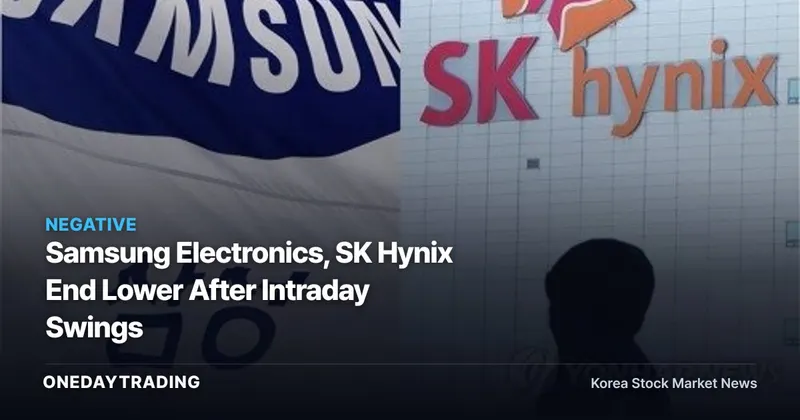
Samsung Electronics and SK Hynix ended the regular session slightly lower on November 4, 2026, after sharp intraday swings. The price action reported by Yonhap News suggests that the stocks reacted rapidly to supply-demand (order flow) and uncertainty, rather than signaling a clear direction for the semiconductor industry. The key points are the wide intraday trading ranges and concentrated selling by foreign investors, not the modest declines at the close.
The sharp swings refer to a session in which early gains failed to hold, prices reversed lower, and then recovered part of their losses. A single day’s movement does not provide sufficient grounds to draw conclusions about the semiconductor industry or future share prices. The actual impact of each factor behind the intraday volatility has also not been established.
Samsung Electronics Ranged From 228,000 Won to 208,000 Won
Samsung Electronics rose as much as 3.87% intraday to 228,000 won on November 4, 2026, before falling 5.24% to 208,000 won. Its regular-session closing price was 218,000 won, down 0.68% from the previous session. This indicates that neither buying at the high nor selling at the low continued one-sidedly through the close.
Based solely on the closing price, the decline was limited. Although the stock appeared only slightly weaker on the surface, the session involved several reversals in intraday direction. Investors should distinguish between a definitive reassessment of the semiconductor industry and price volatility occurring within a single day. The available data supports only the latter.
SK Hynix Also Reversed Direction Intraday
SK Hynix climbed as much as 5.58% intraday to 1,476,000 won on November 4, 2026, before falling 6.80% to trade at 1,303,000 won. The stock displayed volatility similar to Samsung Electronics, with gains and losses occurring during the same session.
However, the data does not include SK Hynix’s closing price or its price change rate from the previous day. The intraday price of 1,303,000 won therefore should not be interpreted as the closing price or used to compare its decline directly with Samsung Electronics. Separating the confirmed price path from the unconfirmed closing figures is the starting point for analysis.
Foreign Net Selling Was Concentrated in the Two Chip Stocks
According to Yonhap News, foreign investors recorded net sales of 2.502 trillion won on the KOSPI market on November 4, 2026. SK Hynix and Samsung Electronics ranked first and second, respectively, among stocks with the highest foreign net selling. This is why stock-specific selling amounts should be considered when assessing movements in the KOSPI electrical and electronics industry sector, which includes both companies.
Foreign net selling totaled 1.1657 trillion won for SK Hynix and 808.3 billion won for Samsung Electronics on November 4, 2026. These supply-demand (order flow) figures coincided with intraday weakness in both stocks. However, foreign net selling alone cannot explain every cause of the sharp swings, and the data does not quantify the impact of each factor.
Vote-Count Uncertainty and Concerns Over Acceptance Constraints
Kang Jin-hyuk, an analyst at Shinhan Securities, said, “The broader market plunged as the midterm election vote count progressed.” He added that early counting trends, together with gubernatorial election results, raised the possibility of delays in AI data-center permitting and fueled concerns over “acceptance constraints.” This is an expert interpretation of the day’s volatility and does not mean the actual impact was measured.
The market’s price action can be viewed as an immediate response to uncertainty, rather than the reflection of a confirmed industry outcome. Election-related anxiety involving Donald Trump was also cited as a factor that day, but the available data cannot isolate how much each factor affected the prices of Samsung Electronics and SK Hynix.
Conditions Separating Bullish and Bearish Scenarios
A bullish scenario would involve continued recovery from the intraday lows. Investors should monitor the closing-price trends of Samsung Electronics and SK Hynix, the direction of foreign-investor trading, and changes in concerns about delays to AI data-center permitting raised during the vote count. Rather than relying on any single factor to determine direction, investors should watch whether prices and supply-demand (order flow) move together.
A bearish scenario would involve continued foreign net selling and renewed declines toward the two stocks’ intraday lows. When an opening gain reverses into a decline, as it did that day, early strength alone is not enough to conclude that confidence in the industry outlook has solidified. Conversely, if foreign selling subsides, the case for interpreting the day’s volatility as a persistent bearish signal would also weaken.
Indicators Investors Should Monitor Next
- Price: Monitor whether subsequent trading extends the price action from Samsung Electronics’ 218,000 won closing price and its intraday range between 228,000 won and 208,000 won.
- Supply-demand (order flow): Watch whether foreign investors continue net selling SK Hynix and Samsung Electronics and whether their rankings among the stocks with the highest foreign net selling change.
- Uncertainty: Determine whether concerns cited by analyst Kang Jin-hyuk over the midterm election vote count and delays to AI data-center permitting persist.
- Data limitations: Do not compare the two stocks’ closing performances on the same basis until SK Hynix’s closing price and price change rate from the previous day are confirmed.
Samsung Electronics Key MetricsAs of 2026-11-04
| Period Returns | 1 Week -10.33% 1 Month -21.38% |
|---|---|
| Trading Value · Trading Volume | 88.3 billion won · 31,857,207 shares |
| Supply-Demand (Order Flow) | Foreign Investors −818.6 billion won net sold Institutional Investors +133.1 billion won net bought |
| Recent News Tone | Positive Catalyst 7 · Negative Catalyst 5 |
Real-time price and supply-demand (order flow) data is provided by Korea Investment & Securities (KIS), while supply-demand (order flow) and news-tone figures are calculated independently by One Day Trading.
Supply-Demand (Order Flow) and Momentum Assessment🟡 Neutral · Wait-and-See
Positive and negative signals are mixed, indicating a period for continued monitoring.
- ▼Trend AlignmentShort- and medium-term bearish alignment (Day -1.1% · 1 Week -10.3% · 1 Month -21.4%)
Upcoming Events to Monitor
- 11.12Index Options ExpirationLowKOSPI200 options expiration
- 11.26Bank of Korea Monetary Policy BoardHighBenchmark interest rate decision meeting
- 12.09FOMC Policy Rate DecisionHighU.S. Federal Reserve monetary policy announcement — direction of interest rates and the dollar
- 12.10Futures and Options ExpirationMediumQuadruple witching — watch for volatility and supply-demand (order flow) disruptions
This article was automatically summarized and analyzed based on the original news report. View the original article (Yonhap News)