
Democratic Victory Hopes Reprice Green-Energy Stocks
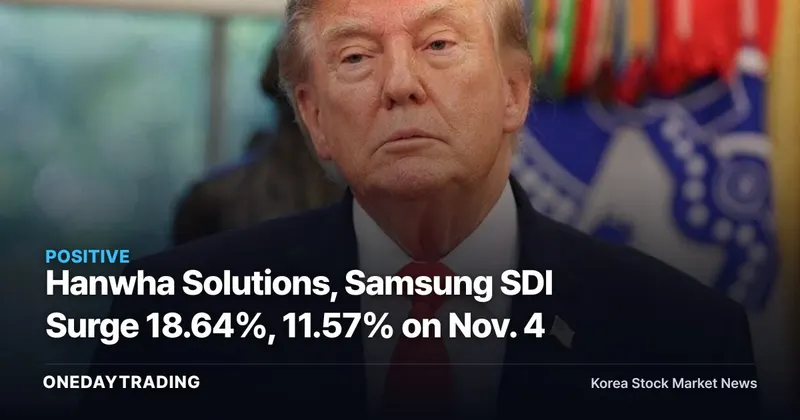
Hanwha Solutions and Samsung SDI jumped 18.64% and 11.57%, respectively, on the 4th. South Korean solar and rechargeable-battery stocks were the first to react to the U.S. midterm election results and projections reported by Maeil Business Newspaper’s securities desk. Investors must distinguish between election-driven policy expectations and corporate earnings that have yet to materialize.
The U.S. midterms determine the composition of Congress, and the market’s focus this time is on projections that Democrats will retake the Senate majority and secure a majority in the House. Expectations that a shift in congressional power would check the Trump administration’s rollback of green policies provided a catalyst for revaluing the related industry sectors.
NBC Projects a Democratic House Majority
Democrats regained their Senate majority. As of 11:30 p.m. local time on the 3rd, NBC projected that Democrats would secure 255 of the House’s 435 seats. While the Senate result has been confirmed, investors should note that a Democratic House majority remains a projection rather than a final result.
U.S. President Donald Trump accepted the election result in which Republicans lost their majorities in both chambers but reaffirmed that he would veto Democratic-led legislation. Even with a different congressional makeup, the details and prospects of new green-support legislation—and whether Inflation Reduction Act-related incentives will be restored—remain undecided.
Rally Spreads From Hanwha Solutions to EcoPro
Hanwha Solutions closed at 27,999.04 won on the 4th, up 4,399.04 won, for a gain of 18.64%. OCI Holdings also rose 10.38%. The scale of the gains in solar stocks shows that the market priced in renewed policy expectations before any actual policy implementation.
On the same day, Samsung SDI rose 11.57% and LG Energy Solution gained 5.03%. EcoPro BM and EcoPro advanced 10.96% and 9.54%, respectively. Hyundai Motor Securities analyst Jang Moon-soo said Democratic control of both chambers could revive expectations for green-energy policies supporting solar and rechargeable batteries, while anticipated investment in energy storage systems and power grids would also benefit the related industry sectors.
The Hurdle Between Policy Expectations and Corporate Earnings
The news will begin to affect earnings if green-support legislation and expanded investment in energy storage systems and power grids become reality. What is visible now is the price reaction in related stocks; what is not yet confirmed is the passage of new legislation or an improvement in corporate earnings. Continued policy expectations would support the revaluation case for solar and rechargeable-battery stocks, but the calculation changes if a presidential veto or legislative negotiations block progress.
With share prices already higher, the next assessment requires evidence of actual business volumes. Investors should examine order announcements, utilization rates, and earnings to determine whether policy expectations are translating into real demand. Until those data emerge, the scale of the sharp gain (surge) alone is insufficient evidence that the green-energy industry sector has entered a new cycle.
Supply-Demand (Order Flow) Warning Lingers Behind KOSPI Gain
The KOSPI opened at 5,786.13 on the 4th and moved between 5,828.13 and 5,421.72 intraday before closing at 5,683.80, up 35.01 points, or 0.62%, from the previous session. Although the closing price points to a rising market, the intraday path makes it difficult to interpret the election result as an unequivocal catalyst for the broader market.
In the main KOSPI market on the 4th, foreign investors sold a net 2.502 trillion won, while retail investors and institutional investors purchased a net 1.1441 trillion won and 1.0136 trillion won, respectively. The sharp gain (surge) in green-energy stocks therefore coincided with fragile KOSPI supply-demand (order flow). A thematic rally did not amount to a broader recovery in market risk appetite.
Samsung Electronics and SK Hynix Move the Other Way
Samsung Electronics and SK Hynix fell as much as 5%–6% intraday on the 4th before closing down 0.68% and 0.14%, respectively. Large-cap semiconductor stocks moved in the opposite direction even as green-policy expectations strengthened. This is why gains in green-energy stocks alone cannot explain whether the post-election index rebound will persist.
Kiwoom Securities analyst Han Ji-young said Democratic control of Congress could restrain the Trump administration’s fiscal spending and ease upward pressure on long-term interest rates. She also suggested that expectations of a Democratic victory may already have been priced into the market, adding that the rebound’s durability would depend on whether concerns surrounding the AI industry and geopolitical risks subside.
Conditions Separating the Bull and Bear Cases
Bull case: Democrats are ultimately confirmed to have secured a House majority, and discussions over green-energy support continue. If expectations for increased investment in energy storage systems and power grids persist, the policy premium attached to solar and rechargeable-battery stocks may remain intact.
Bear case: A presidential veto and legislative negotiations prevent policy expectations already priced into the market from becoming law. If concerns about the AI industry or geopolitical risks remain unresolved, the KOSPI’s short-term rebound may also struggle to continue. The stocks most vulnerable would be those that rapidly priced in election expectations without equivalent support from earnings.
Next Signals for South Korean Investors to Watch
- Check whether the projected Democratic House majority becomes a final result.
- Following Donald Trump’s veto pledge, distinguish between the details of green-support legislation and whether it can actually pass.
- Review order announcements, utilization rates, and earnings from Hanwha Solutions, OCI Holdings, and battery stocks to assess whether policy expectations are translating into demand.
- Track Samsung Electronics, SK Hynix, and supply-demand (order flow) from foreign investors to determine whether the green-energy rebound is broadening across the KOSPI.
Hanwha Solutions Key MetricsAs of 2026-11-04
| Period Return | 1 Week +6.74% 1 Month -21.05% |
|---|---|
| Trading Value · Trading Volume | 28.8 billion won · 24,309,679 shares |
| Supply-Demand (Order Flow) | Foreign Investors Net selling of 35.1 billion won (10 consecutive days) Institutional Investors Net buying of 19.2 billion won |
Price and supply-demand (order flow) data are real-time figures from Korea Investment & Securities (KIS), while supply-demand (order flow) and news-tone aggregates are calculated independently by OneDayTrading.
Supply-Demand (Order Flow) · Momentum Assessment🟡 Neutral · Wait and See
Mixed positive and negative signals suggest a wait-and-see phase.
- ▼Supply-Demand (Order Flow) ContinuityForeign investors net sellers for 10 consecutive days (−35.1 billion won)
Upcoming Dates to Watch
- 11.12Index Options ExpirationLowKOSPI 200 options expiration
- 11.26Bank of Korea Monetary Policy BoardHighBenchmark interest rate decision meeting
- 12.09FOMC Policy Rate DecisionHighU.S. Federal Reserve monetary policy announcement — direction of interest rates and the dollar
- 12.10Futures and Options ExpirationMediumQuadruple witching — watch for volatility and supply-demand (order flow) disruptions
This article was automatically summarized and analyzed based on the original news report. View original article (Maeil Business Newspaper Securities)