
Three-Line Briefing
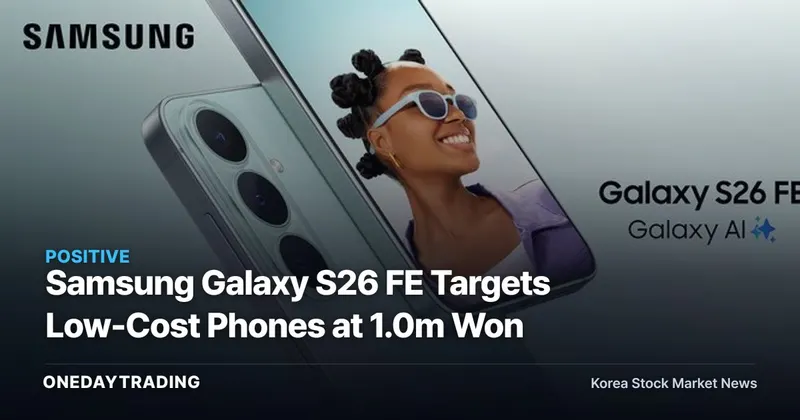
- Samsung Electronics is targeting the weakened low-cost phone market with the Galaxy S26 FE, which packs key flagship features into a price in the low 1 million won range.
- The key issue is not simply a lower launch price, but how much Samsung has narrowed the perceived performance gap while absorbing rising component costs.
- Even if sales volume increases, higher discounts and component costs could limit earnings contribution, so investors should track average selling prices and cost trends rather than shipments alone.
What Is Changing
The Galaxy S26 FE is the result of Samsung Electronics’ pricing strategy of bringing major flagship features into the low 1 million won range. For investors, the key question is not merely whether it can revive mid- to low-end demand, but whether Samsung can protect smartphone business margins while offering premium features at a lower price. When component prices continue to rise, simply lowering the launch price does not directly translate into improved earnings.
The profit and loss of a single smartphone is determined by the combined cost of sourcing components such as the application processor, display, camera module, memory and battery, along with assembly and logistics costs and distribution and marketing expenses. Maintaining core flagship features inevitably raises the share of high-spec components. If Samsung Electronics reused previous-generation components or adjusted specifications to reduce costs, the product could gain price competitiveness, but sales expansion would be limited if consumers perceive a wider performance gap.
Looking at the supply chain in stages, price increases by materials and component suppliers are first reflected in Samsung Electronics’ costs, while carrier subsidies and retail discounts add further pressure at the finished-product stage. For the Galaxy S26 FE to revive the market, manufacturing-cost reductions, tight control of initial inventory and management of discount rates across distribution channels must work together. If sales volume rises while promotional spending expands, revenue may increase even as the operating profit margin declines.
By the Numbers and in Context
The fact that the launch price is in the low 1 million won range signals an attempt to target the price gap between flagship phones and standard mid- to low-end devices. Consumers can avoid the burden of top-tier pricing while gaining core features, and Samsung Electronics can broaden its demand base without damaging its premium brand image. However, when component prices are rising, this price band leaves limited room to absorb cost volatility.
The contraction of the low-cost phone market also means demand has become more price-sensitive. The Galaxy S26 FE’s performance should be judged by actual sales and carrier inventory turnover during the four to eight weeks after launch, rather than by preorders. If shipments exceed those of the previous model while the average selling price holds, the quality of the product-line expansion will be confirmed. But if discounts widen rapidly, that would signal price competition is eroding profitability.
Beneficiary and Casualty Stocks
- Samsung Electronics: If the Galaxy S26 FE absorbs mid- to low-end demand, smartphone shipments and component procurement could increase. However, expanded high-spec component use and promotional spending would limit improvement in the mobile business margin.
- Samsung Electro-Mechanics: Higher supplies of key components such as camera modules and multilayer ceramic capacitors could provide a volume benefit. But if Samsung Electronics intensifies cost-cutting pressure, the company could face demands for lower unit prices.
- LG Innotek: Changes in Samsung Electronics’ volumes are a variable in competition for the camera-component supply chain. The impact on component adoption will depend on how much the Galaxy S26 FE’s specifications overlap with higher-end models.
- Qualcomm: If Samsung Electronics maintains the share of externally sourced application processors, chip supply opportunities will arise. But volumes could decline if Samsung expands the use of in-house chips or low-cost solutions to reduce costs.
Risk Check
- If component prices continue to rise, Samsung will have to adjust specifications or distribution margins to maintain a price in the low 1 million won range.
- If carrier subsidies expand at launch, sales volume may rise while the actual average selling price falls rapidly.
- Discounts on older iPhones from Apple or high-spec, low-priced models from Chinese manufacturers could weaken the Galaxy S26 FE’s differentiation.
- If sales fall short of expectations, Samsung Electronics will face inventory-adjustment and marketing-cost burdens at the same time.
Bottom Line
The Galaxy S26 FE is Samsung Electronics’ card for regaining low-cost demand, but success cannot be judged by a launch price in the low 1 million won range alone. If actual sales continue while the average selling price and mobile business margin hold, the outlook is positive. If discount competition intensifies, damage to profitability will emerge before headline growth.
Frequently Asked Questions
How much will the Galaxy S26 FE cost?
According to a Maeil Business Newspaper report, the Galaxy S26 FE is being presented as a strategy to include major flagship features at a price in the low 1 million won range. The exact launch price should be checked alongside Samsung Electronics’ official announcement and conditions by sales channel.
Can the Galaxy S26 FE revive the low-cost phone market?
Offering flagship features at a lower price could lift mid- to low-end demand. However, price competition from Chinese manufacturers, carrier subsidies and the pace of initial inventory turnover will determine whether sales actually expand.
How could it affect Samsung Electronics’ stock price?
If higher sales volume leads to stable average selling prices and margins, the impact on mobile business earnings will be positive. Conversely, if component costs and promotional spending rise faster than sales, the stock impact could be limited; investors should watch smartphone shipments and profitability in the next earnings release.
Samsung Electronics Key MetricsAs of 2026-09-06
| Period Return | 1 Week -0.58% 1 Month +3.86% |
|---|---|
| Trading Value · Trading Volume | 3조 5,861억원 · 1,403만 1,862주 |
| Supply-Demand (Order Flow) | Foreign investors −286억 Net Selling Institutional investors +6,359억 Net Buying |
| Recent News Tone | Positive catalyst 8 · Negative catalyst 8 |
Price and supply-demand data are real-time values from Korea Investment & Securities (KIS); supply-demand and news-tone aggregates are calculated by One Day Trading.
Supply-Demand and Momentum Assessment🟡 Neutral · Watch
Positive and negative signals are mixed, so this is a period to watch.
Upcoming Dates to Watch
- 09.10Simultaneous Futures and Options ExpiryMediumQuadruple witching — watch for volatility and order-flow disruption
- 09.16FOMC Policy Rate DecisionHighU.S. Federal Reserve policy announcement — direction of rates and the dollar
- 10.08Index Options ExpiryLowKOSPI200 options expiry
- 10.22Bank of Korea Monetary Policy BoardHighBenchmark interest rate decision meeting
This article was automatically summarized and analyzed based on the original news report. View original report (Maeil Business, Companies)