
Summary
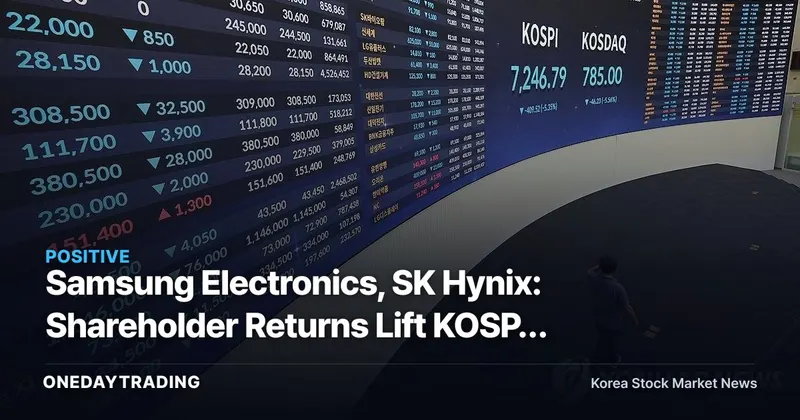
Samsung Electronics (005930) and SK Hynix (000660) shares generated upward momentum for the KOSPI on August 21, 2026, even as US government bond yields climbed again and concerns over slowing global consumption weighed on sentiment. What this really signals isn't just the state of the semiconductor industry — it's that shareholder returns are prompting a recalculation of the valuation floor for large-cap tech stocks.
Shareholder returns refer to a capital policy in which a company returns profit and cash to shareholders through share buybacks and retirements, or expanded dividends. When this policy holds firm even as the memory cycle wobbles, investors look first to the defensibility of per-share value rather than to earnings volatility.
What Happened
According to Yonhap Infomax's markets coverage, Korea's domestic market felt a cold wind from the US on August 21. The renewed rise in US government bond yields lifts the discount rate applied to growth stocks, while concerns over slowing global consumption are shaking demand estimates for smartphones, PCs, and servers. On top of that, the Middle East crisis is stirring both oil prices and exchange rates at once, unsettling foreign investors' supply-demand (order flow).
Yet the KOSPI held firm on the strength of Samsung Electronics and SK Hynix. Saying large-cap semiconductor stocks pulled the index higher is only half the story. The more important point is that the market has begun to broaden its view of how the two companies deploy their cash flow — from growth investment all the way to shareholder returns.
Samsung Electronics (005930) and SK Hynix (000660) are the semiconductor axis with the greatest index sensitivity in the Korean market. When both stocks (tickers) are strong at once, the perceived beta of foreign passive funds and domestic large-cap funds rises. Conversely, when the two stocks turn down, the index can grow heavy even if the number of advancing issues on the KOSPI is high.
Structural Background
The key to semiconductor investing lies in separating HBM from commodity memory. HBM, or high-bandwidth memory, is high-value-added DRAM attached to AI accelerators, directly linked to investment by Nvidia, AMD, and cloud data centers. SK Hynix's heavy exposure to HBM means its earnings sensitivity swings sharply whenever AI server investment increases.
Samsung Electronics moves in tandem across memory, foundry, smartphones, and home appliances. So its purity as an AI-memory play is lower than SK Hynix's, but its cash-generating base is broader. When rates rise again, the market can assign a higher defensive premium to the combination of cash flow and shareholder returns than to a single growth narrative.
Impact on Stocks and Sectors
- Samsung Electronics: Memory recovery and shareholder returns are being valued together. If foundry yields and mobile demand stay weak, upside momentum will be limited, but expectations for cash-flow-backed dividends and buybacks support the lower bound of valuation.
- SK Hynix: With a high share of revenue coming from HBM, its earnings reflect the expansion of AI data-center investment quickly. Still, the margin premium holds only when HBM yields, customer orders, and commodity DRAM prices all align at once.
- Semiconductor equipment, materials, and parts suppliers: As investment expectations for large-cap stocks revive, the warmth can spread through the equipment, materials, and packaging value chain. However, actual orders only follow once customers' capex plans and utilization rates are confirmed.
- KOSPI large-caps: When Samsung Electronics and SK Hynix rise, index-tracking funds mechanically increase their Korea weighting. This flow shows up first in portfolios with heavier semiconductor weightings than banks or automakers.
Bull vs. Bear Scenarios
The bull scenario is straightforward. If US rates don't spike further, AI server orders hold up, and both companies flesh out concrete shareholder-return policies, multiples on KOSPI large-caps will climb again. In that case, the market prices in next year's earnings per share and improved capital efficiency ahead of this year's profit.
The trigger for the bear scenario is interest rates. If US government bond yields climb further, the present value of future earnings gets discounted even if HBM growth stays high. If slowing consumption presses down on smartphone and PC memory prices, the high margins of AI memory alone won't be enough to defend the broader DRAM cycle.
Middle East risk is also hard to ignore. Rising oil prices hit through the exchange-rate channel before they hit through costs. A weaker won can be favorable for exporters on an accounting basis, but foreign investors trim their KOSPI exposure the moment currency-translation loss risk grows.
Investor Action Points
- US 10-year Treasury yield: The direction of rates after the Jackson Hole symposium in late August will determine semiconductor multiples. If rates rise, even stocks with strong earnings will face valuation pressure.
- HBM orders and yields: For SK Hynix, next quarter's customer orders, HBM shipments, and yield commentary are the key variables. If rising shipments come with falling yields, margin expectations will crack first.
- Samsung Electronics' capital policy: The allocation among dividends, buybacks, and capex is the key question for Samsung Electronics. Once shareholder returns are confirmed through actual disclosures, re-rating by index-tracking funds gains strength.
- USD/KRW exchange rate: If the exchange rate spikes, foreign investors' supply-demand (order flow) can flip within a single day. Separate from earnings expectations for semiconductors, this raises the overall risk premium on the KOSPI.
FAQ
Why do Samsung Electronics' shareholder returns matter for its share price?
Samsung Electronics' shareholder returns help defend the floor for per-share value during a semiconductor cycle marked by high earnings volatility. Once dividends or share buybacks and retirements become concrete, investors evaluate cash-flow distribution alongside simple operating profit.
Will SK Hynix keep benefiting from HBM?
SK Hynix's HBM tailwind persists as long as AI server investment holds up and orders from major customers don't dry up. The real issue isn't shipment volume but yields and margins. Even if HBM volumes increase, earnings sensitivity falls if yields become unstable.
When should investors confirm the KOSPI semiconductor rally?
The KOSPI semiconductor rally should be confirmed through US interest rate trends in late August, next quarter's earnings guidance from Samsung Electronics and SK Hynix, and the USD/KRW exchange rate. If all three indicators turn favorable at once, the index-wide advance will outlast a narrow, stock-specific rally.
Samsung Electronics: A Real-Time Data Snapshot
Samsung Electronics' latest closing price is 278,500 won (+2.77% vs. the previous day), and the composite signal combining foreign/institutional investor supply-demand (order flow) with news flow and momentum reads 🟢 Buy-leaning. Foreign investors, institutional investors, news flow, and momentum are all positive, making the stock (ticker) worth watching.
- ▲ Dual-track buying — foreign investors +1.13 trillion won · institutional investors +159.3 billion won, buying in tandem
- ▲ Trend alignment — short- and medium-term uptrend aligned (same-day +2.8% · 1-week +3.9% · 1-month +6.9%)
- ▲ News flow — 13 positive catalysts vs. 2 negative catalysts — positive catalysts dominate
Recent related news skews favorable, with 13 positive catalysts versus 2 negative catalysts.
※ Price and foreign/institutional investor supply-demand (order flow) data are provided by Korea Investment & Securities (KIS) and reflect figures as of the time of publication.
This article is automatically summarized and analyzed content based on the original news report. View original (Yonhap Infomax)