
Key Takeaways
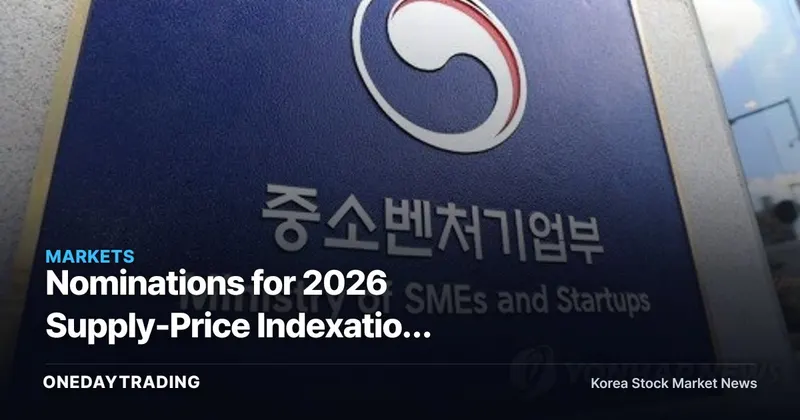
The Ministry of SMEs and Startups (MSS) is accepting nominations for the 2026 Supply-Price Indexation Excellence Awards through October 8. The supply-price indexation system requires that even when raw material prices spike, the principal contractor cannot pass the burden onto subcontractors — instead, cost changes must be reflected in the contract unit price. This award should be read less as a statement about the system itself, and more as a signal of how many companies are actually putting indexation into their contracts.
What Happened
On the 23rd, the MSS issued a notice calling for nominations for the 2026 Supply-Price Indexation Excellence Awards, with applications closing October 8. Eligible applicants are companies — both principal contractors and subcontracted (entrusted) companies — that can demonstrate they have actively operated indexation clauses. The award is a routine annual process, but this round comes amid heightened raw material price volatility, which could make the results more meaningful to read.
The core of the indexation system is simple: principal contractors and subcontractors specify in their contracts that price changes in key raw materials will be reflected in the supply unit price according to a pre-agreed formula. For example, if steel or copper prices rise, that increase is added on top of the existing contract price. Since the clause is voluntary rather than mandatory, how many companies actually write it into their contracts is the real measure of the system's effectiveness.
Background and Context
The policy emerged to address a long-standing asymmetry in subcontracting structures. When raw material prices rise, large principal contractors typically have the bargaining power to pass the cost onto their selling prices, whereas small and medium-sized subcontractors have long been stuck absorbing the cost increase until the contract term ends. This asymmetry has repeatedly eroded subcontractors' operating profit margins whenever raw material prices swing, and the government identified it as a contracting-practice problem, leading to the indexation system being written into law. The award functions as an annual report card on how voluntarily this practice has spread.
Why This Notice Matters Now
The award itself is not a market-moving event. But as an annual indicator of how deeply rooted the contracting practice has become in determining who absorbs the shock when raw material prices swing, it serves as a reference point for gauging earnings volatility among industrial and materials subcontractors.
Market and Stock Impact
- Parts and materials SMEs with high exposure to steel and non-ferrous metal inputs - Companies that supply to principal contractors who have written indexation into their contracts see improved margin protection during periods of rising raw material prices.
- Tier-1 suppliers in the automotive and electronics parts value chain - Whether automakers and electronics manufacturers have spread the system widely enough to be recognized as indexation excellence award winners serves as an indicator of the stability of their suppliers' profitability.
- Shipbuilding and construction equipment subcontractors - Because this sector uses highly volatile raw materials such as steel plate and cement, whether indexation clauses are applied has a direct impact on earnings volatility.
- Large principal contractors - As indexation spreads, it becomes a contractual obligation to absorb cost burdens during raw material upcycles, which could narrow the room for managing cost-of-revenue ratios.
Investor Checkpoints
- The indexation adoption-rate statistics the MSS is expected to release with this award - an indicator of how much faster adoption has spread compared to the prior year.
- The recent trajectory of key raw material prices such as steel and non-ferrous metals - the real-world effectiveness of indexation can only be tested when raw material prices actually swing.
- The industry distribution of principal contractors among the award recipients - this reveals which industries have adopted the system earliest.
- The schedule for any follow-up discussions on expanding mandatory indexation - a shift from voluntary to mandatory would change contracting practices altogether.
Outlook
In an optimistic scenario, repeated awards could encourage more principal contractors to write indexation clauses into contracts, establishing the pass-through of cost increases to subcontractors as standard practice. In that case, the impact of raw material price volatility on subcontractors' earnings would become milder than it is today. Conversely, as long as the system remains voluntary, there is a risk that a gap will persist between the government's reported adoption figures and what is actually felt on the ground. Even where indexation clauses exist, if the detailed formulas are designed to favor the principal contractor, the protective effect for subcontractors may not be as large as the numbers on paper suggest.
Frequently Asked Questions
What is the supply-price indexation system?
It is a system in which principal contractors and subcontractors specify in their contracts that changes in the prices of key raw materials will be reflected in the supply unit price according to a pre-agreed method. Its core purpose is to distribute the burden of raw material price swings at the contract stage, rather than leaving subcontractors to absorb the entire impact.
When does this nomination period close?
The Ministry of SMEs and Startups is accepting nominations for the 2026 Supply-Price Indexation Excellence Awards through October 8. Both principal contractors and subcontracted companies are eligible to apply.
Does this notice affect stock prices?
The nomination notice itself is a procedural matter and is not expected to have an immediate impact on any specific stock (ticker). However, since it relates to a policy tied to the medium- to long-term margin stability of parts and materials subcontractors with high raw material exposure, it can serve as a reference indicator for gauging earnings volatility in the industrials and materials sectors.
This article was automatically summarized and analyzed based on the original news source. View Original (Yonhap News Securities)