
Key Summary
This signals that the center of gravity in U.S. tech is shifting from internet and smartphones toward space technology and artificial intelligence. For Korean investors, the more important variable is not the day-to-day swings of a single stock like SpaceX, but the revaluation of the value chain that runs through launch vehicles, satellites, and defense into AI infrastructure. It is worth noting that themes tied to unlisted companies that are hard to invest in directly typically spread warmth to domestic component, materials, and service partners.
What Happened
As the cutting edge of the IT industry shifts from its traditional internet and mobile-device focus toward space technology and AI, some argue that the Magnificent Seven (M7) structure that has long led the market is being shaken. In parts of the market, discussion is spreading that leadership could rotate away from the existing seven megacaps toward a new cluster of leaders weighted heavily toward space and AI.
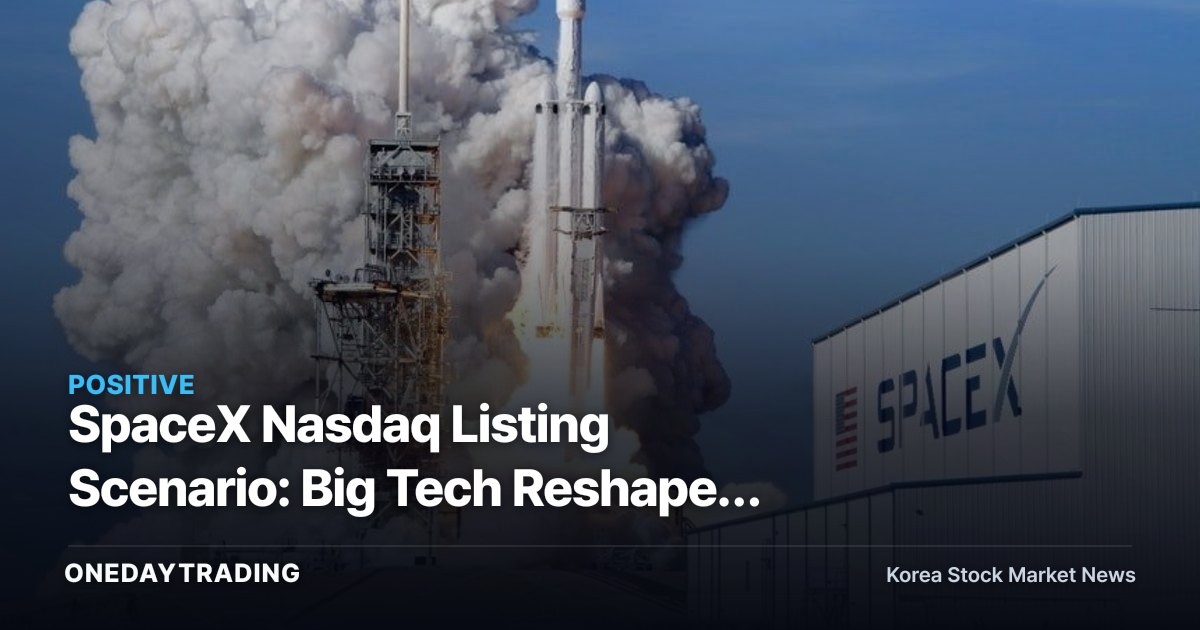
The symbol cited for this shift is SpaceX, led by Elon Musk. Although unlisted, its valuation is assessed at astronomical levels, and every time a potential listing is raised it stirs investor sentiment across the broader space theme. The key point is that areas that legacy Big Tech has not addressed — satellite internet, reusable launch vehicles, and low-Earth-orbit communications networks — are emerging as the next axis of growth.
That said, it must be clearly noted that as of now, SpaceX's specific listing timeline or offering terms are not confirmed facts. There is a time lag before theme-driven expectations are validated by actual company earnings or orders.
Background and Context
The forces that lifted the market over the past several years were the cloud, advertising, and the mobile ecosystem. But as slowing growth rates and regulatory burdens have accumulated, the market is searching for the next growth narrative, and AI infrastructure and the space industry have emerged simultaneously as candidates. The two areas share a common denominator: high-performance semiconductors, high-reliability components, and large-scale capital investment.
Given Korea's industrial structure, this trend connects through components and materials, satellite payloads, and defense-linked technologies rather than finished products. The government's launch of the Korea AeroSpace Administration and its policy to localize launch vehicles also add a mid- to long-term demand base for the domestic supply chain.
Impact on the Market and Stocks
- Hanwha Aerospace: With its launch-vehicle engines and propulsion systems, it is regarded as a flagship pillar of Korea's space industry. If global space investment expands, rising demand for launch services and engines feeds directly into its revenue structure.
- Hanwha Systems: By pursuing satellite systems and low-Earth-orbit communications, it has the potential to benefit from the expansion of space infrastructure. However, the upfront investment burden is a variable for near-term profitability.
- AP Satellite & Intellian Technologies: By supplying communications equipment such as satellite terminals and antennas, they are positioned for rising downstream demand as low-Earth-orbit satellite networks proliferate.
- SK Hynix & Samsung Electronics: Since both space and AI drive demand for high-performance memory and computing chips, they can indirectly benefit along the AI infrastructure axis.
- Kencoa Aerospace: With its base in aerospace component machining, it has room for expanding component demand as launch frequency increases.
Investor Checkpoints
- Official announcements regarding whether SpaceX actually pursues a listing and its timeline — approach by distinguishing rumor from confirmed fact.
- Quarterly earnings and order disclosures from domestic aerospace firms — check whether theme-driven expectations actually convert into revenue and order backlog.
- The Korea AeroSpace Administration's launch-vehicle and satellite project budgets and order schedules — the point at which policy demand flows into the supply chain.
- Trends in AI semiconductor capital expenditure and memory prices — check whether the rationale for the shared space-AI beneficiary thesis holds up.
Outlook
If space and AI establish themselves as the next-generation IT leadership themes, Korean industry — which holds both a launch-vehicle and satellite value chain and high-performance semiconductors — has room to expect structural benefits. If policy support aligns with expanding global investment, a trickle-down effect to domestic partners could also gradually emerge.
On the other hand, the space industry has low earnings visibility and is capital-intensive, so stocks that have priced in theme-driven expectations carry heavy valuation burdens. The SpaceX listing itself is uncertain, and the risk that volatility across growth stocks could widen depending on macro variables such as interest rates and the exchange rate must be considered as well.
Hanwha Aerospace Through Real-Time Data
Hanwha Aerospace's latest closing price is 1,122,000 won (-5.63% vs. the previous day), and the signal light combining foreign and institutional investor supply-demand (order flow) with news and momentum is 🟡 Neutral · Wait-and-See. With positive and negative signals mixed, this is a zone to watch.
- ▲ Order-flow continuity — foreign investors net buyers for 3 consecutive days (+9.2 billion won)
- ▲ News flow — 13 positive catalysts vs. 3 negative catalysts — positive bias
Recent related news is favorable, with 13 positive catalysts and 3 negative catalysts.
※ Price and foreign/institutional investor supply-demand (order flow) data are provided by Korea Investment & Securities (KIS), as of the time of publication.
This article is content automatically summarized and analyzed based on the original news. View original (Maeil Business Newspaper, Securities)