
Summary
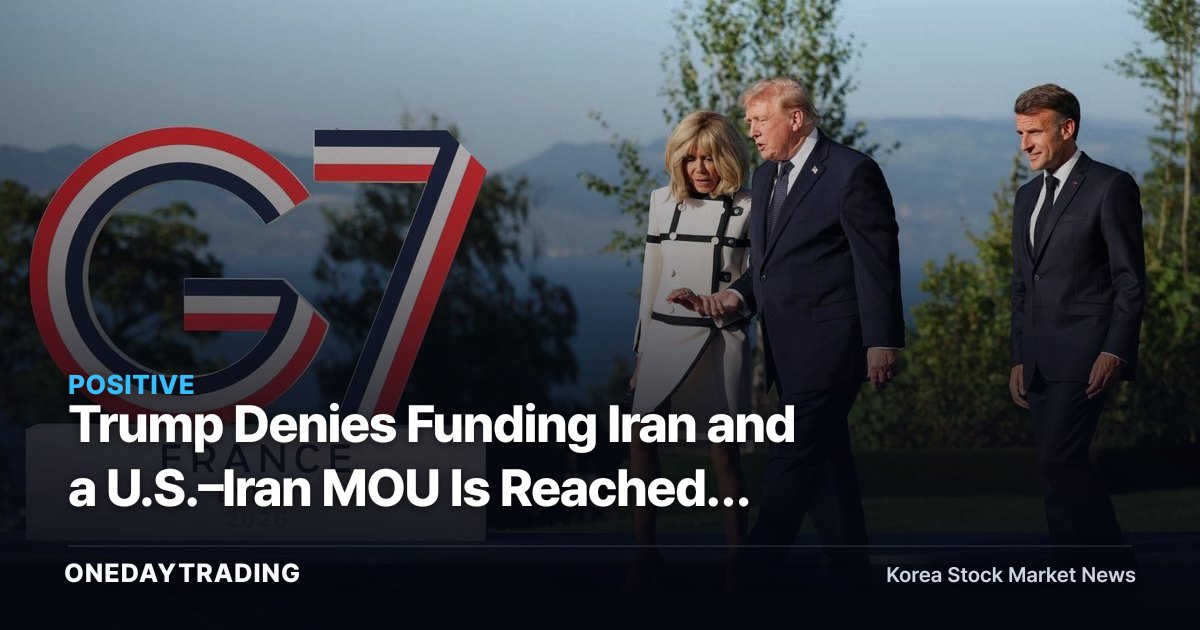
Over the weekend, the United States and Iran signaled they had reached a memorandum of understanding (MOU), while President Trump drew a clear line at the G7 summit, stating that the U.S. would not inject any funds into Iran. The key point is that expectations of easing Middle East tensions are shaking the geopolitical risk premium embedded in global oil prices — and this splits the profit and loss of South Korea's refiner, airline, and defense sectors in opposite directions.
The Full Story
This issue has two clear pillars. One is the announcement that an agreement in the form of a memorandum of understanding was established between Washington and Tehran; the other is President Trump's emphasis, during his G7 meeting with allies, that the U.S. is not providing funds to Iran. The existence of the agreement is a signal that dialogue channels remain alive, but his denial of financial support simultaneously reveals the limitation that the agreement does not guarantee economic compensation.
Unlike a treaty with strong legal binding force, an MOU is closer to a stage that confirms intent. As a result, rather than interpreting it as an immediate lifting of sanctions or a large-scale return of Iranian crude, the market is more likely to read it as a starting point for further negotiations. Trump's denial of injecting funds can also be read as a move conscious of both domestic political burden and negotiating leverage.
Structural Background
Global oil prices carry a risk premium reflecting the possibility of Middle East conflict, independent of actual supply-demand (order flow). Because a large share of crude is transported through the Strait of Hormuz, when fears of military conflict surrounding Iran ease, this premium tends to come off and cap the upside of oil prices. Conversely, if the agreement collapses or negotiations sour over funding issues, the premium revives. Because South Korea depends entirely on imports for its crude oil, the direction of the oil price level is directly linked to the trade balance, inflation, and the earnings of related industry sectors.
Stock & Sector Ripple Effects
- Airline stocks such as Korean Air and Asiana Because jet fuel accounts for a high share of operating costs, if eased tensions cap the upside of oil prices, cost pressure eases and the upside benefit is significant.
- Refiner stocks such as S-Oil, SK Innovation, and GS Falling oil prices cut both ways in terms of refining margins and inventory valuation gains, so in the short term, concerns over inventory losses may come to the fore.
- Defense stocks such as Hanwha Aerospace and LIG Nex1 If Middle East tensions subside, geopolitical momentum may weaken, but because defense orders are structured as multi-year contracts, the immediate impact is limited.
- Shipping stocks such as HMM Stability on Middle East routes lowers freight-rate volatility and insurance/detour costs, which can work favorably on the cost structure.
- Export manufacturing broadly Improvement in the inflation and interest-rate path that comes with stable oil prices can act as an indirect positive catalyst for consumption and investment sentiment.
Bull vs. Bear Scenarios
The bullish logic is simple. As U.S.–Iran dialogue continues, the probability of a conflict scenario declines, and if the upside of oil prices is capped, the cost burden eases for South Korea's import-dependent economy and for the airline and transportation sectors. If risk appetite recovers, it is also favorable for the KOSPI overall.
The bearish variables are hard to ignore as well. An MOU has weak binding force, so negotiations can backtrack at any time, and if the denial of financial support provokes an Iranian backlash, tensions could escalate once more. In that case, the oil premium revives, providing a short-term rebound catalyst for refiner stocks while returning as cost pressure for airline and transportation stocks. The uncertainty of the agreement itself is the biggest risk.
Investor Action Points
- Use global oil price (Brent, WTI) levels and volatility indicators to confirm whether the risk premium is actually coming off.
- Check the schedule of follow-up U.S.–Iran negotiations and official sanctions-related announcements to track whether the MOU is progressing to a substantive stage.
- For airline and refiner stocks, examine jet fuel costs separately from refining margins and inventory items in quarterly earnings, and respond by distinguishing the beneficiaries from those hurt according to the direction of oil prices.
- Monitor the won-dollar exchange rate and inflation trends in parallel to gauge even the secondary effects that oil price changes have on the cost structure.
This article is content automatically summarized and analyzed based on the original news report. View Original (CNBC)