
Key Takeaways
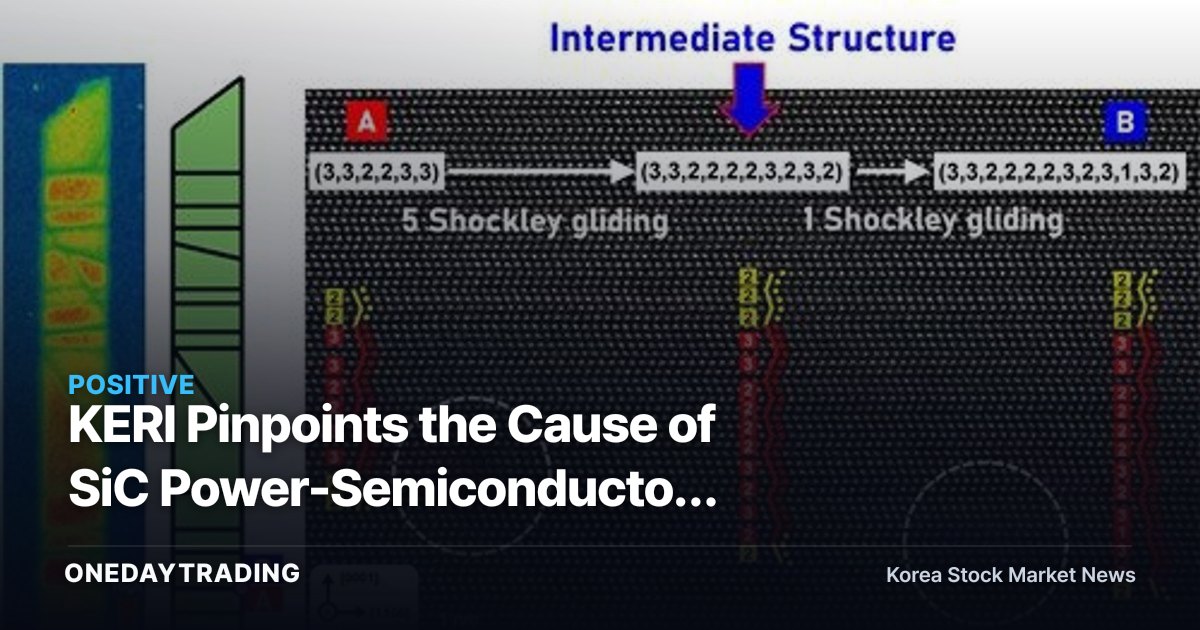
The Korea Electrotechnology Research Institute (KERI) has identified the root cause of the critical defect — the so-called "killer defect" — that lowers the manufacturing yield of SiC (silicon carbide) devices, widely regarded as the next-generation power semiconductor, and published its findings in an international academic journal. While this is not an event that translates into immediate revenue, yield is the single biggest bottleneck in SiC mass production, making this a favorable mid-to-long-term development for Korea's power-semiconductor materials and device value chain.
What Happened
SiC power semiconductors withstand high voltage and high temperatures far better than conventional silicon devices, and adoption is rapidly increasing in EV inverters, charging infrastructure, and the power-conversion sections of solar and energy-storage systems. The problem is that microscopic defects arising during crystal growth and device fabrication act as "killer defects" that can instantly render a device defective. These defects have long been cited as a structural weakness that drives yields down and costs up.
In this study, KERI determined why and through what pathway these killer defects form, and published the results in an international academic journal. Once the formation mechanism is understood, it becomes possible to design processes that suppress or screen out defects in advance — a meaningful step, as it provides a starting point for raising mass-production yields.
Background and Context
The SiC wafer and device market is an arena dominated by global players, and for Korean companies as latecomers, securing yield and cost competitiveness has been the foremost challenge. The fact that a government-funded research institute has academically pinpointed the cause of a critical defect signals that foundational technology is accumulating — technology that domestic materials and device makers can use to catch up on process know-how.
Impact on the Market and Stocks
- DB HiTek: As an operator of a power-semiconductor foundry, it could be a direct beneficiary of yield-improvement technology as it expands processes for SiC and other next-generation power devices.
- SK Inc.: Its subsidiary SK Siltron runs a SiC wafer business, so progress in killer-defect suppression technology directly affects wafer quality and yield competitiveness.
- Samsung Electronics: It could be an indirect beneficiary of a broader SiC process-technology base, in terms of its power-semiconductor lineup and automotive semiconductor expansion.
- LX Semicon · RFHIC: Part of the compound-semiconductor value chain for automotive, power, and communications applications, they are tied to the expanding SiC ecosystem.
Investor Checkpoints
- Whether the research results actually translate into improved mass-production yields: check the relevant companies' references to SiC line utilization and yields in quarterly earnings and conference calls.
- The pace of recovery in EV and power-conversion demand: monitor EV sales and charging-infrastructure investment indicators, the downstream drivers of SiC adoption.
- Disclosures of SiC wafer capacity expansion or new orders, and the timeline of government power-semiconductor support policies.
Outlook
It is a positive that identifying the root cause of the critical defect that was holding back yields creates room for domestic power-semiconductor materials and device makers to improve cost competitiveness. That said, the path from academic discovery to mass-production application requires time for validation and capital investment, and the gap with global leaders and the possibility of an EV-demand slowdown are variables that make it difficult to drive the share price on short-term expectations alone. Investors should approach this by distinguishing thematic hype from genuine improvements in yields and earnings.
DB HiTek Through Real-Time Data
DB HiTek's latest closing price is 156,100 won (+1.04% from the previous day), and the signal light combining foreign-investor and institutional supply-demand (order flow) with news and momentum is 🟢 Buy-leaning. With foreign-investor and momentum factors positive, the stock is worth watching.
- ▲ Order-flow continuity — Foreign investors net buyers for 4 consecutive days (+10.5 billion won)
※ Price and foreign-investor/institutional supply-demand (order flow) data are provided by Korea Investment & Securities (KIS) and are as of the time of publication.
This article is content automatically summarized and analyzed based on the original news report. View original (Yonhap News, Industry)