
Summary
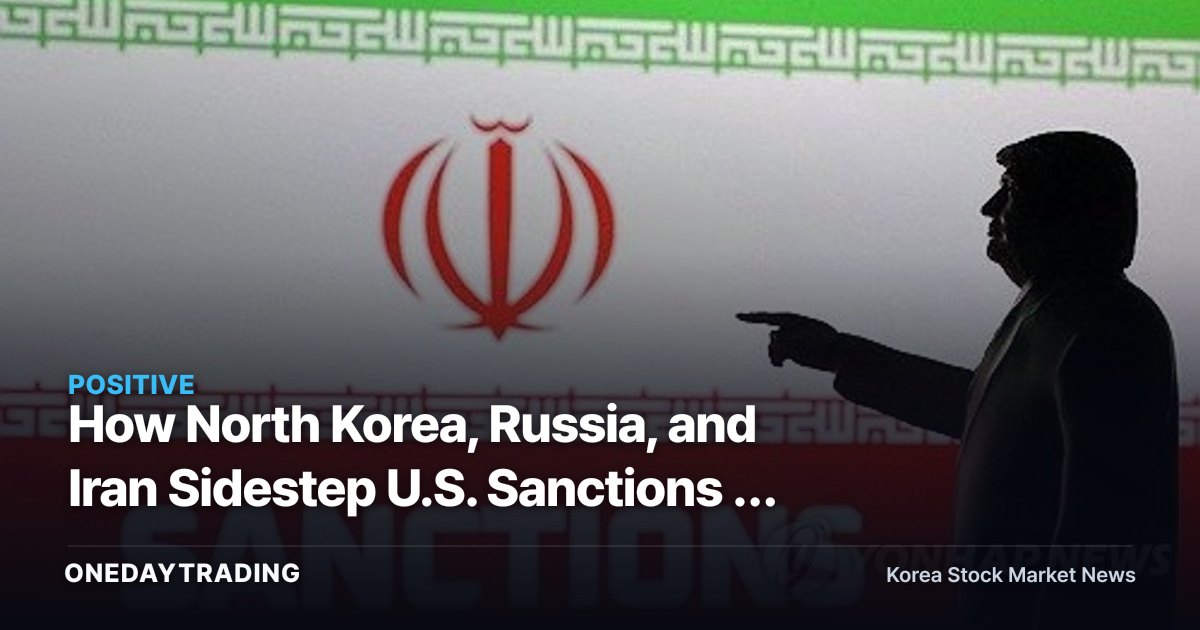
While the United States maintains sweeping economic sanctions targeting North Korea, Russia, and Iran, these countries are circumventing the sanctions net through third-country intermediary trade, cryptocurrency, and so-called shadow fleets. The fact that sanctions deliver only a limited immediate blow points to a prolonged geopolitical conflict, which acts as an investment variable on both the defense-demand and energy-supply fronts.
How It Unfolded
The U.S. Treasury and State Departments operate all-encompassing financial, trade, and energy sanctions against the three countries, citing weapons of mass destruction development, the invasion of Ukraine, and nuclear programs. Yet the sanctioned states respond by diversifying their workarounds rather than confronting any single sanction head-on.
A representative tactic is transshipment via third countries and the laundering of ownership. Ship-to-ship transfers that move crude oil or coal onto another vessel on the high seas, along with the falsification of shipping documents and country of origin, have been caught repeatedly. In the case of Russian crude, a shadow fleet of aging tankers cobbled together is identified as the key conduit for evading the price cap.
To counter financial blockades, cryptocurrency and informal remittance networks are used. North Korea in particular is repeatedly cited for laundering virtual assets stolen through hacking and converting them into foreign currency. In the end, the structure is such that widening the mesh of the sanctions net simultaneously increases the number of holes to slip through.
Structural Background
The effectiveness of sanctions ultimately hinges on multilateral coordination and the will to enforce. With U.S. unilateral sanctions alone, if major demand countries such as China and India do not join in, trade flows simply shift in their direction. The clearer the substitute demand for an item — as with energy and raw materials — the greater the incentive to circumvent, and as long as buyers willing to purchase at discounted prices exist, the trade continues in a hidden form.
For this reason, sanctions are less a means of forcing the targeted country into immediate submission than a pressure tool that gradually raises costs. From an investment standpoint, what matters is not the intensity of the sanctions themselves but the persistence of the geopolitical tension they create and the direction of supply-chain realignment.
Impact on Stocks and Sectors
- Hanwha Aerospace: A geopolitical standoff that even sanctions cannot resolve underpins the trend of rising global defense budgets. The room for expanding exports of self-propelled howitzers and ammunition, coupled with European rearmament demand, is the key driver.
- LIG Nex1: With a high share of missiles and precision-guided weapons, the company is directly exposed to demand swings out of the Middle East and Eastern Europe. The trajectory of its order backlog is the gauge of earnings visibility.
- Hyundai Rotem: Exports of ground equipment and the K2 tank are a beneficiary channel of prolonged geopolitical risk.
- S-Oil and SK Innovation: The more Russian and Iranian supply goes underground, the greater the volatility in the price and refining margins of normally distributed crude. Supply disruptions can be positive for refining margins, but at the same time low-priced volumes from shadow fleets pressure margins — a double-edged dynamic.
- HD Hyundai Heavy Industries: The aging shadow-fleet problem may, over the long term, connect to demand for eco-friendly and new-build vessel replacement.
Bull vs. Bear Scenarios
The bull scenario is clear. The longer sanctions fail to end conflicts and standoffs drag on, the more structurally defense spending rises across countries, and the thicker Korea's defense export pipeline becomes. Energy-supply uncertainty partly carries over into pricing power for refiners and shipbuilders.
Conversely, the bearish variables are equally evident. Defense stocks have already priced in much of the export expectations, leaving accumulated valuation burdens, and momentum could cool quickly if the situation shifts toward a ceasefire or negotiations. For refining stocks, there is a risk that margins are actually compressed if circumvention volumes grow and low-priced crude floods the market. The fact that sanctions evasion itself cushions the supply shock and weakens the scenario of a sharp gain (surge) in oil prices is also a double-edged sword.
Investor Action Points
- For defense stocks, track the timing of order disclosures and new export contract announcements rather than quarterly earnings to confirm the substance of the momentum.
- Judge the direction of oil prices by watching Brent and WTI levels together with refining-margin indicators, and separate out whether announcements of tighter sanctions actually translate into real supply cutoffs.
- Check the schedule for additional U.S. sanctions packages and the release of targeted-company lists to see whether circumvention crackdowns spread to specific sectors.
- Since geopolitical themes carry high volatility, adjust position sizing toward stocks with confirmed order and earnings grounds rather than concentrating on a single name.
Hanwha Aerospace Through Real-Time Data
Hanwha Aerospace's most recent closing price is 1,122,000 won (-5.63% from the previous day), and the signal light combining foreign-investor and institutional-investor order flow with news and momentum is 🟡 neutral / wait-and-see. With positive and negative signals mixed, this is a zone to watch.
- ▲ Order-flow continuity — foreign investors net buyers for 3 consecutive days (+9.2 billion won)
- ▲ News flow — 13 positive catalysts vs. 3 negative catalysts — positive catalysts dominate
Recent related news is favorable, with 13 positive catalysts and 3 negative catalysts.
※ Price and foreign/institutional order-flow data are provided by Korea Investment & Securities (KIS), as of the time of publication.
This article is content automatically summarized and analyzed based on the original news report. View the original (Yonhap News Securities)